Get Full Government Meeting Transcripts, Videos, & Alerts Forever!
Get email alerts on the Early Education Child Care topic
No spam. Unsubscribe anytime.
State leaders defend expanded child care investments as providers warn wait list remains
Summary
Administration officials and early education advocates outlined the governor's FY26 proposals to maintain Commonwealth Cares for Children, expand preschool partnerships and fund workforce supports, while providers and local officials said thousands of income‑eligible children remain on waiting lists and workforce shortages threaten capacity.
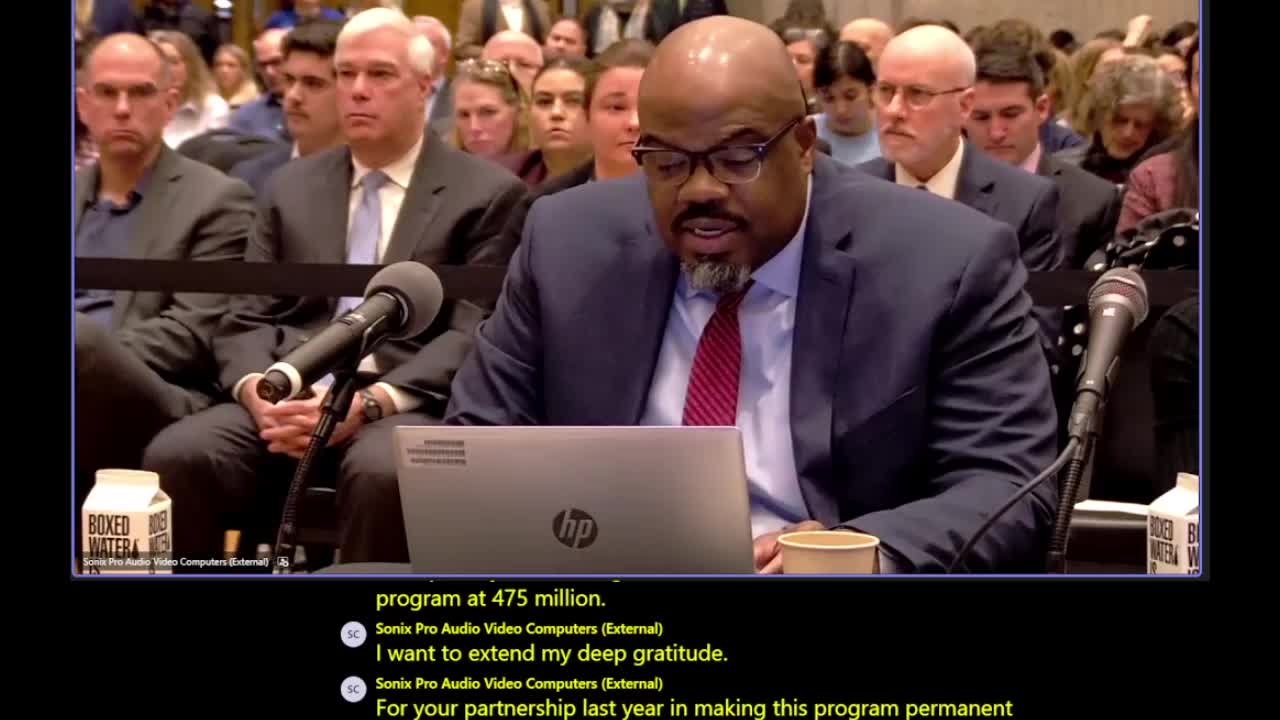
Secretary of Education Patrick Tutwiler outlined the Healy-Driscoll administration's fiscal year 2026 proposals for early education and child care at a Joint Ways and Means hearing at UMass Amherst, saying the administration will keep Commonwealth Cares for Children (C3) funded at $475,000,000 and seek additional supplemental funding for workforce and capacity building.
The administration emphasized access and workforce stability as the central goals for the early‑education portions of the governor's request.
“At the education secretariat, we have five core values that drive how we approach this work,” Secretary Pat Tutwiler said, listing “advance equity and inclusion, maintain a holistic perspective, embrace collaboration, champion innovation, and center fulfillment.” He described the budget as a package that pairs the governor's House 1 proposal with a fair share supplemental filing to expand access, workforce supports and preschool partnerships.
Why this matters: State leaders say the package will hold existing gains and expand capacity and affordability by preserving the C3 stabilization dollars, maintaining $1.1 billion for child care financial assistance and adding targeted funds for preschool partnerships, early literacy and workforce pathways. Providers and municipal officials, however, told the committee that the income‑eligible wait list — which programs have kept closed to new enrollments over the last year — will not be cleared at the funding levels proposed in House 1 alone, and that teacher turnover and teacher pay remain constraining capacity.
Details and bids: The administration said the supplemental request would allocate $100,000,000 in fair share funds for capacity building, family access and workforce supports, and $67,000,000 for the Commonwealth Preschool Partnership Initiative (CPPI) including $17,700,000 in House 1 and additional multi‑year funding to expand CPPI into more districts. Commissioner Amy Kershaw of the Department of Early Education and Care said C3 has helped add more than 17,000 seats and raised wages, but acknowledged that vacancies and the income‑eligible wait list remain significant.
Providers and advocates urged additional near‑term funding. Bill Eddy of the Massachusetts Association of Early Education and Care asked the committee to prioritize serving children on the income‑eligible wait list and recommended a targeted supplemental appropriation of $32,000,000 to move roughly 2,000 children off that list. He also asked the committee to maintain C3 tiering that prioritizes programs serving low‑income and at‑risk children.
Workforce and quality: Witnesses across panels emphasized that raising rates alone is not sufficient without investments that reduce turnover and build career pathways — for example, scholarships, apprenticeship programs and employer partnerships with community colleges and UMass. Kershaw highlighted expansions of apprenticeships, educator scholarships co‑administered with the Department of Higher Education, and a new educator portal to support credentialing and retention.
What remained unresolved: Agency leaders said House 1 alone will sustain many of the expansions launched under the administration but that the fair share supplemental package is intended to close remaining gaps. Kershaw and Tutwiler said that at the House 1 funding level the Department will not open the income‑eligible wait list statewide and would prioritize continuing service for families already enrolled and growth in cases referred by DCF and DTA.
Ending: Lawmakers pressed agencies for geographic data and implementation timetables and asked for more detail on how supplemental funds would be distributed by region, by age group and to bilingual/ESL‑heavy communities. Several committee members said they want an early budget agreement on key local aid line items so districts and towns can finalize their budgets in the coming weeks. The hearing continued into K‑12 and higher education testimony after the early‑education panel.