Get Full Government Meeting Transcripts, Videos, & Alerts Forever!
Get email alerts on the Surveillance Privacy topic
No spam. Unsubscribe anytime.
Austin council member pulls item on automated license-plate-reader pilot, cites civil‑liberties concerns
Summary
Council Member Siegel pulled agenda item 103 from the addendum and said the city should await a pending audit and public discussion before deciding whether to make the automated license plate reader (ALPR) pilot permanent.
Council Member Siegel pulled agenda item 103 from the addendum on March 25, saying the council should allow the current automated license plate reader (ALPR) pilot to finish and the results of a pending audit to be released before voting on making the program permanent. "I'm concerned with how our city's participation in, frankly, a mass surveillance program such as automated license plate readers could negatively impact our community," Siegel said, specifically naming immigrants and people seeking reproductive and gender‑affirming care as vulnerable groups.
Siegel told colleagues the item was added to the addendum late in the previous week and that the shortened timeline made it difficult to convene public discussion before a vote scheduled for Thursday. "My office made the decision to pull this item after it was added to the addendum late last week, which kind of gave us a short timeline to figure out what public discussion would be needed before our vote this coming Thursday," he said.
Assistant Chief Greenwald, who responded to technical and policy questions during the discussion, described the department's process for external requests for ALPR data, the retention period and limits in the nondisclosure agreement the city requires outside agencies to sign. Greenwald said outside agencies must provide the type of criminal offense and their case number when requesting ALPR data and that a nondisclosure agreement specifies permitted uses. "They have to tell us the type of crime and provide the case number," Greenwald said. He added that the only agency the city is required by law to provide this information to would be U.S. Immigration and Customs Enforcement (ICE).
On data retention and outside access, Greenwald told the council that the system retains ALPR data for seven days and that nothing prevents an outside agency from renewing a request repeatedly; however, he said no outside law enforcement agency had requested ALPR data during the 12 months of the pilot. "Nothing would prevent them from doing that. I think it's worth noting that in the 12 months that we've had the pilot program, we've had absolutely 0 requests from any outside law enforcement agency for any of our data whatsoever," Greenwald said.
Council members pressed on whether ALPR hits would prompt pretext stops. Greenwald said the ALPR system alerts officers to plate matches that have been entered into state or national databases such as TCIC or NCIC; whether an officer may stop a vehicle depends on the underlying offense and department policy. "As long as the plate has been listed into NCIC/TCIC, they'll receive an alert inside the vehicle, and it is up to the officer to look at that particular offense and why that vehicle is entered to know whether or not they can take action based on our policy," he said. Greenwald also said the ALPR matches on plates, not names, and that department training emphasizes that adverse outcomes from misuse could lead to revocation of system privileges.
Siegel raised concerns about how warrants and low‑level offenses could intersect with ALPR hits, citing an approximate figure for outstanding municipal warrants. "I think our municipal court has something like 66,000 outstanding warrants, and the vast, vast majority of them are for unpaid parking tickets," Siegel said; he framed that as an example of how nonviolent, low‑level matters could lead to increased enforcement if plates were entered in searchable systems. Greenwald responded that it would be rare for a low‑level municipal matter to be entered into TCIC/NCIC in a way that would trigger an ALPR match, and reiterated that the system looks for plates rather than names.
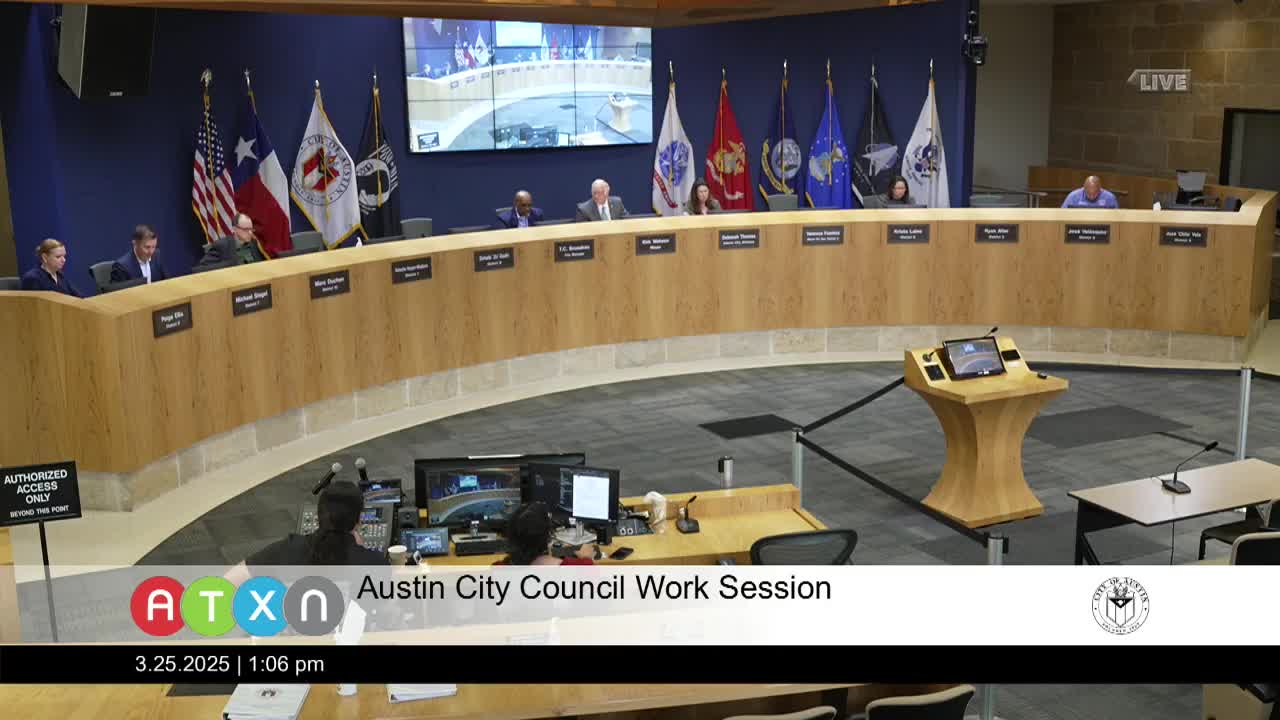
There was no formal vote on item 103 during the work session; Siegel said he pulled the item to allow more public discussion and to await the audit results before the council takes a final vote. The council had earlier recessed for executive sessions to discuss personnel matters under Texas Government Code section 551.074, and then returned to the work session to address the pulled item.
Next steps described during the meeting are that the ALPR pilot will remain in place while the audit proceeds and councilmembers will have additional time to review the audit and public comment ahead of the scheduled vote on Thursday.