Get Full Government Meeting Transcripts, Videos, & Alerts Forever!
Get email alerts on the Short Term Rental Variance topic
No spam. Unsubscribe anytime.
Property owner seeks use variances to continue short‑term rental and camper use amid outstanding violation
Summary
A Rhinebeck property owner asked the board for use variances to permit a short‑term rental and to use a camper on site; the town says an outstanding 2022 violation for a camper in the wetland/flood‑zone buffer must be addressed and the board continued the hearing and requested a formal use‑variance submission.
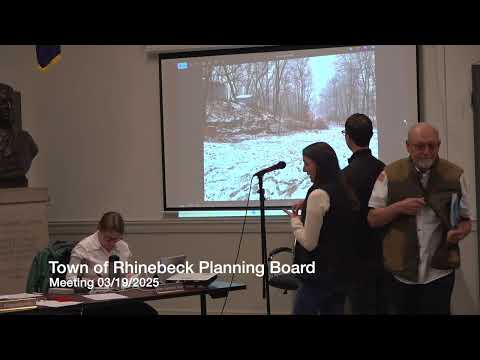
An owner seeking to continue operating a short‑term rental and to use an on‑site camper presented before the Town of Rhinebeck Zoning Board of Appeals on March 19; the board continued the matter and requested additional documentation after staff said an outstanding zoning violation exists.
Nick (applicant) stated he runs a short‑term rental and asked for a use variance so he may continue operating it despite the town code provision that short‑term rentals be limited to a primary residence. “I’m asking for a variance so that, I can continue to run my Airbnb,” he said during the hearing. He also asked for relief to allow use of a camper on the property; town staff said the camper has been sited within a flood‑zone/wetland buffer and was the subject of a violation issued June 15, 2022.
Brian Tam, the town zoning administrator, told the board he issued a violation in 2022 for installing a camper slab inside the wetland buffer and flood zone and that the camper was required to be removed. He noted town records show no board‑of‑health record for the applicant’s claimed septic hookup and that, under the town code, an outstanding violation may render a zoning application incomplete. Board members and staff discussed whether the applicant’s request should proceed as an appeal or as a use variance; the applicant confirmed he is seeking a use variance.
The board continued the public hearing to April 16 to give the applicant time to submit a complete use‑variance application and supporting evidence. Staff reminded the applicant that a use variance requires proof on four factors: demonstration of inability to realize a reasonable return (usually documented with financial statements), uniqueness of the hardship to the property, that the requested use will not alter the essential character of the neighborhood, and that the hardship was not self‑created — and noted a use variance is a higher legal standard than an area variance. The board also scheduled a site visit prior to the continued hearing.
Why it matters: the application raises compliance questions (an outstanding 2022 violation and alleged unauthorized septic hookup) and the applicant is requesting a use variance, which carries a higher burden of proof than an area variance and requires specific financial and evidentiary support.