Get Full Government Meeting Transcripts, Videos, & Alerts Forever!
Get email alerts on the Redistricting topic
No spam. Unsubscribe anytime.
Kaufman County election staff: five voting precincts must be redrawn after voter growth
Summary
Kaufman County Elections staff told the commissioners court a statutory review found five voting precincts exceed the 5,000-voter threshold under Texas Election Code §42.031, meaning boundary changes or new precincts will be required; countywide polling and lack of in-precinct facilities complicate planning.
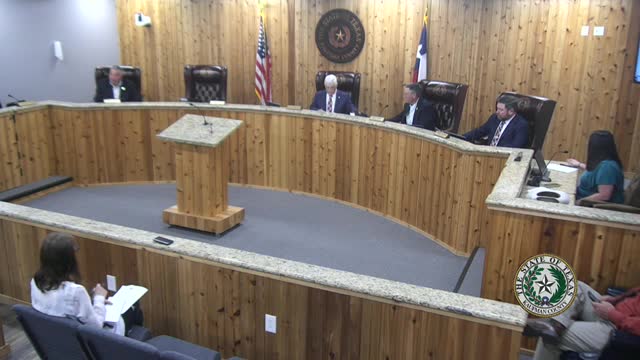
Kaufman County elections staff told the commissioners court on March 25 that five voting precincts must be split or redrawn after recent registration growth pushed several precincts over the statutory threshold.
Tandy, an elections staff member, said the review was conducted under Texas Election Code §42.031, which requires counties to review voting precinct boundaries in March or April of odd-numbered years. “As of yesterday, we’ve exceeded that threshold,” Tandy said, noting one precinct — listed in the materials as precinct 29 — had 5,083 active registered voters.
The county’s review identified five precincts that must be split and several others to monitor for future growth. Tandy told commissioners that, if the five precincts are not absorbed into neighboring precincts, the county would increase its number of voting precincts by five. She also said the boundary changes would become effective on “the first day of the first even-numbered voting year,” language consistent with the code’s effective-date requirements.
Why it matters: splitting or adding precincts affects polling locations, staffing and costs. Tandy said many of the densely populated neighborhoods that pushed the precincts over the threshold do not contain suitable voting facilities. That increases the county’s logistical burden if countywide polling is restricted by state legislation. “Currently, with our existing voting locations, if we continue to use the 24 or 23 that allow us to use them with no recourse, we’re in good shape,” she said, but added that legislative changes that eliminate countywide polling would create tougher choices.
Commissioners reviewed printed maps and street-level data prepared by county staff. Tandy said the office can attempt to shift voters into neighboring precincts where geography and street boundaries permit, which might avoid adding new precincts in some areas. For other precincts, she said, absorption is not feasible because of where growth is concentrated.
Tandy noted the review used active registration counts and does not include voters currently in the county’s suspense files; county staff said they will continue to monitor growth and that an outside firm previously used by the county, Lisonbee Bass, has more sophisticated mapping tools if commissioners want to pursue additional options.
Commissioners asked about costs and logistics, and Tandy said she had invited the county party chairs to the workshop because they are stakeholders in precinct boundary changes. She also told the court she and staff expect to follow up with detailed maps and options for commissioners to consider in the workroom following the workshop.
No formal action was taken at the workshop; the presentation was a statutory review and a preliminary planning step required by state law.