Get Full Government Meeting Transcripts, Videos, & Alerts Forever!
Get email alerts on the Parks And Open Space topic
No spam. Unsubscribe anytime.
New Castle County panel advances proposal to create ‘P’ zoning for publicly owned parks and conserved land
Summary
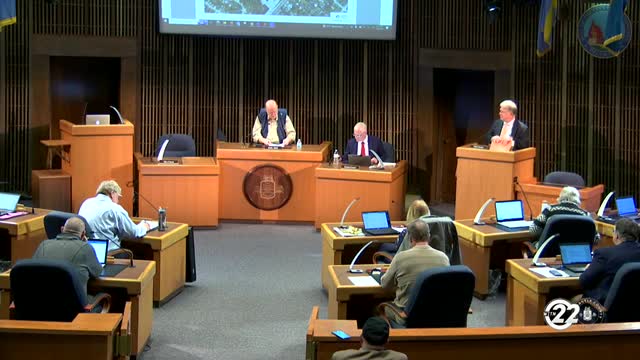
The New Castle County Land Use Committee on March 25 considered substitute 1 to Ordinance 24-130, a proposal to amend New Castle County Code chapter 40, the Unified Development Code, to establish a P zoning district for publicly owned conserved lands and public parks.
The New Castle County Land Use Committee on March 25 considered substitute 1 to Ordinance 24-130, a proposal to amend New Castle County Code chapter 40, the Unified Development Code, to establish a P zoning district for publicly owned conserved lands and public parks. General Manager of Land Use Dave Culver and council sponsors described the substitute as enabling legislation; no final vote was recorded at the committee meeting.
Advocates and county staff said the new park zoning would make maps and permitted uses clearer for residents and county departments. “This was originally introduced before I came back to the county,” GM Dave Culver told the committee, and after reviewing the proposal he recommended language for how rezonings would be handled and how the county would report additions to P-designated land each year.
Supporters said the change matters because many publicly owned parks are currently spread across multiple existing zoning categories, creating confusion for residents and reviewers. Culver said the county will bring county-owned park parcels to council individually for rezoning under the new classification; state and municipal lands could opt into the classification but would follow normal rezoning procedures. He told council that the substitute does not remove any existing permitted uses and that the department consolidated park-appropriate uses from several zoning districts into the new P classification so permitted uses are consistent across county parks.
Council sponsors framed the substitute as a long-standing gap in the Unified Development Code. “This zoning category for publicly owned parkland has been missing from the code,” sponsor Councilman Cartier said, noting that some county parks currently carry business-park or other unrelated designations. Councilwoman Durham and other co-sponsors said the change responds to recommendations in previous comprehensive plans and to the county’s Open Space Advisory Board.
Members of the public — including conservation groups, civic associations and residents who live next to parks — delivered extended public comment in favor of the substitute. Anne Burris, conservation co-chair of the Sierra Club Delaware chapter, told the committee: “Public funds are used to purchase and protect public lands … and these lands are to be protected from development on the people’s behalf.” Dale Swain, who described himself as supporting the measure, said, “I have been wishing that we had this preservation code for years.”
Speakers raised specific local examples where current zoning has caused confusion, including Glasgow Park, Lums Pond and parcels in Yorklyn/Auburn Valley. Several commenters asked the county to proceed cautiously when rezoning parcels to avoid the perception of abrupt or mass rezoning. Bruce Weingard and others urged transparency and careful phasing of any parcel-by-parcel changes so residents retain confidence in the process.
Committee members and staff clarified limits and opt-in rules during discussion. Culver said federal properties are largely exempt from county zoning and that state agencies such as DNREC would need to apply to opt in; the substitute includes a process to accept such applications. Culver also said the department had discussed DNREC’s concerns and made targeted edits, and that the county would report annually to council when eligible parcels are added.
The committee did not take a final vote on substitute 1 to Ordinance 24-130 at the meeting. Council members discussed whether parcels should be rezoned one at a time or in small batches; staff said they could bring a few parcels at a time or one by one depending on council preference. The measure remains subject to future ordinance hearings and a formal council vote.
If adopted, the P zoning classification would be used to rezone county-owned parklands and publicly owned conserved parcels to provide a single, consistent map layer and a clarified set of permitted uses. Supporters said the change would make it easier for residents and planners to identify protected public land and reduce confusion about whether a parcel is open to public recreation.
Next steps: staff will continue to refine the substitute language and bring individual rezoning ordinances forward for council consideration; no formal council action on the ordinance substitute was recorded at the March 25 committee meeting.