Get Full Government Meeting Transcripts, Videos, & Alerts Forever!
Get email alerts on the Internet Crimes Against Children topic
No spam. Unsubscribe anytime.
Law-enforcement task forces and CHP urge expanded funding to address rising online child exploitation and forensic backlogs
Summary
CHP nd California Internet Crimes Against Children (ICAC) task forces told the Assembly subcommittee that online child-exploitation tips and digital-forensics needs have risen sharply, and asked for more investigators, forensic capacity and $5 million proposed for Cal OES to support statewide ICAC work.
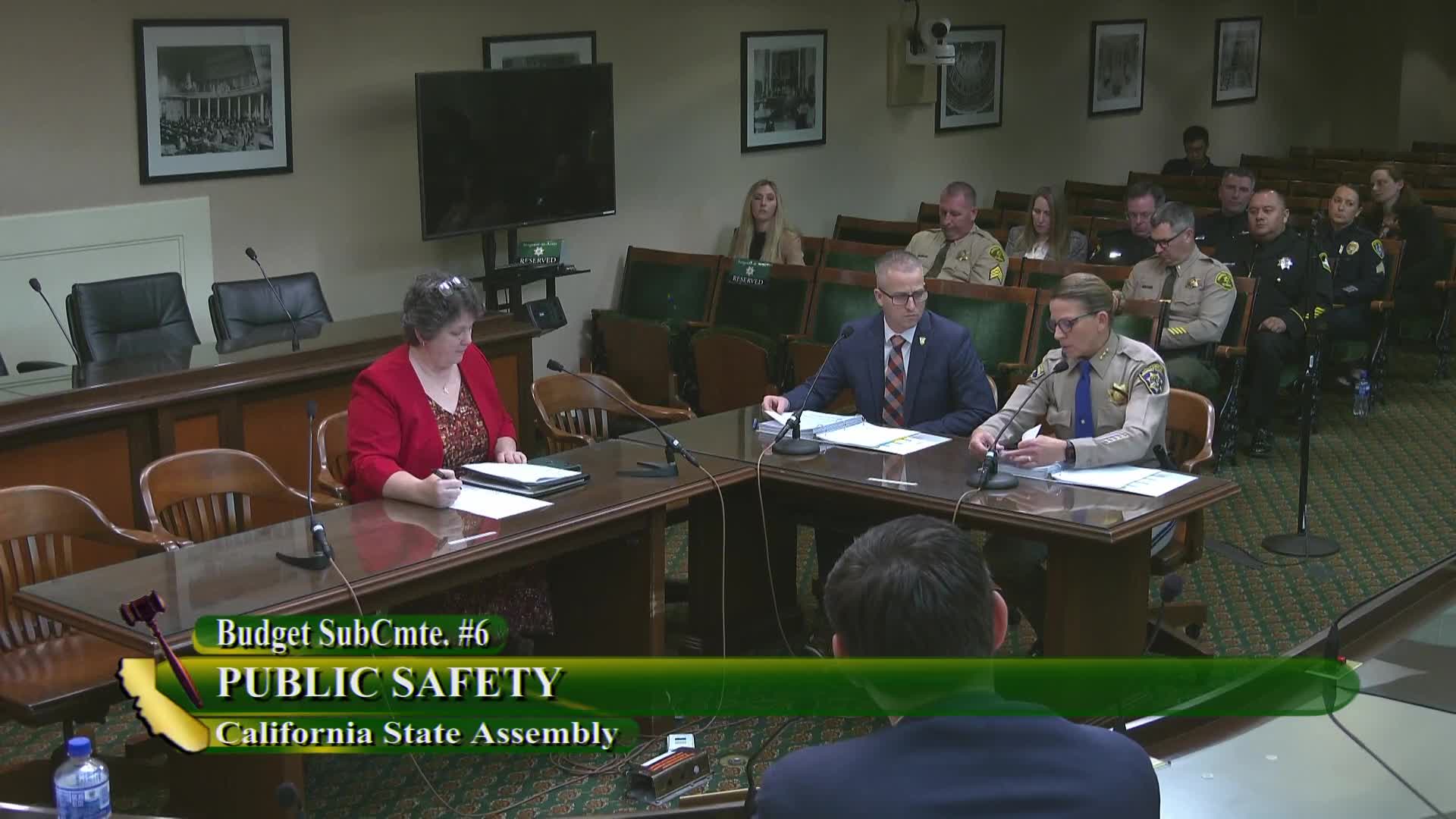
A state panel on internet crimes against children told the Assembly Budget Subcommittee on Public Safety that tips and digital-forensics demands have risen sharply and called for expanded staffing, training and funding to investigate and identify victims.
Assistant Commissioner Robin Johnson told the committee the California Highway Patrol—omputer Crimes Investigation Unit (CCIU) has identified a large gap in enforcement and asked the subcommittee to treat CSAM (child sex-abuse material) distribution and human-trafficking-related investigations as a higher priority. Johnson described a January 2024 Elk Grove case in which investigators executed a search warrant and found more than 100,000 images and videos; she said that case exposed the then-legal circulation of AI-generated CSAM and that the CHP supported Assembly Bill 1831 to criminalize AI-generated CSAM in 2025. Johnson added, "At the end of the day, the real decision we all need to make is how many kids do we wanna save." The CHP said its CCIU handled four cases in 2022, ten in 2023 and 25 in 2025, and reported a high admission/conviction rate for cases it pursues.
CHP representatives described current CCIU capacity as six investigators in Sacramento with additional task-force attachments and said the department requested 12 additional positions in its budget change package to elevate the mission from a secondary to a primary priority. Committee members asked whether CCIU works with existing ICAC task forces; CHP said CCIU conducts peer-to-peer Internet searches, deconflicts through the five ICAC task forces and local agencies, and would collaborate further if positions were funded.
Representatives of the state's five ICAC task forces described a high and growing caseload and a different, distributed investigative model focused on training affiliates, deconfliction and local investigations. Tess Shurkenbach of the Department of Finance summarized a Cal OES proposal in the governor's budget to provide $5,000,000 ongoing general fund with a two-year encumbrance to support the statewide ICAC program.
Lieutenant Juan Hidalgo (Sacramento County Sheriff's Office) said the Sacramento ICAC receives roughly 15,000 tips annually and that task forces collectively provide training and equipment to dozens of affiliate agencies. Detective Sean Smith (Sacramento) explained how the National Center for Missing and Exploited Children (NCMEC) routes cyber tips to task forces and investigators assign tips to local affiliates based on jurisdiction and deconflict through a centralized ICAC portal.
Task-force commanders emphasized the breadth of demand. Monica Robinson (San Diego) said her task force handled approximately 11,000 cyber tips in 2024 and that each tip represents a minor victim; she added that investigators serve multiple search warrants per month and that staffing and training are essential to sustain safe, legal operations. Sergeant Michael O'Grady (Silicon Valley) described a case where a task-force response mobilized 30 officers and multiple agencies within hours to rescue a child from ongoing abuse and arrest a suspect; O'Grady said his task force rescued 68 children last year and is on pace to exceed that number.
Task-force witnesses said existing grant allocations are insufficient. Panel members said the five California ICAC task forces currently receive $950,000 each (distributed from prior state allocations), a level they called stagnant and inadequate relative to growing demand. Witnesses described digital-forensics backlogs, rising equipment costs, high turnover among investigators and the need for prevention and victim-support resources. The panel also discussed coordination with CHP and mutual aid in high-resource cases such as the Elk Grove investigation.
Public comment highlighted related service gaps. A representative of the California Coalition for Youth urged expanded funding for homeless youth services and for the California Youth Crisis Line, noting those programs help vulnerable young people who are also at high risk of exploitation.
Committee members did not vote at the hearing; they asked for follow-up detail on coordination, forensic capacity and the proposed Cal OES funding distribution.