Get Full Government Meeting Transcripts, Videos, & Alerts Forever!
Get email alerts on the Tribal Youth Diversion topic
No spam. Unsubscribe anytime.
Tribal leaders and state officials urge sustained funding for tribal youth diversion programs
Summary
Tribal leaders, the Office of Youth and Community Restoration and the Legislative Analyst—riefed the Assembly subcommittee on tribal youth diversion grant history, program results and gaps, urging sustained funding and capacity building to keep youth connected to culture and out of juvenile systems.
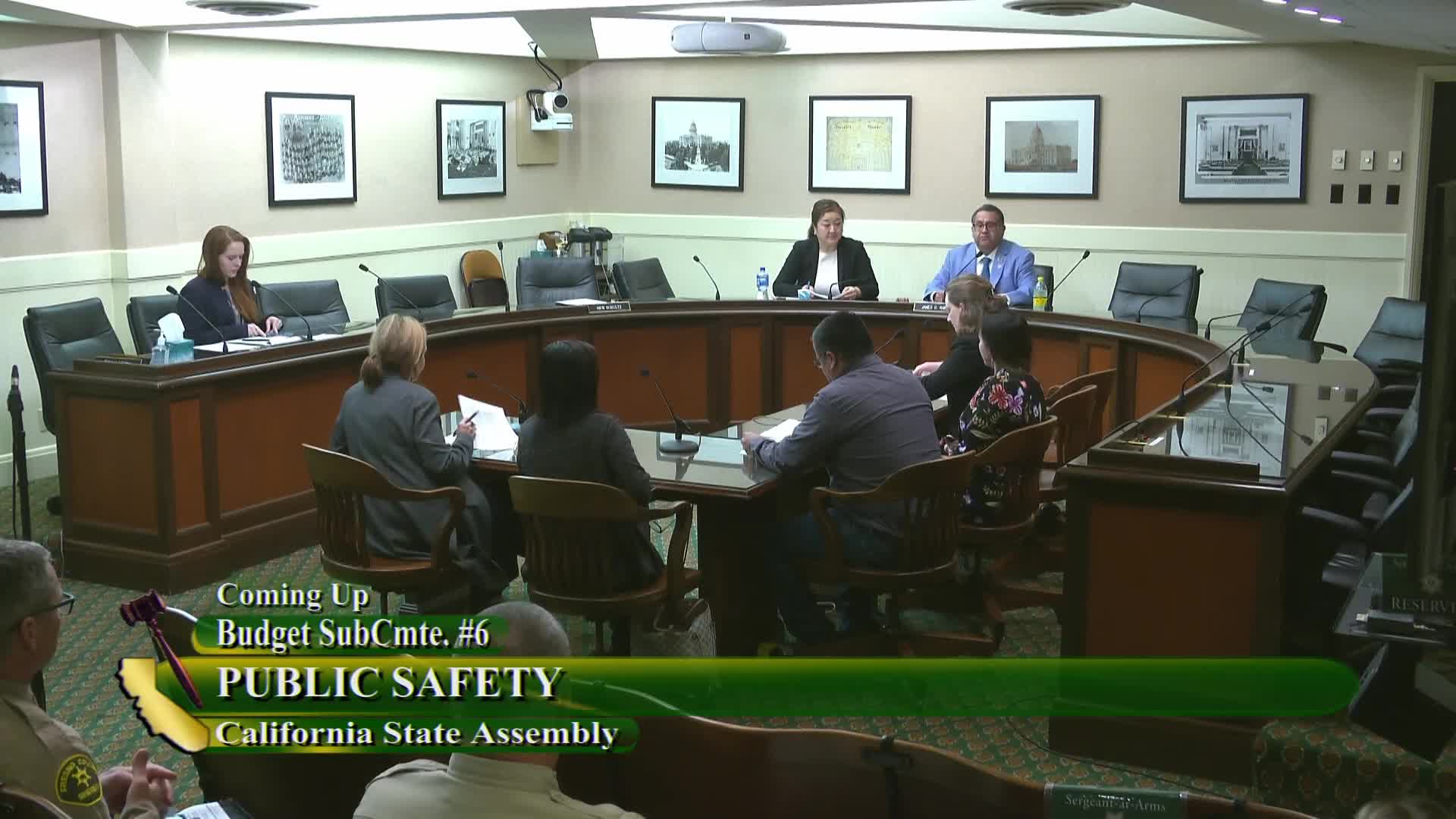
The Assembly Budget Subcommittee on Public Safety heard testimony from tribal leaders, state juvenile-justice officials and the Legislative Analyst on tribal youth diversion programs and the need for sustained funding and capacity building.
Caitlin O'Neil of the Legislative Analyst's Office summarized the program's start and scope, saying the Board of State and Community Corrections received one-time general fund augmentations of about $1,000,000 in 2018-19 and $10,000,000 in 2019-20 to fund competitive grants for tribes. O'Neil told the panel the grants were designed to support trauma-informed, culturally relevant diversion services to keep American Indian youth out of deeper justice-system involvement.
The Office of Youth and Community Restoration (OYCR) and tribal witnesses described how diversion programs were implemented and the services they provided. Catherine Lucero, speaking about diversion work and OYCR efforts, said community-led diversion "is shown to have the best outcomes for children and youth who have committed low level and nonviolent offenses." She described a range of funded activities, from partnerships with tribal and superior courts and schools to cultural programming, mentoring, academic support and college and career workshops.
Tribal leaders gave examples of local impact and ongoing gaps. Joe James, chairman of the Yurok Tribe, described mentors and cultural practices as prevention and said, "We want to speak about how important, helping our young juveniles ... getting the resources maybe they don't have, because of the area." Terrellina Pina, chief operations officer for the Yurok Tribe, described the tribe's use of prior funding to hire a staff attorney and caseworkers and said program participants have graduated high school and gone on to college.
Lorraine Orozco, director of education for the San Pasqual Band of Indians, described using second-cohort grant funds to establish a peer court, trainings and partnerships with school districts and tribal police. Orozco said her cohort was beginning to institutionalize a youth court model when follow-on funding was not allocated and the tribe lost the ability to sustain the program.
Speakers and OYCR staff emphasized program design choices. OYCR representatives said BSCC convened subject-matter experts and presumed federally recognized tribes qualified under the grant prioritization language. OYCR staff described multiple funding and program streams that touch tribal youth, including federal Title II formula grants administered through OJJDP, a community capacity-building initiative using state funding (including a Sierra Health Foundation contract that OYCR said allocated $2.4 million to tribal community-based organizations), and outreach such as listening sessions convened with tribal leaders. OYCR reported five formal listening sessions with over 200 participants and dozens of tribes.
Panel members asked about interruptions to programming and reach. Testimony noted grant periods were roughly three and a half years; the first cohort funded two tribes starting July 2019 and the second cohort funded nine tribes starting July 2020, with one tribe participating in both cohorts. OYCR and tribal witnesses attributed interruptions to COVID-19 and, in at least one case, wildfires. Several witnesses said existing funding did not match local need: Yurok reported serving about 30 youth with a goal of 600, and tribal speakers described turning away families when capacity was exhausted.
Officials and tribal leaders also stressed identification and system coordination challenges. Lucero said a survey of probation personnel found limited knowledge about Native youth and tribal services; she said better identification of tribal youth in juvenile processes and more judicial education could improve outcomes. OYCR noted two ombuds complaints received from youth who identified as Native (one Northern California and one Southern California) and provided summary counts for some transfers and hearings, while urging more robust data collection.
Why it matters: witnesses framed tribal diversion as both a culturally grounded prevention strategy and a public-safety investment. Several speakers urged stable, long-term funding and multilevel partnerships among tribes, schools, probation and state agencies to build capacity, preserve cultural supports and reduce later incarceration.
The subcommittee did not take a formal vote on funding; members asked follow-up questions and signaled interest in funding continuity and capacity building.