Get Full Government Meeting Transcripts, Videos, & Alerts Forever!
Get email alerts on the Educator Workforce topic
No spam. Unsubscribe anytime.
Lawmakers, state officials urge stable, long‑term funding to shore up California teacher pipeline
Summary
State officials, researchers and budget analysts told the Assembly Budget Subcommittee on Education Finance that recent one‑time investments have helped but will not by themselves end teacher shortages; witnesses pressed for sustained, coordinated funding, better data and continued expansion of residency and classified‑to‑credential pathways.
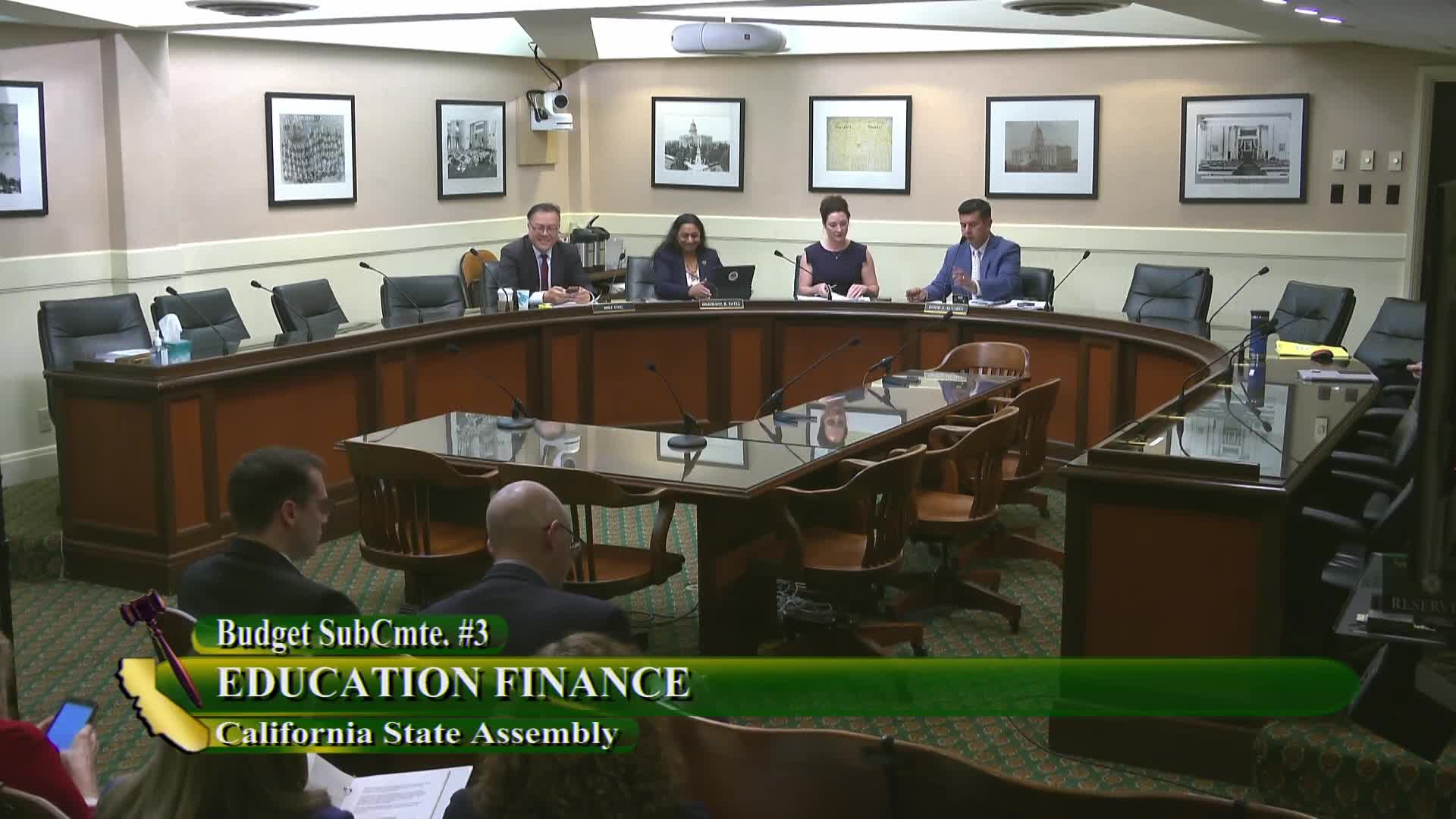
Chair David Alvarez convened the Assembly Budget Subcommittee No. 3 on Education Finance to examine the state's investments in recruiting, preparing and retaining teachers.
Experts and state officials said California's recent one‑time investments have helped start programs that recruit and support teachers but warned those gains could erode without long‑term funding and tighter coordination across agencies.
The Learning Policy Institute representative told the committee that "teacher preparation, certification, experience, and stability matter for student achievement," and that early evidence shows residency and service‑scholarship programs improve preparation and retention in high‑need schools. The Commission on Teacher Credentialing's executive director, Mary Vixie Sandy, presented new supply data showing projected hires of roughly 24,000 to 25,000 teachers in the current year and persistent shortages in multiple subject, special education, math and English language development. Cheryl Cotton of the California Department of Education emphasized that about 90 percent of new demand is driven by attrition.
Witnesses described which state programs have been expanded and where gaps remain. The Commission said it awarded nearly 300 residency grants and that residencies produced higher rates of candidate preparation and retention, but that the program's funding is being drawn down after several large grant rounds. The Commission reported $650 million invested in residencies between 2018 and 2022 that funded 96 local education agencies; recent rounds funded only a subset of viable proposals because remaining funds were limited. The Classified School Employee grant was cited as another successful recruitment path, with more than 8,000 enrollees and roughly 2,000 credential completions to date.
Multiple witnesses and the Legislative Analyst's Office urged stronger targeting and more robust evaluation. The LAO said it recommended rejecting several new proposals in the January budget due to limited evidence of effectiveness and urged the Legislature to narrow priority‑school definitions and focus on long‑standing subject shortages such as math, science, special education and bilingual education.
Committee members pressed for better longitudinal data linking credential issuance, employment, retention and attrition. Commission staff said current systems do not yet allow full cradle‑to‑career tracking of who remains in classrooms year to year; participants described ongoing efforts to link credential, employment and retirement data.
The hearing also surfaced recurring policy questions: how much one‑time funding should be braided to create an end‑to‑end pathway (from Golden State grants and residencies to loan repayment and National Board incentives), whether the state should pay student teachers, and how to align the workforce strategy with Local Control Funding Formula priorities without simply moving shortages from one district to another.
Officials and outside experts asked the Legislature to consider long‑term funding approaches rather than a string of one‑time appropriations, and to build an evaluation framework so the state can measure which programs increase teacher diversity, preparation quality and multi‑year retention.
The committee left the oversight hearing open for follow‑up data requests and directed staff to continue working with agencies and outside researchers on evaluation and alignment.