Get Full Government Meeting Transcripts, Videos, & Alerts Forever!
Get email alerts on the Human Service Zones topic
No spam. Unsubscribe anytime.
Human service zones brief appropriators: structure stabilized, focus shifts to data, staffing and service integration
Summary
Department of Health and Human Services staff described the 19 human service zones, funding from the Property Tax Relief Fund (the "4_57" fund), staffing, and program oversight. Presenters said zone-to-state redesign reduced variation, improved data dashboards, and enabled cross-zone support for child-protection backlogs.
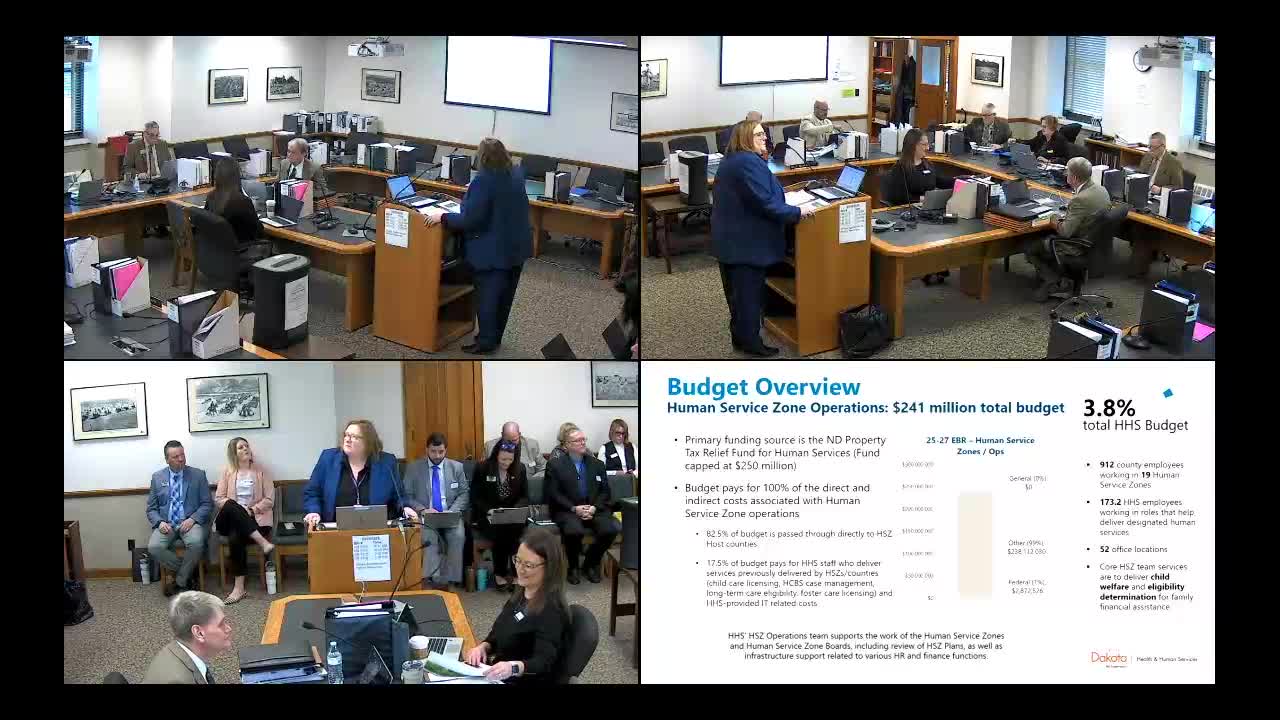
Kristen Hacksbarger, director of zone operations at the Department of Health and Human Services, briefed the Senate Appropriations Committee on the state’s 19 human service zones, the fund that pays for them and the operational changes since zone formation.
Why it matters: human service zones now receive centralized funding from the Property Tax Relief Fund (the session materials refer to the fund as the 457 fund capped at $250 million), and the Department said the arrangement is intended to standardize service delivery across counties, stabilize local operations and reduce administrative variance.
What the department told the committee
- Funding source and scope: Hacksbarger said the primary funding source for the zones is the state Property Tax Relief Fund. She told the committee the fund cap was increased to $250 million in the most recent session and that the fund covers direct and indirect zone costs. Presentation slides showed 19 human service zones, 52 local office locations and department staffing that supports zone operations.
- Staffing and host-county roles: the department described a hybrid model where host counties remain the employer for zone staff (payroll, benefits administration, some facilities/indirect costs) while HHS provides policy, budgeting and technical support. Board structures are local; each zone has a human service zone board with local representation and an elected official on each board.
- Standardization, data and performance measures: Hacksbarger highlighted a set of standardized measures (child-welfare timeliness, eligibility determinations, operational metrics) the department is beginning to track statewide with dashboards. She said zone position-control and payroll tracking have moved to central systems and that dashboards now allow the department and zones to monitor casework and staffing data.
- Cross-zone collaboration and recent successes: the department cited several collaborative efforts to address workload and service continuity. These included a “CAST” child-protection team that temporarily staffed zones with backlog, a “March Madness” effort to clear overdue eligibility reviews, and improved compliance on in-person caseworker visitation for children in foster care (Hacksbarger said zones met the federal face-to-face requirement roughly 96% of the time in recent reporting).
- Turnover and retention: the presentation acknowledged prior turnover in several program areas. Hacksbarger said local dashboards and targeted supports have reduced turnover in pilot areas (CFS/dedicated child-protection staff) and that a sustained recruitment and retention strategy remains a work in progress.
- Revenue and other budget signals: HHS told the committee it is tracking county-generated revenue sources (for example Medicaid-related billings when zones operate as Medicaid providers and some nonemergent transport revenue). The department estimated zones now generate about $5 million in revenue that offsets zone costs and said it will continue to track and report those figures.
Questions and oversight points
Committee members asked about host-county benefit differences, whether zones could change boundaries in future years, and whether statewide call-center operations have improved. Senator Cleary asked how county-generated revenue is treated in zone formula payments; department staff said revenue is tracked and that zones have access to equipment or one-time needs through the regular zone budgeting process. Senators also asked for follow-up on inconsistencies in local benefits and on how the department plans to standardize HR and reporting.
Ending
Hacksbarger said the next priorities for the department include continued evaluation of economic-assistance redesign, expansion of data dashboards and metrics for staffing and case management, and attention to recruitment/retention and case management for children with complex needs. The department offered to supply additional reports and to work with appropriators on any requested budget detail.