Get Full Government Meeting Transcripts, Videos, & Alerts Forever!
Get email alerts on the Appropriations Government Operations Division topic
No spam. Unsubscribe anytime.
Senate reviews Attorney General’s budget; FTEs, litigation pool, lab and cyber needs discussed
Summary
The Senate took up the Attorney General’s budget (House Bill 1003), examining staffing requests, litigation funding and crime-lab equipment, and discussing resource needs if a new guardianship oversight statute becomes law.
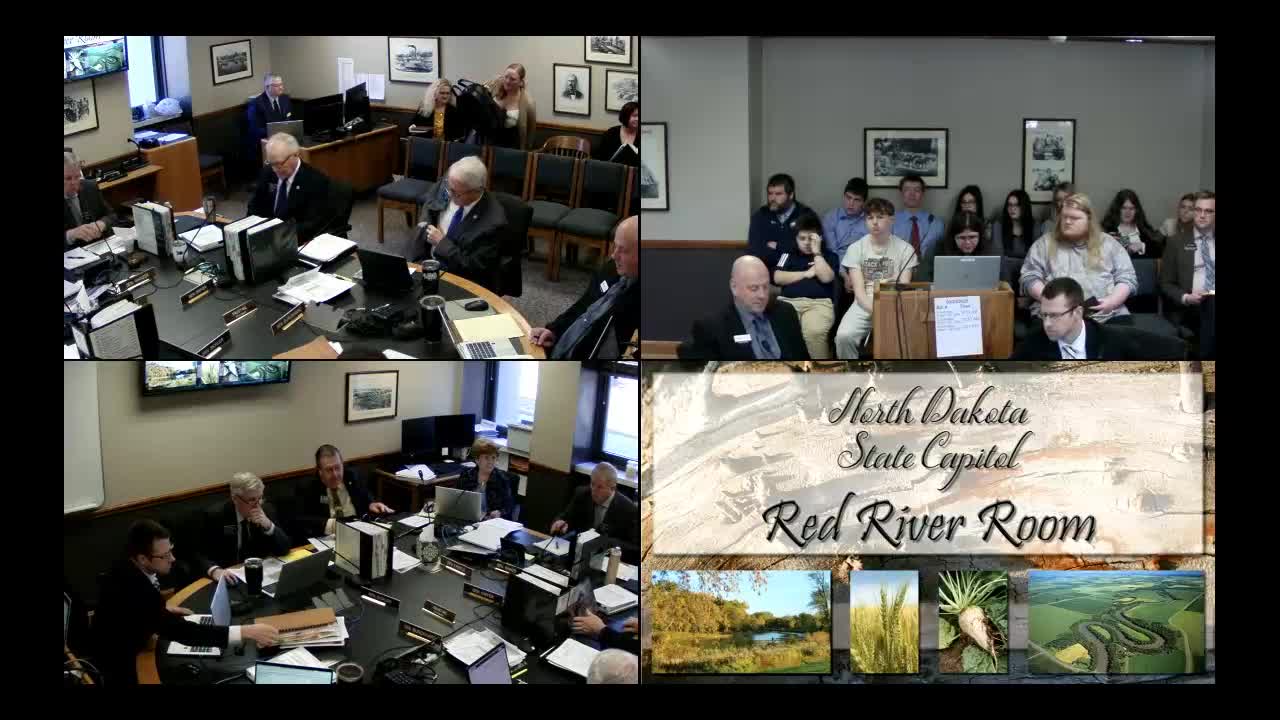
The Senate appropriations Government Operations Division took testimony on the Attorney General’s 2025–27 budget (House Bill 1003). Deputy Attorney General Claire Ness, Attorney General office finance director Becky Keller, BCI Director Lonnie Grabowski, and staff briefed senators on staffing, operating needs, and optional decision packages.
FTE requests and staffing: - The Attorney General requested 15 new FTE in its original submission. The Armstrong executive budget included funding for five of those positions; the House approved four positions (evidence technician, Medicaid fraud control unit attorney, executive staff officer, and a tobacco compliance auditor). The department said the evidence technician and Medicaid fraud control attorney had strong support because substantial federal funding covers part of those roles. - Several existing vacant positions were discussed. Some vacancies (for example, a paralegal-to-attorney reclassification and other attorney vacancies) have been actively recruited; the agency reported several recent hires for gaming positions and others. - Cybercrime information-processing workload: the Bureau of Criminal Investigation (BCI) has grown its agent count without equivalent increases in report-processing staff. The department requested information-processing FTE to clear backlogs; committee members heard there are as many as 200 reports awaiting processing at times. - Victim-witness advocates: two temporary advocates are currently funded from temporary salary lines and prior federal grants; the department requested making them full-time general-funded positions to ensure continuity. Director Grabowski explained that if federal grant support returns, the office would use those federal funds to support an additional (third) position to cover central North Dakota.
Budget and operating items: - Tobacco compliance auditor: the House included a tobacco compliance auditor position tied to a registry fee (electronic smoking/device manufacturer fee). The department warned the registry’s per-product $500 fee may not generate sufficient revenue to cover the full salary; if fees don’t suffice, the department proposed supplementing from Master Settlement Agreement (MSA) tobacco funds. - Equity request: the Attorney General requested approximately $291,777 for pay equity adjustments to bring underpaid employees closer to midpoints; the House did not include this request. - Litigation pool: the agency requested and the House added one-time and other-fund adjustments. The department explained large litigation costs in recent biennia (including DAPL-related costs) and said the litigation pool is routinely used to bring in outside counsel for high-cost cases or to support other agencies that need outside counsel. The House increased the litigation pool authority; some of the added funding was from special funds (SIF) and gaming-related transfers. - Crime lab and equipment: the House added $192,000 for crime-lab maintenance/service agreements and other one-time equipment costs for gas-chromatograph/mass-spectrometers, thermal cyclers, purification water systems, and similar items; the department said maintenance agreements are cost-effective to avoid downtime on expensive equipment.
Other items and contingency issues: - Guardianship oversight (Senate Bill 2029): the department described potential resource needs if the guardianship oversight bill is enacted. The office estimated needing four additional BCI agents and one prosecutor to investigate and prosecute offenses that could arise under a new guardianship oversight program; committee members asked for long-sheet estimates and for contingency language that would make any additional FTEs/funding conditional on the enactment of that policy bill.
Committee direction: senators asked staff to prepare long-sheet and amendment language to reflect optional items (equity pay package, litigation pool adjustments, possible contingent FTEs for guardianship oversight) and asked the department to provide further data on cybercrime report backlogs and anticipated tobacco registry revenues.