Get Full Government Meeting Transcripts, Videos, & Alerts Forever!
Get email alerts on the Reentry Services Identification topic
No spam. Unsubscribe anytime.
Committee holds first hearing on bill to let community correction facilities help residents obtain state IDs
Summary
House Bill 393 would let community based correctional facilities assist residents in obtaining state-issued identification before release. Sponsors said the change would remove a barrier to employment, benefits and housing and support reentry; the committee held a first hearing and took no vote.
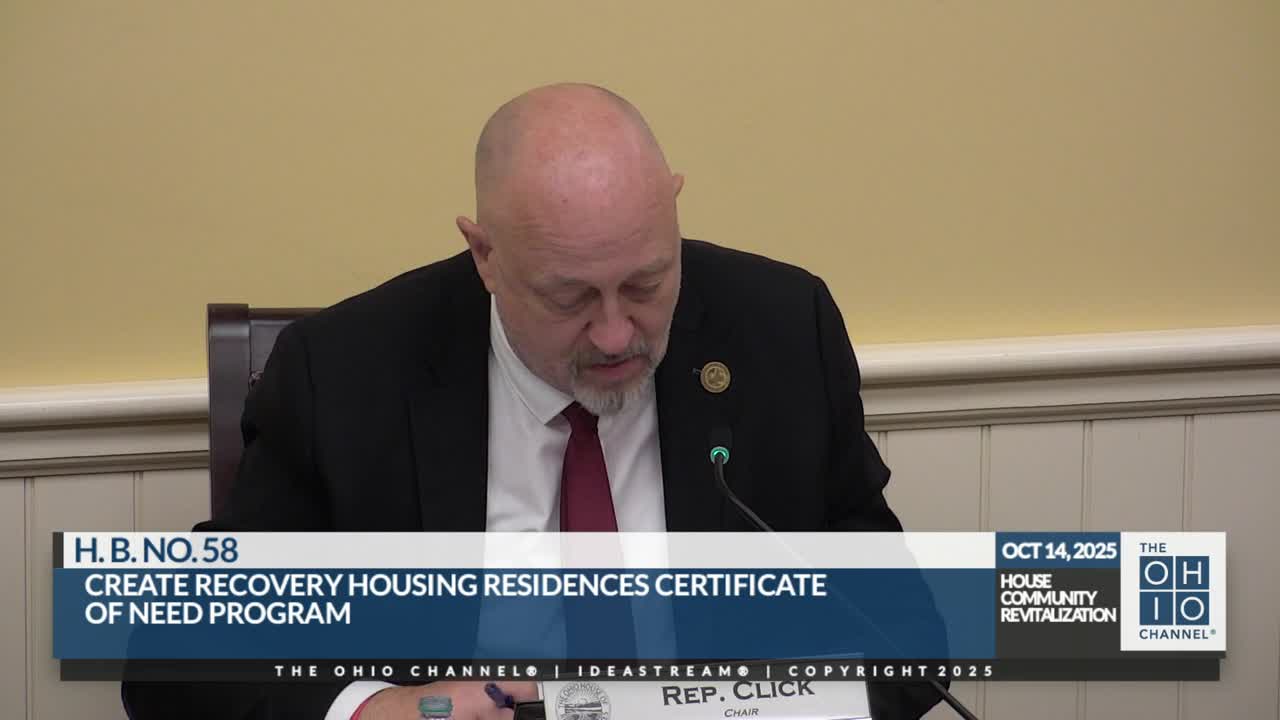
Sponsors Representative Click and Ranking Member Brewer presented sponsor testimony on House Bill 393 during its first hearing before the House Community Revitalization Committee. The bill would allow community based correctional facilities to assist residents with obtaining state-issued identification before release.
Representative Click said the change addresses an oversight in prior legislation that extended ID services to Department of Rehabilitation and Corrections inmates but omitted residents of community based correctional facilities. “A recurring challenge for individuals released from incarceration is the lack of a valid state issued ID card,” Click told the committee, saying that lack of identification “can quickly become a serious barrier to successful reintegration.”
Brewer, the bill’s joint sponsor, told members that expanding the existing state ID program to include community based correctional facilities would help people access SNAP, housing, health care, employment and banking; he described the proposal as bipartisan and supported by community based facilities. Committee members asked clarifying questions about what constitutes a community based correctional facility and who operates these facilities; sponsors explained that some are state-run and others are operated by nonprofit organizations and that the bill would extend the same ID service provision to those facilities.
Why it matters: Sponsors argued that providing IDs before release removes a basic administrative barrier, increases the chance of stable reentry, and reduces recidivism risk by making employment and services accessible immediately on release.
No committee vote was taken on House Bill 393 during the hearing; the committee concluded the first hearing and did not adopt the bill as a working document during this session.