Get Full Government Meeting Transcripts, Videos, & Alerts Forever!
Get email alerts on the Criminal Vehicular Homicide Restitution topic
No spam. Unsubscribe anytime.
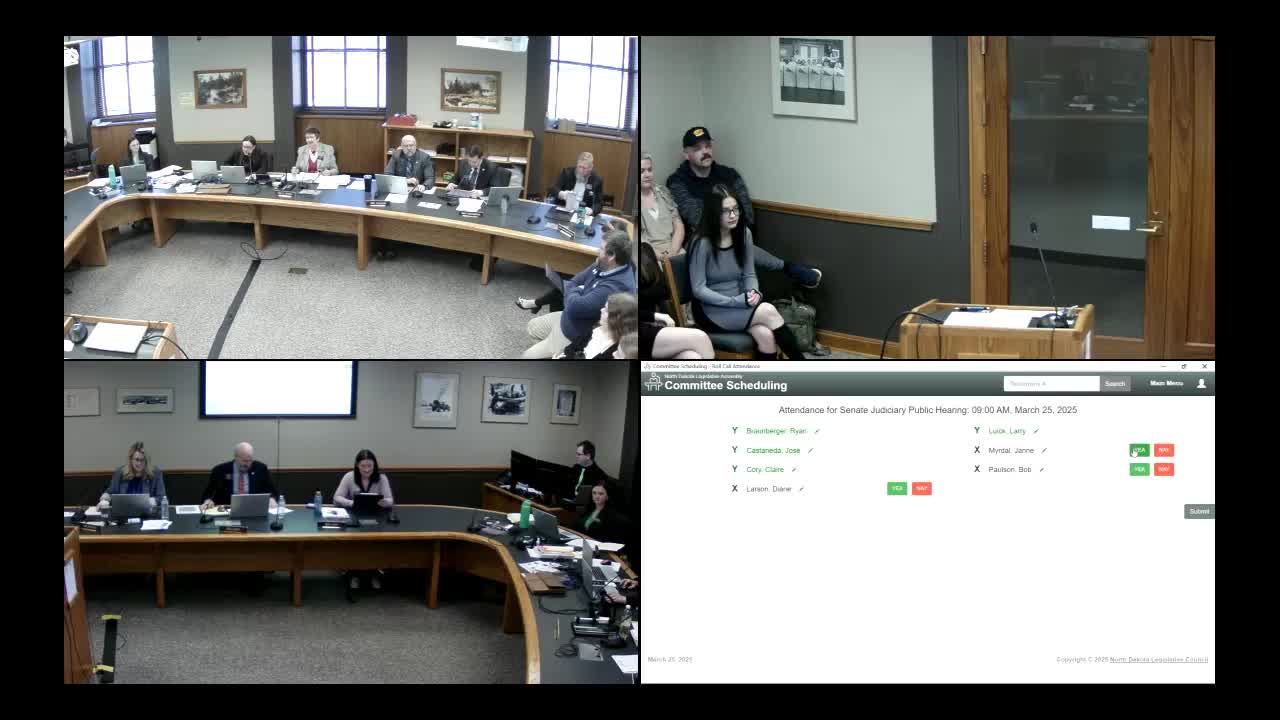
Senate Judiciary Committee hears bill to allow judges to order restitution for children after vehicular homicides
Summary
The Senate Judiciary Committee opened a hearing on House Bill 1558, which would allow judges to order "parental loss restitution" for minor children when a parent or legal guardian is killed in criminal vehicular homicide.
The Senate Judiciary Committee opened a hearing on House Bill 1558, which would allow judges in criminal vehicular homicide cases to order "parental loss restitution" to support minor children when a parent or legal guardian is killed, committee members heard on the bill's first committee appearance.
Representative Austin Schauer, the bill sponsor, told the committee HB 1558 "gives judges the authority to order child restitution payments when the person killed in the crash was a parent or guardian of a minor child." He walked the committee through the assembly's amended draft and the statutory factors the bill would require judges to consider.
The measure would place the parental-loss restitution provisions under the state's probation code, authorize restitution at sentencing or within 60 days, and allow payments to continue until the child reaches age 18, Schauer said. He described a process in which surviving parents or guardians submit a claim affidavit to the prosecutor at least 10 days before a restitution hearing, and listed seven statutory factors courts would weigh — including the child's financial needs and resources, the surviving parent's financial situation, the child's accustomed standard of living, educational needs, custody arrangements, reasonable work-related childcare expenses, and any money or insurance settlement received or anticipated arising from the incident.
"By establishing clear guidelines for calculating child restitution, HB 15 58 provides consistency and fairness to ensure children who have lost mom or dad receive adequate financial support as determined by the judge," Schauer said.
Supporters included Nicole Luthane of Grand Forks, who described the death of her 6-year-old daughter in a 2024 crash and urged the committee to "hold those who make these selfish, reckless choices accountable. Protect our children." Luthane testified about the limits of civil insurance settlements and the financial and emotional toll on survivors.
Frank Harris, director of state government affairs for Mothers Against Drunk Driving, said the bill "sets forward a framework for judges to possibly follow" while preserving judicial discretion. He cited similar enactments elsewhere and said an explicit statutory framework could provide both a pathway for restitution and an additional deterrent message to would-be impaired drivers.
State prosecutors and county attorneys testified in opposition or neutral with substantive concerns about implementation. Jonathan Byers of the North Dakota State's Attorneys Association said the bill would require prosecutors to compile detailed evidence of economic loss in a short window, a task many small prosecutors' offices are not staffed to perform. "The state's attorney's position is they just shouldn't occur in the same criminal process," Byers said, arguing that the time required to gather medical bills, wage-loss calculations and settlement information could shortchange victims if done hurriedly.
Multiple county prosecutors warned that the bill as drafted would place new administrative and evidentiary burdens on small offices and could affect victims' eligibility for other funds. Chase Lingle, senior assistant state's attorney for Morton County, said his office does not handle restitution payments and prefers the clerk of court to distribute funds; he warned that routing money through prosecutors' offices could create liability for counties.
Several prosecutors also noted interaction with existing North Dakota law. Travis Fink of the Commission on Legal Counsel for Indigence told the committee that Article 1, Section 25 of the state constitution (sometimes called Marcy's Law) and statute 12.13208 already speak to restitution and victims' pecuniary loss. "The statute 12.13208 says you have to order restitution for any pecuniary loss," Fink said, and he noted a judge on the list of conferees had differing views on whether the bill was needed to make the practice explicit.
Committee members asked about scope and limits: whether the bill would apply only when a parent is killed (it would), whether it would apply when parents are severely injured (it would not), and whether the court could consider civil settlements when setting restitution (the bill allows subtracting civil settlement amounts). Schauer explained an additional amendment under consideration would bar a civil jury from reducing a civil award by the amount of criminal restitution ordered.
Committee members also pressed on practical questions such as caps, the defendant's ability to pay, juvenile defendants, and how the state's attorney would gather timely medical and economic records. Prosecutors said pre-sentence report timelines and the typical chronology of criminal and civil cases made it difficult to produce a complete restitution figure before sentencing. Byers told the committee that collecting full medical records can take several months.
The committee closed the hearing on HB 1558 without taking a vote. Chair Larson said members would wait to act until a committee member who had to leave could return; the bill remained pending at the end of the hearing.
Clarifying details from the hearing include that the proposed statute would allow restitution to be ordered at sentencing or within 60 days, payments could continue until the child turns 18, surviving parents must provide a claim affidavit at least 10 days before the restitution hearing, and a court could subtract civil settlement amounts from criminal restitution. Proponents cited Bentley's Law and similar statutes adopted in other states as precedents.
While supporters called the bill a targeted tool to help bereaved children, county prosecutors urged further drafting changes or an alternative process so that victims receive full and carefully calculated compensation. The committee took no further action and deferred consideration to a later date.