Get Full Government Meeting Transcripts, Videos, & Alerts Forever!
Get email alerts on the Drug Policy Fentanyl topic
No spam. Unsubscribe anytime.
Ohio senator urges Congress to designate fentanyl a weapon of mass destruction
Summary
Sen. Johnson testified before the House Community Revitalization Committee urging support for Senate Concurrent Resolution 1, which asks Congress to designate illicit fentanyl a weapon of mass destruction; members asked about practical effects and enforcement but the committee took no formal vote on the resolution.
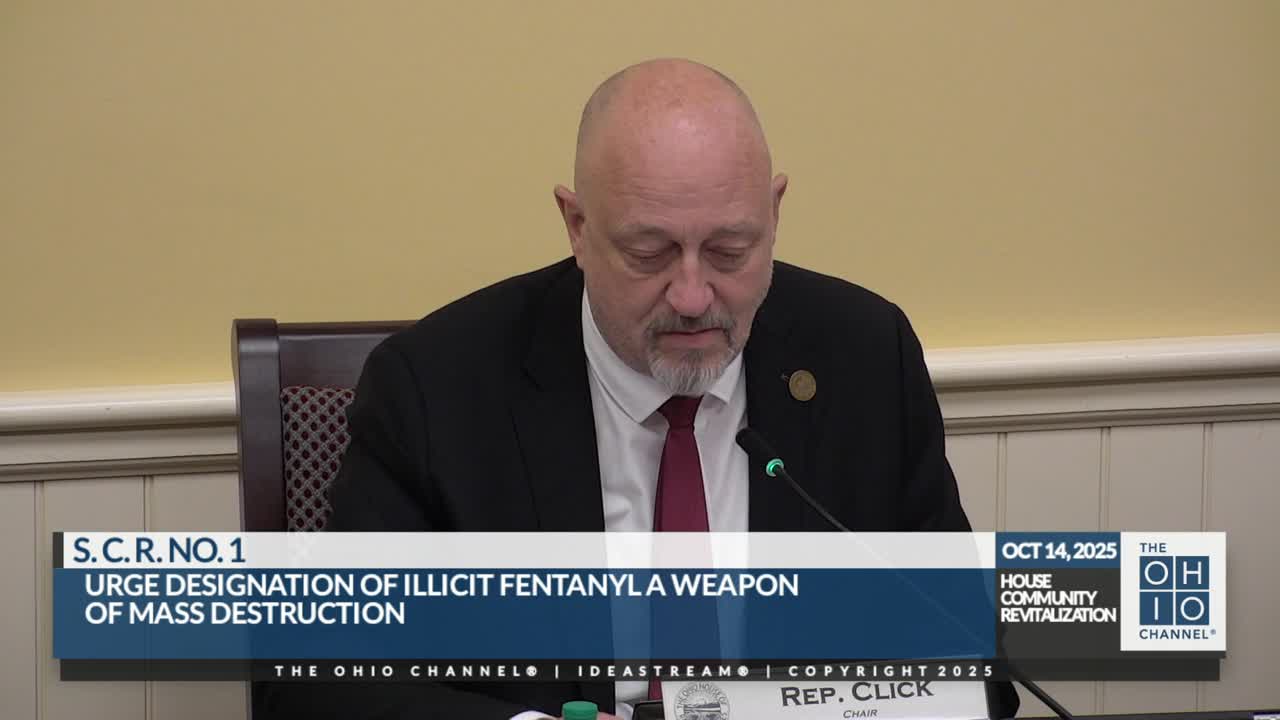
Senator Johnson told the House Community Revitalization Committee on the first hearing of Senate Concurrent Resolution 1 that the resolution urges Congress to designate illicit fentanyl a weapon of mass destruction.
He said fentanyl is “50 times more potent than heroin, 100 times more potent than morphine,” that “only 2 milligrams of fentanyl can be a fatal dose,” and that “1 kilogram of fentanyl has the potential to kill 500,000 people,” citing laboratory and enforcement figures during his testimony. He also referenced the Stop Our Scourge Act introduced in Congress as an example of federal legislation addressing the threat.
Why it matters: Johnson framed the designation as both a public-health and national-security measure. He argued that cartels and foreign actors profit from illicit fentanyl production and distribution and that a federal designation would signal urgency to the executive branch and the intelligence community. “This statement tells our federal government that we’re fed up with this and we really want some real action on it,” Johnson said.
Committee members asked follow-up questions about what a federal weapons designation would change in practice. Chairman Clique asked, “what does that do for us in a practical sense other than making a statement?” Johnson responded that the designation “certainly makes a statement” and contended it could enable stronger federal responses, including increased enforcement and international action. He cited prior examples he said demonstrated state-sponsored or politically enabled production and distribution of fentanyl precursors.
Representative Brewer asked whether the designation would affect “big pharma” or legitimate medical uses; Johnson answered that licensed medical fentanyl (for example, transdermal patches for cancer pain) would not be impacted. The senator also told members that he had seen Department of Justice and DEA examples of how illicit fentanyl is marketed and sold through online channels and on the dark web.
Other members asked whether the subject also constitutes a first-responder safety issue; Johnson said it does, citing reported incidents of police and emergency workers being exposed and harmed. Members also asked about prior votes; Johnson said the Senate measure he sponsored passed unanimously in committee and on the floor.
No formal committee action was taken on SCR 1 during the hearing. The committee record contains the senator’s testimony and follow-up questions but no motion or vote was recorded.
The hearing included extended back-and-forth between members and Senator Johnson on international supply chains, law enforcement risks, and distinctions between legitimate medical fentanyl and illicit fentanyl sold via cartels and online channels. The committee did not adopt the resolution, and staff did not announce next steps before the hearing ended.