Get Full Government Meeting Transcripts, Videos, & Alerts Forever!
Get email alerts on the Historic Preservation topic
No spam. Unsubscribe anytime.
Alachua County historical commission seeks certified‑local‑government status; commissioners ask for cost estimate
Summary
The Alachua County Historical Commission asked the county on May 27 to pursue Certified Local Government status, a federal/state preservation designation that would require a historic‑preservation ordinance, a qualified review board and an updated resources survey.
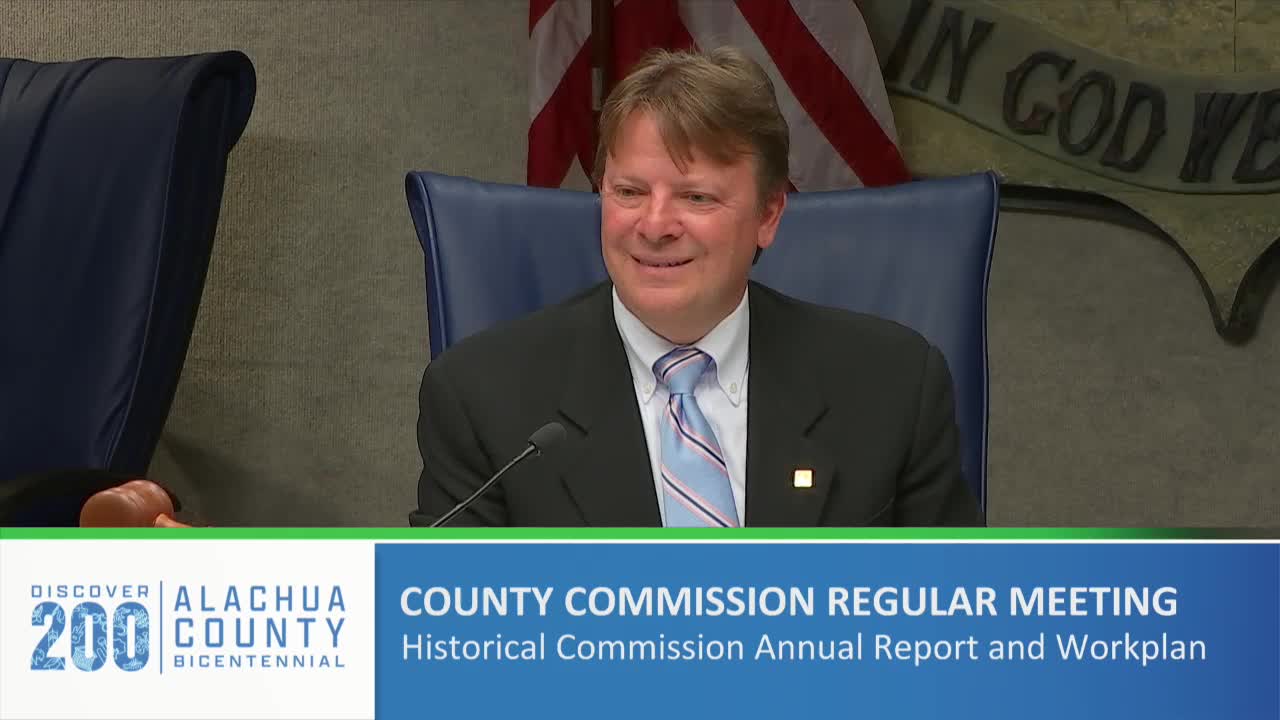
The Alachua County Historical Commission presented its annual report and work plan to the county commission on May 27, and formally recommended that the county pursue Certified Local Government (CLG) designation through the Florida Division of Historical Resources.
The commission’s chair described projects underway — marker applications, cemetery surveys, the remembrance project and collaboration on the Cuscawilla (Cuscuilla) marker — and asked the Board of County Commissioners to authorize staff and the historical commission to prepare a CLG application. Historical commissioners said CLG status would make the county eligible for technical assistance, training and competitive historic‑preservation grants, and would create a formal, regulatory historic‑preservation program for unincorporated areas.
What CLG means and the county’s obligations CLG, created under the National Historic Preservation Act, links local governments with state historic preservation offices and the National Park Service to identify and protect historic resources. To participate the county would need to adopt a historic‑preservation ordinance, create a qualified review body (a preservation board with at least five members qualified in areas such as architecture, history or archaeology), maintain and update a historic resources survey, and provide staff support for the program’s duties (including periodic public hearings and annual reports to the state).
Costs, scope and concerns discussed by commissioners Staff told the commission the county’s current comprehensive plan and land‑development code include preservation policies and some review language but lack the full statutory components CLG requires. Staff estimated an updated historic resources survey and consultant assistance could cost in the range of $50,000–$100,000; that figure was described as a rough estimate and may be eligible for grant funding but is not guaranteed.
Commissioners raised questions about scope and cost: which structures qualify as historic (the threshold is commonly 50 years old but nomination requires demonstrable historic significance), whether the county could assign CLG duties to an existing advisory board, and whether cities could opt into a county CLG program. Commissioners asked staff to return with specific cost estimates for a survey, ordinance drafting, staffing needs and alternatives that could strengthen protection using existing land‑development rules without creating a new regulatory board.
Board action The commission voted to ask staff to return with a financial and implementation plan (including alternatives) and to include any options for using existing regulatory tools. The motion directed staff to prepare budget and staffing estimates for the board’s consideration.
Why this matters CLG designation creates a formal, enforceable preservation program for unincorporated county properties — including potential tax‑abatement incentives and greater technical help for preservation projects — but it also creates regulatory obligations, enforcement mechanisms and recurring staffing costs. Commissioners sought a clear cost/benefit analysis before committing to ordinance drafting and program implementation.
Ending Staff will return with specific cost estimates for an updated resources survey, ordinance drafting, staffing needs and options that rely on existing codes, then present those figures as part of future budget deliberations.