Get Full Government Meeting Transcripts, Videos, & Alerts Forever!
Get email alerts on the Neighborhoods Foreclosure Fund topic
No spam. Unsubscribe anytime.
Committee defers $912,000 foreclosure-registry appropriation after members request more detail
Summary
The finance committee deferred an appropriation request that would have allocated $912,000 from the city’s foreclosure registry fund for neighborhood programs and four staff positions, asking for a follow-up with more detailed budget breakdowns.
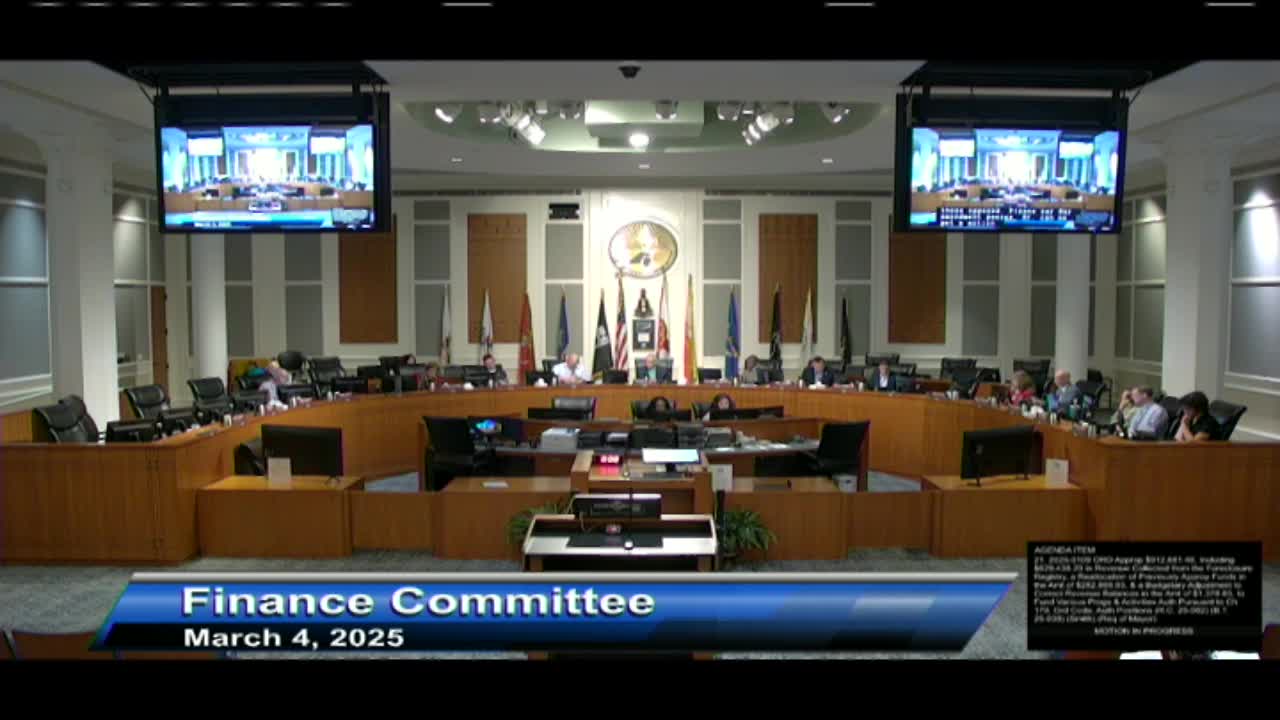
The Jacksonville City Council Finance Committee deferred a bill March 4 that would reappropriate $912,000 from the city’s foreclosure property registry to fund neighborhood matching grants, blight removal programs and four administrative positions.
Robert Umby, housing property administrator in the neighborhoods department, told the committee the appropriation includes two cycles of the neighborhood matching grants program, funds to support code and compliance blight-removal activities and administrative costs for four positions. Staff described the $912,000 figure as composed of roughly $630,000 in new appropriations plus $280,000 of previously appropriated funds being repurposed.
Councilmembers asked for more detailed budget breakdowns and the fund balance. Auditor Philip Peterson told the committee the foreclosure registry had about $760,000 before this proposed appropriation; applying the $630,000 new appropriation would leave an estimated balance of about $130,000 in the fund. Members asked for a clearer accounting of how much of the appropriation goes to personnel versus programs.
Why it matters: The foreclosure registry is a restricted fund governed by state statute; committee members noted that authorized uses are limited and asked for assurance the funds will be spent according to statutory restrictions. The neighborhood matching grants program has historically paid up to $5,000 per award; members discussed whether the $5,000 cap remains appropriate amid rising costs.
Outcome: Committee members agreed to defer the item for two weeks to allow staff to produce the requested line-item detail and to answer follow-up questions about program cycles, the fund balance, and the proportion of funds for staff salaries versus program activity. The item will return at the next cycle for reconsideration.