Get Full Government Meeting Transcripts, Videos, & Alerts Forever!
Get email alerts on the Juvenile Fitness topic
No spam. Unsubscribe anytime.
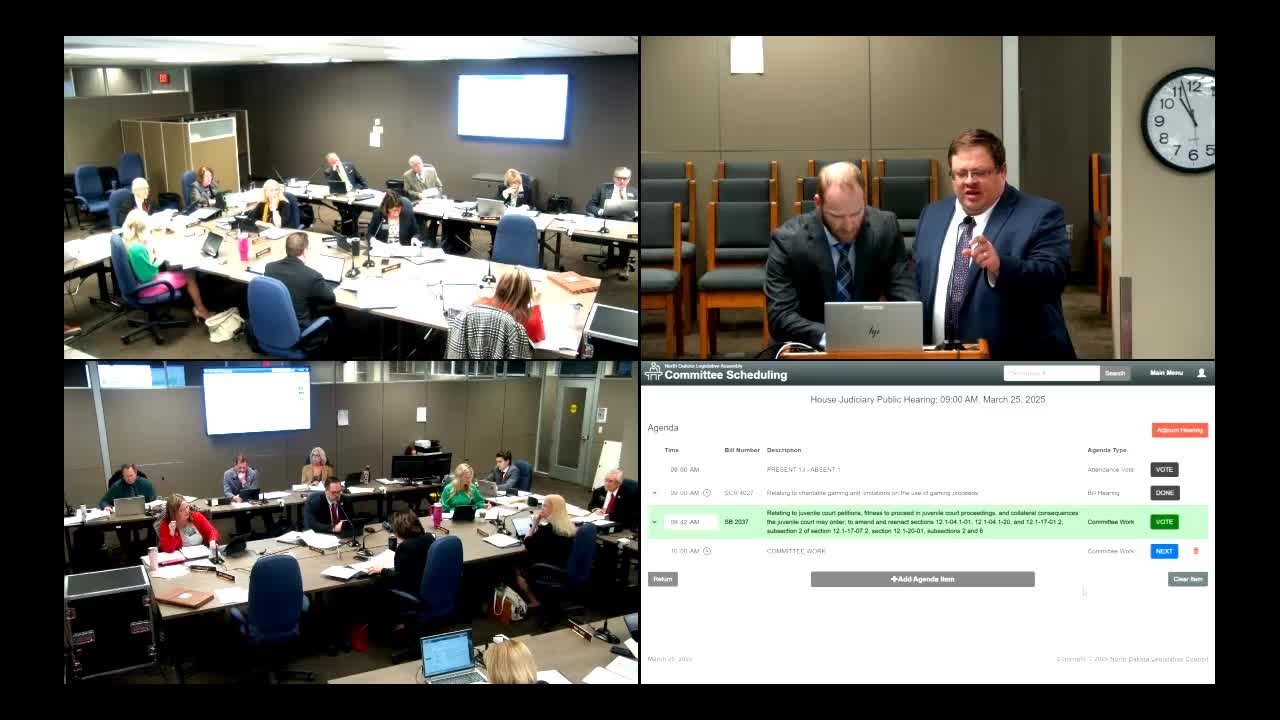
Committee advances juvenile fitness‑to‑proceed bill to appropriations after failing to restore CHINS language
Summary
Senate Bill 2036, which revises juvenile fitness‑to‑proceed (competency) procedures and sets time frames for evaluations and remediation, was sent to Appropriations by the House Judiciary Committee 11–1; a motion to restore a provision that would have allowed certain incompetent juveniles to be handled via CHINS failed on a 6–6 tie.
The House Judiciary Committee voted to recommend that Senate Bill 2036 be reported to Appropriations by a vote of 11–1. The bill updates juvenile fitness‑to‑proceed (competency) procedures, tightens time frames for evaluations and reports, and creates a remediation pathway intended to restore juveniles to competency so cases can proceed.
Travis Fink, who the committee identified as a presenter from the Commission on Juvenile Justice work group, said SB 2036 responds to concerns that juveniles may not have attained competency in the same way adults do, particularly because juveniles as young as 10 can be adjudicated delinquent in North Dakota. The bill distinguishes fitness (ability to assist in defense) from criminal responsibility and sets shorter deadlines for examinations and reports so juveniles are not left detained while evaluations wait.
The committee discussed what should happen when remediation fails or when a juvenile cannot be restored to competency. The bill as reported from the Senate had included language allowing certain cases to be handled under the child‑in‑need‑of‑services (CHINS) framework; the House Judiciary Committee considered a motion to restore that CHINS language, which would provide an alternative statutory pathway for children not restorable to competency and likely create additional services and fiscal needs for human service zones.
Representative Van Winkle moved to reinsert the CHINS language; the motion was seconded by Representative Satrim. The roll call resulted in a 6–6 tie and the motion failed. Committee members who opposed restoration said the fiscal implications were not yet acceptable; those supporting it said without a CHINS pathway, some juveniles deemed incompetent would have their cases dismissed with no service pathway.
After defeat of the CHINS proposal, Representative Olson moved a do‑pass recommendation; the motion was seconded by Representative Schneider and carried 11–1. The committee recorded a $500,000 appropriation included in the bill for contracts and training related to competency evaluations and remediation. Committee members asked for continued coordination with the Department of Health and Human Services and human service zones to implement remediation and evaluation protocols.
What happens next: SB 2036 is recommended to the House Appropriations Committee. Sponsors said they expect DHHS and human service zones to continue planning implementation and to return with fiscal detail in future budget discussions.