Get Full Government Meeting Transcripts, Videos, & Alerts Forever!
Get email alerts on the Agricultural Property Tax topic
No spam. Unsubscribe anytime.
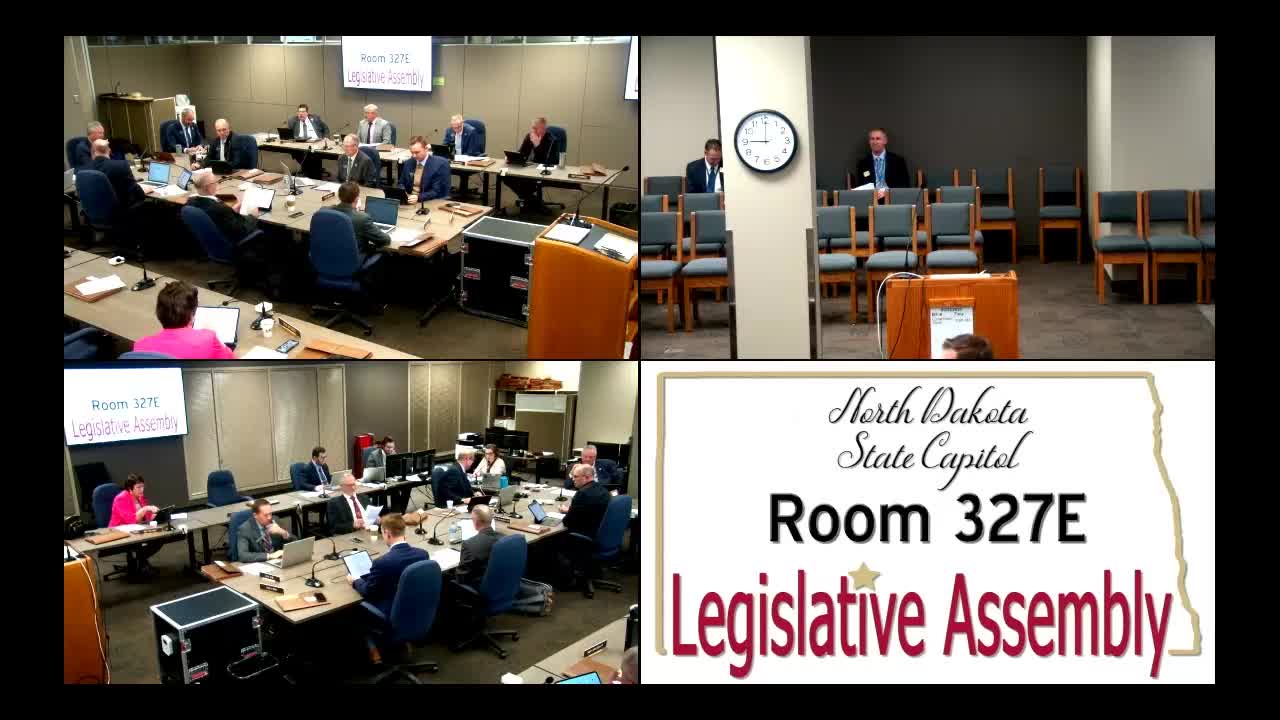
Finance and Taxation advances bill clarifying farm property tax exemptions; debate on family definitions and scope
Summary
The Finance and Taxation Committee advanced Senate Bill 2039, as amended, following debate over whether to expand and clarify which farm storage structures qualify for an agricultural property tax exemption.
The Finance and Taxation Committee advanced Senate Bill 2039, as amended, following lengthy debate over how the state defines agricultural property and which storage structures qualify for an agricultural property tax exemption.
The amendment adopted by the committee, labeled 01004, reorganizes the bill's definitions and explicitly includes storage of harvested crops within the statutory term "raising agricultural crops." The amendment also distinguishes properties platted before March 30, 1981, from those platted on or after that date and adds a narrow farm-structure exemption for certain storage buildings on pre-1981 platted land.
Why it matters: The change could expand the class of buildings that qualify for agricultural property tax treatment in some cases, a move lawmakers said is intended to clarify longstanding assessment confusion in areas where towns have grown up around farm facilities. Committee members and outside witnesses said the fiscal impact is unclear because existing records do not identify how many properties would be affected.
Committee discussion and key details
Representative Haggard, the amendment sponsor, told members the draft "separates the platted and unplatted, from 1980 using the 1981 date" and that the amendment "exempts the platted and unplatted lands prior to 1981" while laying out seven-factor tests for later‑platted property. Legislative counsel Megan Gordon explained the drafting choices, saying the amendment "does a little bit of reorganizing of the provision to try to provide some clarity as far as when those conditions do apply." Gordon identified the change that adds storage of harvested crops to the definition of raising agricultural crops and noted that including that language represents an expansion compared with prior attorney general guidance: "previous attorney general's opinions have not historically included the storage of crops in the definition of the term raising agricultural crops." (Megan Gordon, legislative counsel)
Committee members repeatedly pressed for precision on the phrase "direct relative." Representative Steiner said she would prefer narrower language and asked whether a second cousin should qualify. Representative Greenheck described how prior bills had defined "direct relative" broadly: "spouse, surviving spouse, child, parent, brother, sister, grandparent, great grandparent, grandchild, great grandchild, aunt, uncle, niece, nephew, first cousin, second cousin, whether by blood, adoption or marriage." Pete Hanover of the North Dakota Farm Bureau described the practical aim: "We're trying to make sure that those that are exempt ... and are in a business together, if they're second cousins, ... are all included in this." (Pete Hanover, North Dakota Farm Bureau)
Tax administration and fiscal uncertainty
Shelley Myers of North Dakota Property Tax told the committee she found the amendment "pretty clear" as drafted and said assessors would consult state's attorneys for legal questions; she described the amendment as an improvement over current Century Code language. At the same time several lawmakers said the committee lacked reliable data to estimate the fiscal effect of broadening the exemption. "We have no idea how much money that exemption is going to impact the state," Representative Steiner said, noting assessors and agencies had not provided cost estimates.
Votes and procedural actions
- The committee removed a prior amendment and considered amendment 01004. A motion to adopt amendment 01004 (mover: Representative Doctor; second: Representative Anderson) passed and the committee moved forward with the bill as reorganized.
- Representative Greenheck moved a further amendment to change one procedural condition (striking the word "4" and replacing it with "5"). That further amendment passed by roll call, 7–6; the committee then placed the bill forward with that further change in place.
- After additional discussion, the mover withdrew the recent change and the committee returned the bill to the form with amendment 01004 only. The committee then approved a final motion to give Senate Bill 2039 a "do pass" recommendation as amended; the motion carried on the committee roll call.
What the amendment does (summary)
- Adds storage of harvested crops to the statutory definition of "raising agricultural crops." This is an explicit legislative change from past attorney general interpretations and therefore functions as a statement of legislative intent.
- Reorganizes the statute to treat platted land differently depending on whether it was platted before or after March 30, 1981. For platted property dated on or after that cutoff the amendment requires application of the seven-factor test in the bill; for pre-1981 platted property the amendment narrows exclusions in the farm-structure exemption.
- Includes a specific narrow exemption for structures on pre‑1981 platted land owned by a farmer and used exclusively to store harvested crops "until the crop is delivered to the first endpoint user and affixed to that particular land," per the amendment language described by legislative counsel.
Remaining questions and next steps
Committee members flagged several open issues the amendment leaves unresolved: how to define "direct relative" consistently in statute, how assessors will implement and verify family relationships for exemptions, and the bill's net fiscal impact. Several members suggested that fuller vetting with assessors and additional data might be appropriate before widening the exemption further.
The committee carried the amended bill out of committee; Representative Haggard was asked to carry the bill forward to the next stage.