Get Full Government Meeting Transcripts, Videos, & Alerts Forever!
Get email alerts on the Highway Naming Equity topic
No spam. Unsubscribe anytime.
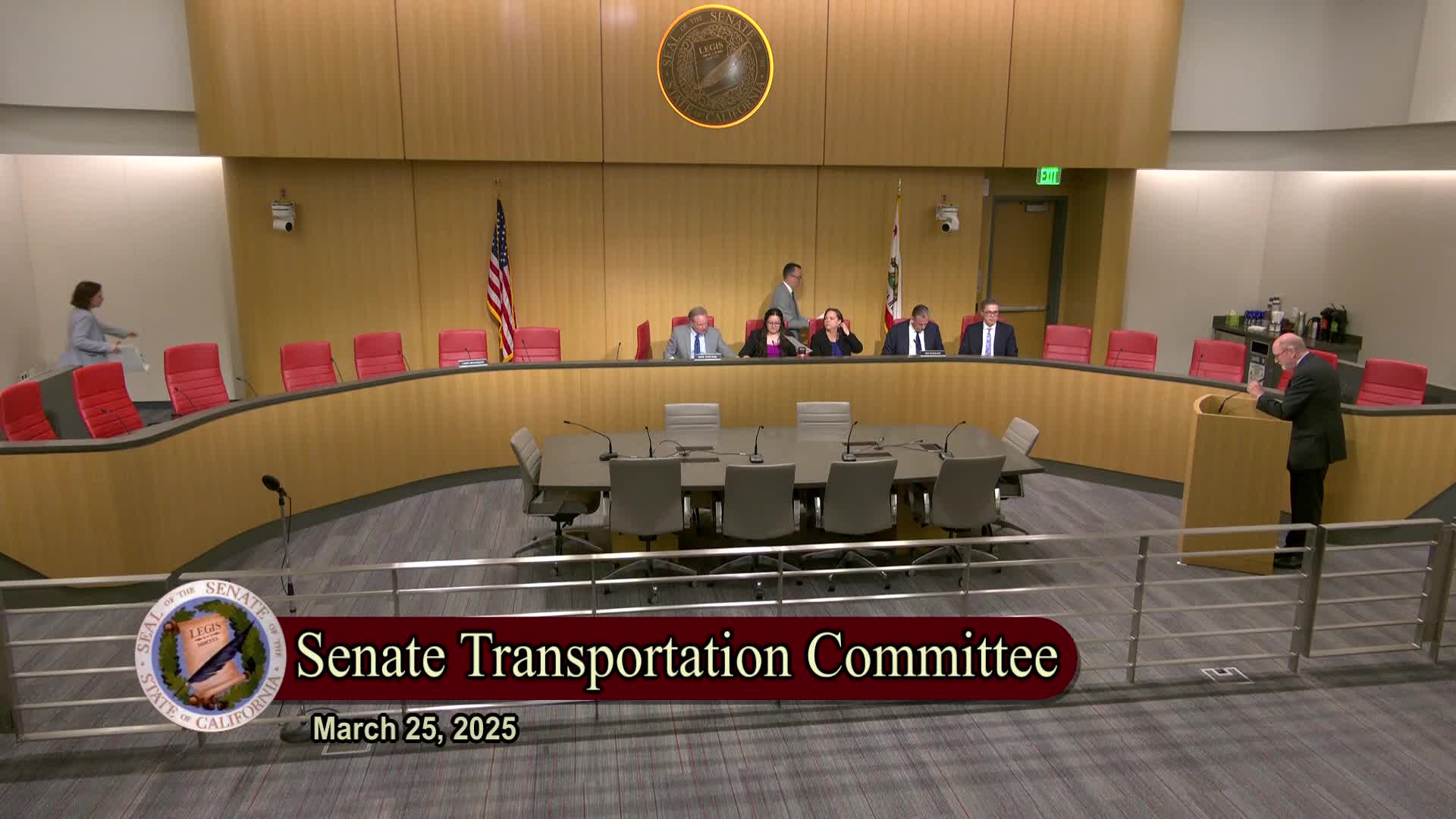
Senate panel advances bill to create highway signage fund aimed at name equity
Summary
Sen. Laird’s SB 467 would create a Highway Signage Fund to help cover costs of naming signs after underrepresented people; committee advanced the bill as amended and kept it on call pending absent members.
Sen. Hannah-Beth Jackson Laird presented Senate Bill 467 to a Senate committee, proposing a Highway Signage Fund to address an imbalance in who is memorialized on California roads.
The bill’s lead author told the committee that roughly 82% of highways, roads and bridges named in California currently honor men and that the fund would provide money to help pay for signage when a naming resolution is approved. Senator Laird said the fund would not change the existing approval process — naming would still require the usual legislative resolutions — and that the measure includes no state appropriation. “Signs cost between $8,000 and $10,000 whenever there’s a naming,” she said.
The bill’s sponsor said staff are discussing implementation with Caltrans and the State Controller’s Office to ensure the fund could be implemented. Senator Loehr offered a technical amendment renaming the account the “Highway Signage Fund.” Committee members questioned whether private fundraising already covers these costs in most cases. One member said public-safety organizations and unions typically raise funds for signage and challenged whether a state fund is necessary. Other members replied that private fundraising can be difficult in lower‑income communities and that the fund would address an equity gap for nominees who lack private fundraising capacity.
Committee staff and members confirmed the measure does not appropriate money but establishes a mechanism for private contributions into a fund that could be used if the Legislature or an appropriating body chose to allocate funds. After discussion the committee put the bill on call pending absent members; at the time the motion to pass as amended to the Committee on Appropriations carried on the record with a 6-2 vote (chair aye, vice chair no), and later procedural steps kept the bill on call for final tally and absent-member votes.
Votes at committee: motion to pass as amended to the Committee on Appropriations (tally recorded in committee as yes:6 no:2). The committee recorded that the bill remained on call to allow absent members to be added to the roll before final action by the full Senate.