Get Full Government Meeting Transcripts, Videos, & Alerts Forever!
Get email alerts on the Pension Investments topic
No spam. Unsubscribe anytime.
Committee splits on amended bill to allow in-state investments, restrict direct Chinese holdings
Summary
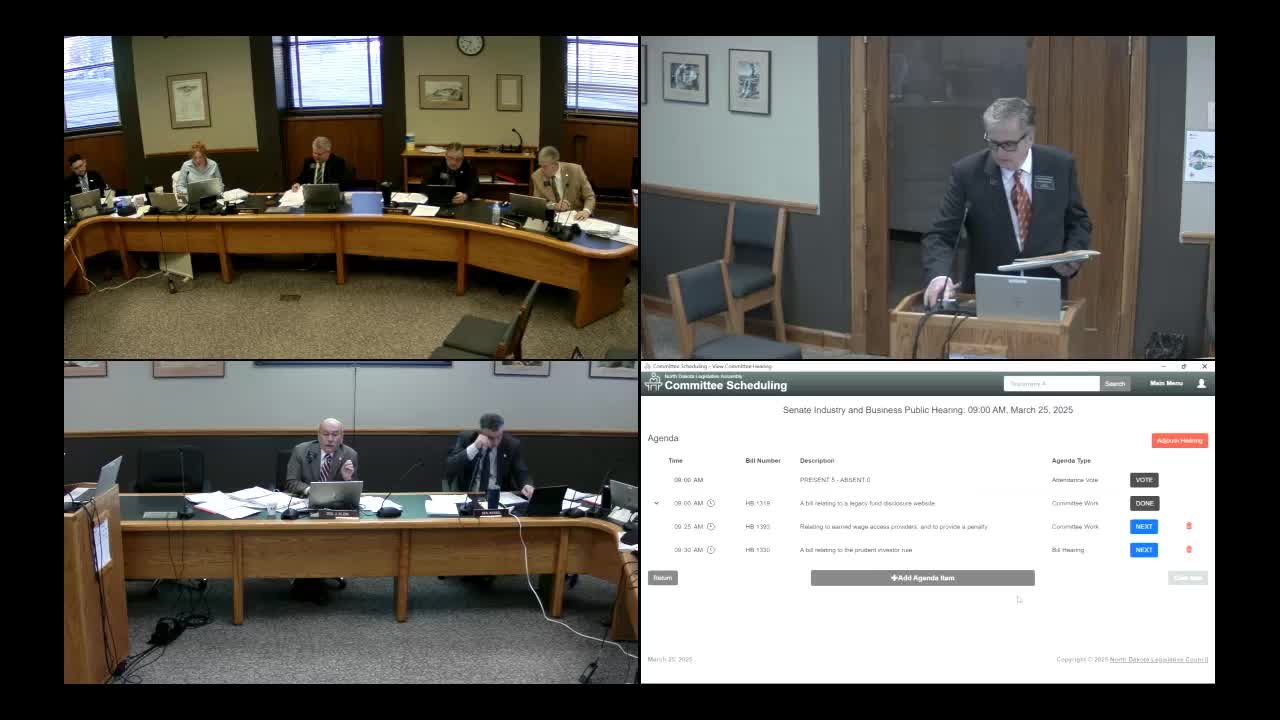
The Senate Industry and Business Committee voted to recommend a do-pass on an amended House Bill 1330 after debating changes that would allow some large in-state investments while restricting direct Chinese holdings; the committee's final vote was 3-2.
The Senate Industry and Business Committee heard extended testimony on House Bill 1330, a bill that would change how the legacy fund's investments are governed under the prudent-investor framework, add authority for certain large in-state infrastructure and "primary-sector" business investments, and permit divestment from direct investments in specified Chinese companies.
Representative Bern (Representative Satrim) introduced the concept as a two-part approach: curbing certain direct Chinese investments while giving the State Investment Board (SIB) and the Legacy Advisory Board additional flexibility to invest in projects and businesses in North Dakota. "What I'm gonna be proposing to you is a couple of amendments to a really good bill," Representative Satrim told the committee. He said the goal is to help develop in-state businesses and infrastructure and to give the boards additional discretion to invest in projects that could retain capital and jobs in North Dakota.
State investment office testimony: Jody Smith, interim executive director of the Retirement and Investment Office, described the existing in-state investment program and the practical limits of excluding China from commingled funds. She testified that direct investments in Chinese companies account for about $22 million of the office's $24 billion portfolio and cautioned that excluding China more broadly (for example, by changing definitions that capture commingled funds) could expand the exclusion to billions of dollars of holdings. "Due to the size of the Chinese economy and exposure to the markets and the prominence in this matter of major indexes, it is difficult as a fiduciary to exclude China completely from our portfolio," she testified.
Smith also explained mechanics of the in-state program: since 2021 more than $450 million has been committed to 40 North Dakota businesses and communities through matching and other programs; the legacy fund has committed funds through the Bank of North Dakota and the North Dakota Growth Fund (managed by 50 South) and works with qualified managers to vet direct investments.
Scott Anderson, the Retirement Investment Office's chief investment officer, described the prudent-investor standard and how diversification and portfolio-level analysis determine whether a large in-state investment would be prudent. He said the legacy advisory board previously set limits (for example, typical in-state investments capped near $10 million with a few larger exceptions) to protect diversification. The proposed amendment would permit a larger, single infrastructure investment if both boards deemed it beneficial.
Concerns and trade-offs: Committee members asked whether codifying country-based exclusions or adding more prescriptive language would handcuff future boards and whether changes could reduce returns. Smith and Anderson said the advisory board already has authority to direct divestment of direct investments (and that the current $22 million is a modest slice of the legacy fund). Anderson warned that codifying country-level limits can restrict managers' opportunity set and potentially reduce returns. State Treasurer Thomas Beadle, who serves on the advisory board and the State Investment Board, echoed the point that placing restrictions in statute can limit managers and that any handcuffs run the risk of lowering potential returns.
Committee action: The committee first voted 5-0 to adopt an amendment (the committee recorded the amendment vote as 5-0). Later, after debate and a newly added sunset clause proposed in committee, members voted on a do-pass motion for the amended bill; the roll-call recorded two "No" votes (Senator Klein and Senator Kessel) and three "Aye" votes (Chairman Barta, Vice Chair Baim and Senator Inghitt), yielding a 3-2 do-pass recommendation. Senator Anget was named the carrier.
Why it matters: The legacy fund is a large, state-managed sovereign wealth fund whose earnings help finance state government. Lawmakers and board members balanced concerns about ethical or geopolitical risks from certain foreign investments against fiduciary duties to maximize return per unit of risk. Testimony emphasized that the existing approach focuses divestment on direct investments while leaving commingled index exposure intact unless further action is specified.
Ending: The bill will advance based on the committee's 3-2 do-pass recommendation. Committee members and agency witnesses flagged follow-up topics the Legislature may address in later sessions, including precise definitions of "primary-sector" investments, guardrails for in-state investments, and whether any statutory restrictions should include a sunset review period.