Get Full Government Meeting Transcripts, Videos, & Alerts Forever!
Get email alerts on the Education topic
No spam. Unsubscribe anytime.
Committee backs bill to exempt Center for Distance Education from some OMB procurement and forms rules
Summary
House Bill 12‑69 would place into statute a procurement exemption for the North Dakota Center for Distance Education that lets the center buy educational content and education technology for virtual K‑12 delivery without following certain OMB competition rules, while preserving IT security and contracting oversight.
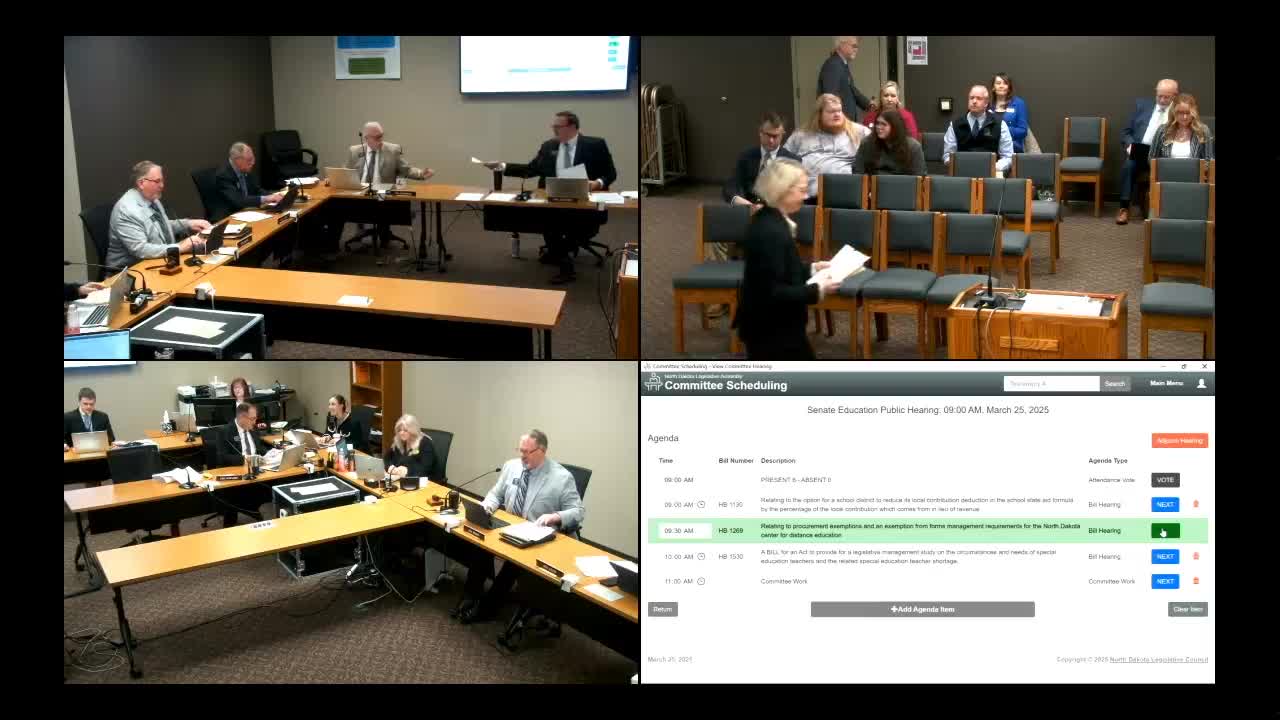
Representative Cynthia Schreiberbeck introduced House Bill 12‑69, which would exempt the North Dakota Center for Distance Education (NDCDE) from certain Office of Management and Budget (OMB) procurement competition requirements for educational content, educational technology tools, and related services used to deliver K‑12 virtual instruction. "The bill eliminates the OMB procurement requirement for contracts by the North Dakota Center for Distance Education for educational content, educational technology tools, and related services for virtual delivery of education to students in kindergarten through grade 12," Representative Schreiberbeck said.
Dr. Alyssa Martin, state director for NDCDE, testified the bill is intended to speed contracting and to reflect the practical realities of virtual course delivery. She told the committee the exemption would not remove state IT security vetting or other core contracting requirements: "This first of all does not exempt us, from third party security reviews. ... We will continue to do that under this bill," Dr. Martin said. She said long procurement timelines — sometimes six months to a year — and a limited vendor pool for highly specialized integrations can delay access to curriculum and tools, including AI‑powered tutoring tools and frequent LMS updates. The bill would also exempt NDCDE from the statutory definition of “state forms,” which the center said can conflict with how student assignments and coursework are handled in learning management systems.
Chad Keach, state procurement officer at OMB, testified in support and said the engrossed bill modernizes an earlier administrative exemption granted in 2013 by placing the exemption into statute and narrowing it to educational content and technology for virtual delivery. Keach said the House amendment limited a broader original exemption to ensure NDCDE would still comply with state IT laws and standards.
Why it matters: supporters said the changes let NDCDE procure specialized vendors and deploy updates more quickly while preserving security and contract review. Dr. Martin described a recent example where procurement for an AI tool consumed months and delayed teacher training and student rollout. Keach told the committee the engrossed bill ensures NDCDE remains subject to information‑technology and security requirements even when procurement competition rules do not apply.
Committee action: after testimony from the sponsor, NDCDE and OMB representatives, the committee voted to report the bill favorably from committee. Committee members said they supported the limited, targeted exemption and praised the negotiated amendment language that preserved IT oversight.
Ending: the committee recorded a due‑pass recommendation and selected a committee member to carry the bill forward. Supporters asked the committee to adopt the engrossed amendment that narrows the exemption and retains compliance with state IT statutes.