Get Full Government Meeting Transcripts, Videos, & Alerts Forever!
Get email alerts on the Education topic
No spam. Unsubscribe anytime.
Bill would let school districts use in‑lieu revenues to reduce local contribution for building projects
Summary
House Bill 11‑30 would give school districts an option to count in‑lieu revenues toward the local contribution deducted in the state school aid formula when the money is used for construction, potentially shifting how state aid and local levies interact for districts that have passed bond referendums.
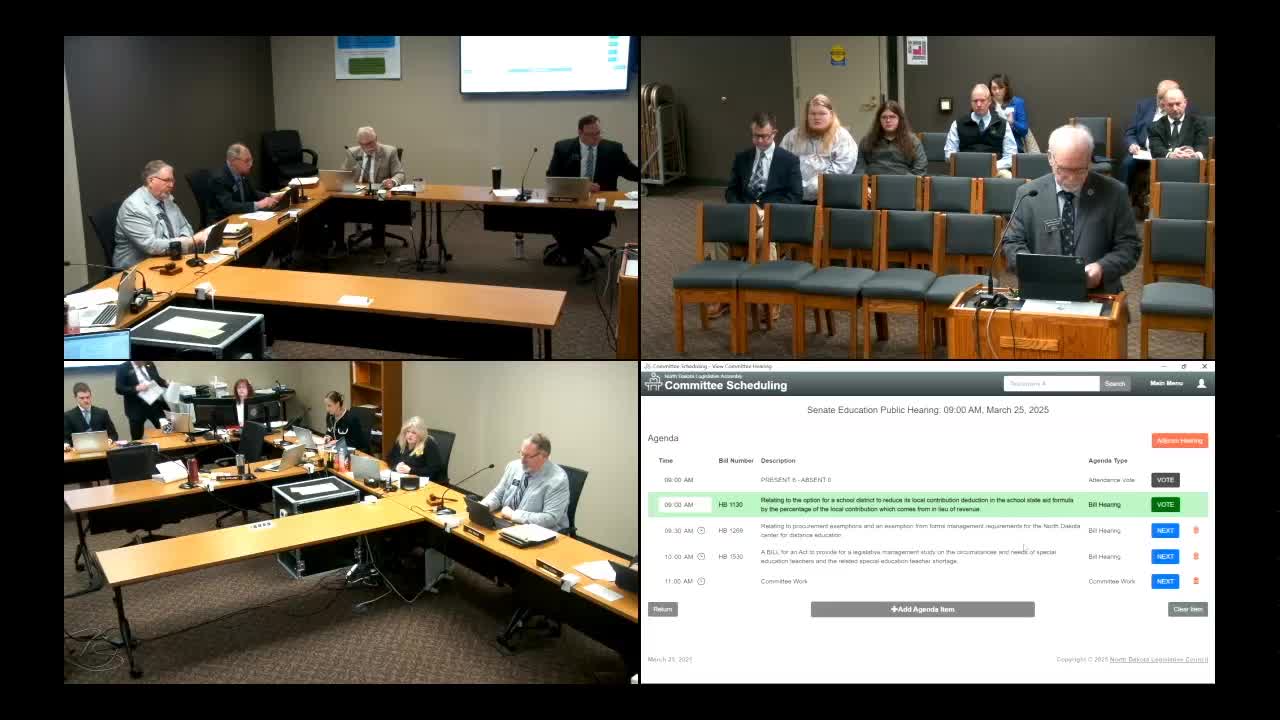
Representative David Richter introduced House Bill 11‑30 to the Senate Education Committee, saying the measure offers school districts a second option for calculating the local contribution used in the state school aid formula when those dollars are used for construction. "House Bill 11‑30 comes out of the presentations and discussions with the interim school task force," Richter said as he described the proposal.
The bill would allow a district that passes a bond referendum to elect, for construction projects, to reduce the local contribution deduction by the share of its local contribution that comes from in‑lieu revenues (payments made to districts based on production rather than property valuation). Under current law districts use sinking and interest (bond) mill levies for certain deductions; HB 11‑30 would let districts choose either the existing sinking‑and‑interest‑based method or the new in‑lieu‑based calculation.
Why it matters: supporters say the change lets production‑based revenues (for example, certain oil, gas, telecommunications, or mobile home payments classified as in‑lieu revenue) be used to support voter‑approved construction without an equivalent reduction in state support. Steve Holden, superintendent of Mackenzie County School District No. 1 in Watford City, testified in favor and described the bill as, in practice, a form of property‑tax relief for construction: "It it's property tax right now that is unable to be leveraged at the local level, without getting subtracted at the state level," Holden said.
How it would work: the bill calculates the percentage of a district’s total local contribution that is in‑lieu revenue and permits that percentage to be deducted for eligible building projects. Representative Richter walked the committee through sample district calculations in the handout he provided, showing example percentages that ranged widely by district (for example, one sample showed a 56.27% figure used in an illustration). Richter told the committee that roughly 60 districts have already passed bond referendums and would be eligible now and that the new option would likely affect 28–30 of those districts based on the fiscal note analysis.
Implementation questions and limits: committee members asked whether districts would be able to switch between option A (the existing sinking‑and‑interest method) and option B (the in‑lieu method) frequently. Richter said the calculation process makes annual switching impractical and that any minimum lock‑in likely would be at least a biennium — but he also said that a specific lock‑in provision was not written into the bill and would require an amendment. Committee members also asked how the bill would interact with a separate bill (House Bill 13‑81) altering the percentage used later in the aid formula; Richter said HB 13‑81’s percentage applies after the deductions in HB 11‑30 are computed, so HB 13‑81 would not change whether HB 11‑30 is calculated but HB 11‑30 would change the base to which HB 13‑81 is later applied.
Fiscal context and distribution: witnesses and the sponsor noted the fiscal note and its potential state cost; a committee member referenced a fiscal note dated Dec. 5. Richter and witnesses emphasized HB 11‑30 applies only to construction (sinking and interest debt) and is not an operating appropriation. They also said that results would vary by district: some large western districts that already have high sinking‑and‑interest mill levies would not take the new option because the existing sinking‑and‑interest deduction is more advantageous for them.
Public testimony: superintendent Steve Holden and others testified in support, stressing the difficulty districts face in aligning production‑based revenues with bond mill calculations and saying the bill helps equalize access to construction funding without changing operating dollars.
Status: the hearing concluded with questions but no committee vote recorded at this hearing. Committee discussion noted implementation details (lock‑in period, calculation timing) remain unsettled and may require amendment language.
Ending: committee members asked staff for lists of affected districts and for the fiscal detail that underpins the sample calculations. Sponsors and supporters signaled willingness to add clarifying language, particularly about the minimum period a district must remain on a chosen option.