Get Full Government Meeting Transcripts, Videos, & Alerts Forever!
Get email alerts on the Child Welfare topic
No spam. Unsubscribe anytime.
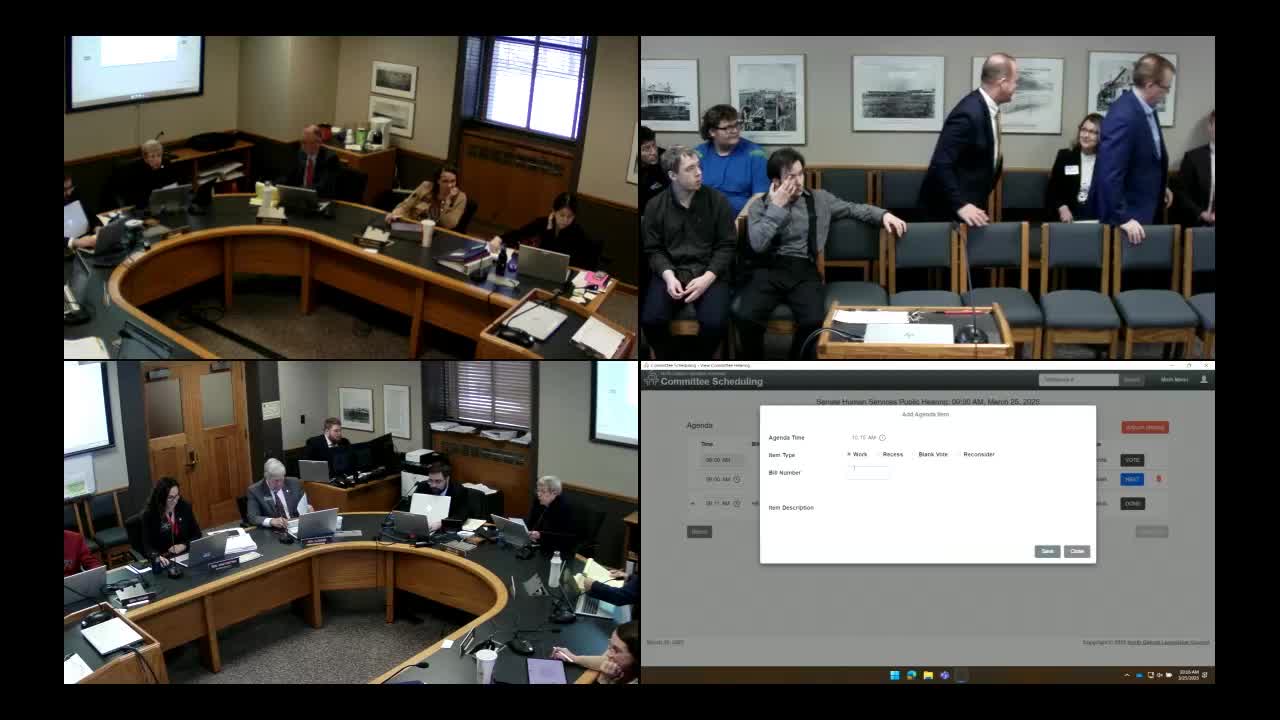
Senate committee weighs CPS liaisons in schools and mandated‑reporter training; zones and schools caution on confidentiality and funding
Summary
The Senate Human Services Committee spent an extended hearing on proposals to station Child Protective Services liaisons in school districts and to revise mandatory‑reporter and youth behavioral health training for school staff.
The Senate Human Services Committee spent an extended portion of its hearing on two connected child‑welfare topics: House Bill 1095, which would allow school districts to designate Child Protective Services (CPS) liaisons stationed in school districts, and House Bill 1562, which would change mandatory‑reporter training requirements and tie the training to teacher licensure renewal.
Jonathan Alton, chief legal officer for the Department of Health and Human Services, presented an amendment that tightened several provisions and clarified roles. "We did put 'qualified' just to allow for the school districts to still determine who would this person would be," Alton said, describing changes that remove some language about schools assisting with CPS investigations and narrow reporting to "confirmed decisions" to avoid unnecessary disclosures.
Kim Jacobson, director of Agassiz Valley Human Service Zone and president of the North Dakota Human Service Zone Directors Association, said the zone directors oppose the bill in its current form and support several of the proposed amendments but remain concerned. "House Bill 1095 is unnecessary," Jacobson told the committee, arguing the bill would not allow zones to share information they are barred from sharing by federal and state confidentiality laws and that it would create unfunded duties for school districts.
Jacobson said primary concerns include:
- Funding and staffing: The bill permits school districts to designate liaisons but does not allocate funding or limit the number of liaisons, leaving districts to bear costs. - Confidentiality and data privacy: CPS staff said federal privacy rules and state statute limit what they can disclose; even de‑identified summary reports may risk re‑identification in small districts. Jacobson recommended caution about public district reports that could inadvertently disclose family identities. - Role clarity and systems conflict: Zones and DHHS said a liaison cannot substitute CPS investigative work. CPS must speak to the reporter and gather direct information; a liaison's hearsay cannot replace that process.
Committee members and witnesses agreed training is central to improving coordination. The committee discussed House Bill 1562, which would require the mandatory‑reporter training be documented at initial licensure and at renewal (every five years) and would permit school districts to provide a minimum of eight hours per biennium of professional development on youth behavioral health and child abuse and neglect. Kim Jacobson and other zone representatives supported stronger, practical local training and suggested a one‑page "what to expect" handout for mandatory reporters.
Alton summarized the department's edits to the liaison bill, explaining the amendment removes language that would have invited school personnel to assist with CPS investigations and instead focuses on contact points and coordination. He also proposed limiting public reporting to de‑identified summaries and relying on existing statewide training references.
Several senators noted that a lack of local relationship building between schools and human service zones — exacerbated by the shift to online training and post‑pandemic staffing changes — has reduced informal collaboration. Committee members suggested the children's cabinet or existing zone boards might be better vehicles to address system coordination and training than a statutory liaison requirement.
No formal votes were taken on either bill during the hearing. Committee members indicated they wish to coordinate the two measures: one to strengthen mandatory‑reporter training content and another (or a different vehicle) to explore how to improve school‑zone coordination without violating confidentiality law or imposing unfunded mandates.
Key points from witnesses and the department
- The department proposed amendment language to narrow liaison duties, require contact information be shared with zone directors, and limit public reporting to de‑identified data. - Zone directors urged caution: a liaison cannot force CPS to disclose protected information and could create expectation gaps if schools believe they will get case updates they are not entitled to. - Training revision (HB 1562) would shift some annual training to licensure renewal and add youth behavioral health topics; witnesses suggested pairing statewide online training with locally coordinated follow‑up facilitated by zones.
Next steps
Committee members asked staff to compare HB 1095 and HB 1562 and return with drafting options that preserve confidentiality, identify funding sources or clarify permissive rather than mandatory duties, and specify training content and delivery methods.