Get Full Government Meeting Transcripts, Videos, & Alerts Forever!
Get email alerts on the Tax Increment Financing topic
No spam. Unsubscribe anytime.
Portland committee hears community calls to reform tax-increment financing, weigh alternatives
Summary
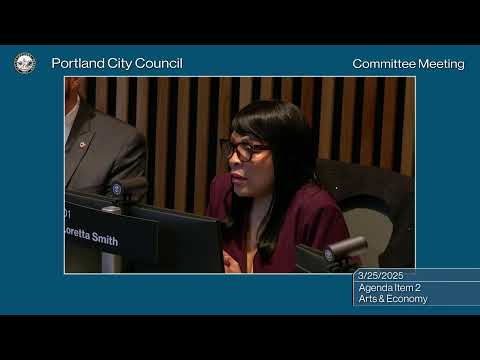
Portland’s Arts and Economy Committee on March 25 opened a broad discussion of tax-increment financing, a financing tool city and regional agencies have used to fund development projects, as community groups urged changes to prevent displacement and to increase public oversight.
Portland’s Arts and Economy Committee on March 25 opened a broad discussion of tax-increment financing, a financing tool city and regional agencies have used to fund development projects, as community groups urged changes to prevent displacement and to increase public oversight.
The committee heard sustained testimony from three community presenters—Amanda Pham Haines of Unite Oregon, Joy Elise Davis of Imagine Black, and Duncan Juan of Oppano (Jade District)—and from several public-comment speakers who called for enforceable community benefits, changes to state law, and local alternatives such as land banking and workforce investments.
The discussion centered on two competing framings of TIF. Amanda Pham Haines, statewide housing justice manager at Unite Oregon and director of the Anti-Displacement PDX coalition, told the committee that without meaningful oversight TIF “can and will reinforce the same cycles of displacement that Portland’s urban renewal policies have historically created.” She said the statutory framework and program materials are difficult for the public to access, and singled out Oregon Revised Statutes (ORS) chapter 457 as the source of TIF authority cited by Prosper Portland during earlier questioning. “If we can’t clearly articulate this tool’s impact, how can we tell a renter struggling with rising costs or a homeowner worried about their mortgage that TIF will benefit them?” Haines asked.
Joy Elise Davis, president and executive director of Imagine Black, said Portland’s history of urban renewal and TIF has disproportionately harmed Black Portlanders and that recent agency rebranding has not changed the law. “Until those intentions are codified into law, they remain fragile,” Davis said, urging the council to pursue state- and local-level changes that would codify anti-displacement protections, require legally enforceable community benefits agreements, and create community-led governance for TIF dollars.
By contrast, Duncan Juan, community development director at Oppano, described the Jade District’s micro‑TIF experience as a more positive, community-driven example. Juan said the Jade (J) District’s micro‑TIF covered roughly one square mile and amounted to about $1 million over 10 years; a community steering committee made the funding decisions for small-business grants, storefront repairs, placemaking and rapid repairs. Juan credited that locally governed approach with financing storefront improvements, rapid-repair grants and community events while leveraging other funding sources for affordable housing. He said the neighborhood has produced more than 200 units of affordable housing through a mix of funding sources, though none of those units were funded directly from the J District’s TIF pool.
Public commenters echoed the presentations. Tyler Fellini, executive director of Portland Jobs with Justice and a registered lobbyist, urged stronger public oversight of Prosper Portland’s TIF spending and cited an agency-commissioned assessment reporting a decline in BIPOC residents near the Interstate Corridor urban renewal area. Lynn Fulton of the Argye Terrace Neighborhood Association and the Park Rose Argye Opportunity Coalition said outer East Portland neighborhoods have been treated as an afterthought in prior urban renewal campaigns and called for workforce training and targeted local investment.
Committee members framed the topic as both urgent and complex. Councilor Dunphy noted Portland remains one of the few West Coast cities still using TIF and said outcomes matter more than theory. Councilor Clark and Chair Green discussed pursuing a committee-led fact-finding report from Prosper Portland, inviting outside experts, and exploring alternative tools including participatory budgeting, land banking and targeted workforce programs. Several councilors expressed interest in pursuing state-level changes to ORS 457 if local reforms prove insufficient.
No formal actions or votes were taken during the committee’s March 25 meeting. Committee members said they intend to continue the conversation, seek additional testimony from Prosper Portland and other bureaus, and consider producing a fact-finding report after the current budget cycle.
Ending: The committee concluded by scheduling follow-up work: further presentations, a request that staff coordinate a Prosper Portland briefing and consideration of how district-level governance, land banking, and workforce supports could be layered with TIF to reduce displacement risk. Committee members and presenters repeatedly stressed that any reform will require sustained interagency coordination and, if necessary, state‑level statutory changes to bind promises into law.