Get Full Government Meeting Transcripts, Videos, & Alerts Forever!
Get email alerts on the Juvenile Justice Capacity topic
No spam. Unsubscribe anytime.
Lawmakers Hear from Courts and Providers on Juvenile-justice Bed Shortages, Out-of-state Placements
Summary
Witnesses told the House Appropriations Subcommittee on Human Services that Michigan has available beds but uneven access and coordination, leaving some youths months in detention and requiring occasional out-of-state placements.
The House Appropriations Subcommittee on Human Services heard testimony on juvenile-justice capacity and placement coordination from court officials and nonprofit providers who said systemwide frictions are leaving youths in detention for months while they wait for appropriate treatment beds.
Cameron Clark, of Family Court Administration at Leelanau County Family Court, told the committee that state placement processes are centralized and often slow. “They kind of sit on their high throne and tell us what's best for our kids,” Clark said, adding that delays can leave youths “6 to 12 months in a detention facility awaiting a bed for treatment.” Clark described Northern Michigan as a “services desert” and said counties or courts themselves, rather than state-contracted private providers, often have unused bed capacity that is not being tapped.
Why it matters: extended detention stays interrupt education, treatment and case progress and can push youths past juvenile-court age limits, forcing judges to decide whether to place them in juvenile facilities after they turn 18 or to close cases. Committee members pressed witnesses on how to measure need, how lists of available beds are updated and who can be held accountable for matching youth to the right program.
GrowthWorks CEO Nick Griswold described a Wayne County model in which five nonprofit agencies provide probation and placement services for different geographic areas. Griswold presented county-level data showing sharp declines in some statewide metrics from 1999 to early 2023: he said recidivism measures that once ranged “between 38 and 56 percent” were 3.9 percent as of 02/2023, and placements in state training schools dropped from roughly 731 youth per day in 1999 to about 10 in 02/2023. He also said out-of-state placements that once numbered in the hundreds have fallen to near zero, though his agency recently used an out-of-state provider (Buckeye Ranch in Ohio) after concluding vetted in-state options could not meet a youth’s needs.
Griswold emphasized two related points: not all beds are interchangeable, and bed-count increases alone may not help youths who need highly specialized programming (for example, sexually problematic behaviors, traumatic brain injury treatment or intensive mental-health services). He told lawmakers that some in-demand facilities maintain long wait lists and that detention lengths for youngsters on wait lists can be long: the committee heard an example of an average detention length of about 180 days for youths waiting on a secured treatment wait list, with two youths on the list exceeding 530 days "and counting." Griswold described the local screening GrowthWorks performed before placing a youth out of state — including site visits, interviews and review of licensing and corrective-action histories — and said family access and post-care coordination were central concerns when out-of-state placement was considered.
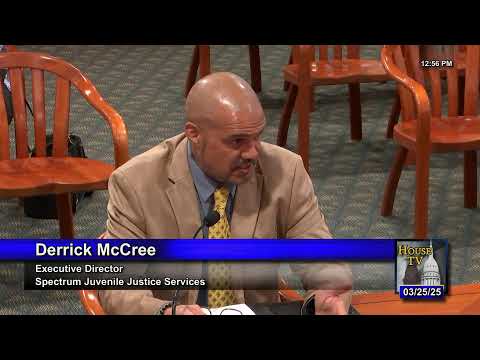
Derek McCree, executive director of Spectrum Juvenile Justice Services, described operations at two secured facilities his organization runs in the Highland Park area. He said the sites are licensed for roughly 80 beds each, with a stated functional capacity of about 130; at the hearing he said they had about 101 youth in care and room for approximately 29 more. Spectrum offers on-site education, psychiatric services, and evidence-based therapies (including cognitive behavioral therapy and dialectical behavior therapy) and, McCree said, attempts to tailor treatment and reintegration supports rather than treating detention as punishment.
Committee members asked practical questions about coordination with the state Department of Health and Human Services (DHHS), auditing of county childcare funds and the technical work of matching youth to appropriate beds. Representatives pressed on whether a real-time bed list exists and how reliably providers update availability; witnesses said a statewide list has been discussed and reportedly exists in some form but cautioned that it is only as accurate as the providers who update it.
The committee recorded one formal procedural action: without objection, it approved the minutes of March 18.
What’s next: Chair Roth said DHHS was not present at this hearing and asked the department to follow up at a future meeting to explain the statewide bed-list process and related funding and oversight. Witnesses requested clearer, faster placement pathways and more specialized, community-based programming so youths who need treatment do not remain in detention while awaiting the right placement.
The testimony underscored three recurring themes: (1) available capacity is unevenly distributed and sometimes locked to certain operators or counties, (2) not all beds match youths' clinical needs, and (3) delays in placement are producing prolonged detention stays that frustrate courts and families.