Get Full Government Meeting Transcripts, Videos, & Alerts Forever!
Get email alerts on the Law Enforcement Workforce topic
No spam. Unsubscribe anytime.
Minnesota lawmakers unveil Law Enforcement Scholarship Act to address officer shortage
Summary
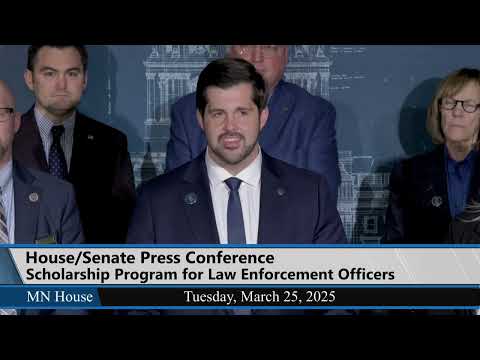
Minnesota lawmakers on a joint bipartisan platform outlined the Law Enforcement Scholarship Act of 2025, a proposal to create scholarships for licensed police officers and certain dependents to pursue degrees in law enforcement or criminal justice at campuses in the University of Minnesota and the Minnesota State Colleges and Universities system.
Minnesota lawmakers on a joint bipartisan platform outlined the Law Enforcement Scholarship Act of 2025, a proposal to create scholarships for licensed police officers and certain dependents to pursue degrees in law enforcement or criminal justice at campuses in the University of Minnesota and the Minnesota State Colleges and Universities system.
Representative Dan Wolgamott, co-chair of the House Higher Education Finance and Policy Committee, summarized the bill and the intent behind it: "right now, Minnesota is facing a law enforcement workforce shortage that directly impacts the safety and security of our communities." He said the legislation is modeled on a program in Nebraska and was "just introduced yesterday" in the Senate and will be heard in committee.
The proposal would make scholarships available to three groups: licensed police officers; dependents of licensed police officers; and dependents of officers with a 100% permanent duty disability. "There are three main criteria of people who are eligible for this scholarship," Wolgamott said. The scholarship would cover tuition on a semester-by-semester basis for degree or program work related to law enforcement or criminal justice, with renewal and other administrative details to be set by the Office of Higher Education.
The bill’s sponsors and supporters framed the measure as part of a response to staffing shortages. "Right now, there are over a thousand open positions in law enforcement," Wolgamott said. He added that about 2,700 officers are in the 50-to-55 retirement-age band, a figure he said contributes to the urgency. Mark Ross, president of the Saint Paul Police Federation, said the program would help recruitment and retention: "This program is gonna go a long ways for recruitment and retention of police officers in the state of Minnesota," he said.
Sponsors described the program’s goals as threefold: attract new officers to Minnesota, retain officers approaching retirement, and encourage education among the next generation of law enforcement. The scholarship would allow current officers who hold two-year degrees to pursue baccalaureate degrees; sponsors noted departmental promotion practices and some local incentives make a four-year degree valuable for career advancement.
Key program details are unresolved. Wolgamott and other sponsors said the number of awards and whether the program is launched as a pilot or with broader funding will depend on higher-education budget targets and negotiations. "We don't have a fiscal note yet," Wolgamott said. He described the proposal as "scalable" and said the program’s scope may change as legislators determine the higher-education target and funding availability.
On service commitments, sponsors said the bill does not require recipients to remain employed by Minnesota police departments after receiving scholarship support. "No, there's no requirement for that," Wolgamott said, adding that such requirements are difficult to enforce and that historically the majority of graduates from Minnesota institutions tend to remain in the state.
Committee process and comparisons to Nebraska were discussed but data on outcomes in Nebraska was described as limited. Wolgamott and Mark Ross said anecdotal reports indicate some retention benefits in Nebraska, but exact statewide metrics were not available. Ross said individual campuses track results differently.
Speakers also detailed where shortages are largest. Ross said Minneapolis police were "probably down 400 police officers," St. Paul down about 70, and statewide shortfalls including deputies, troopers and conservation officers total about 1,000. Wolgamott estimated Minnesota currently has "probably about 9,500 sworn cops — a little under 10,000," and said the state could face an additional gap of roughly 2,500–2,700 officers over five years if trends continue.
Next steps for the bill include hearings in higher-education committees and negotiations over budget targets. Sponsors urged public support while acknowledging the state budget constraints facing the 2025 Legislature.
Votes or formal committee outcomes were not taken at the press event; fiscal and award-volume details remain to be developed in the legislative and budgeting process.