Get Full Government Meeting Transcripts, Videos, & Alerts Forever!
Get email alerts on the Sports Tourism topic
No spam. Unsubscribe anytime.
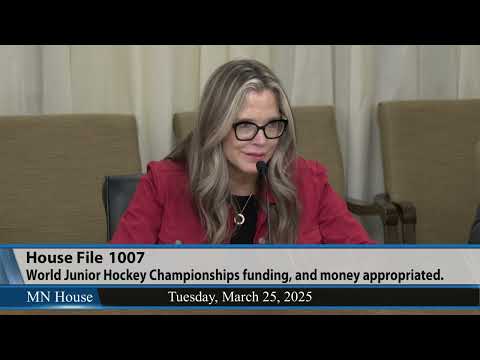
Committee Hears Request for $5 million to Support 2026 World Junior Hockey Championship in Minnesota
Summary
Lawmakers and event organizers urged the House Jobs and Economic Development Committee to approve a $5 million grant to Minnesota Sports and Events to help cover local costs tied to the 2026 IIHF World Junior Hockey Championship, citing possible $75 million economic impact and 250,000 attendees.
Representative Norris presented House File 1007 to the Minnesota House Jobs and Economic Development Committee, asking for a $5,000,000 grant to Minnesota Sports and Events to help pay local costs associated with the International Ice Hockey Federation's 2026 World Junior Championship, which will be played Dec. 26, 2025 through Jan. 5, 2026, at venues including the Xcel Energy Center and 3M Arena at Mariucci.
Committee members were told the event will include 29 tournament games, exhibition matches across seven Minnesota cities and training sites including the National Sports Center in Blaine. Organizers estimate about 250,000 spectators will attend and forecast an economic impact of roughly $75,000,000 for the state, with an expected $5,750,000 in state tax revenue based on recent comparable events.
Testifying in support were hockey veteran Lou Nanne, St. Paul Mayor Melvin Carter and Wendy Blackshaw, president and CEO of Minnesota Sports and Events. Nanne described the tournament as a “commercial for the state of Minnesota,” urging lawmakers to view the request as an investment rather than an expense. Mayor Carter said the event would showcase St. Paul and the state as a destination for world-class hockey and hospitality. Blackshaw told the committee the $5 million would cover event costs that remain in state — public safety, permitting, transportation, venue operations and local union labor — and that, if the grant is not provided, organizers would cover World Juniors with ticket revenue but might have to pause future bidding for other large events.
Committee members asked about how much of the estimated economic activity is driven by out‑of‑state visitors versus local spending. Blackshaw said the agency contracts the University of Minnesota to conduct economic-impact studies and that for other events, such studies showed a substantial percentage of tickets were purchased by out‑of‑state buyers (she cited 60% for a recent gymnastics event). Members also asked whether the $5 million figure is precise; Blackshaw said it is intended to pay event-specific expenses and that ticket revenue would fund remaining costs.
Representative Witte and Representative Norris emphasized the state’s hockey profile and argued the appropriation would sustain momentum from prior events and enable future bids for major competitions. Multiple members signaled support but noted the $5 million request comes amid tight state budgets.
The committee did not take a final appropriation vote during this hearing; the chair said the bill would be held over for further consideration.