Get Full Government Meeting Transcripts, Videos, & Alerts Forever!
Get email alerts on the Disability Employment topic
No spam. Unsubscribe anytime.
Minn. committee hears $2 million request to support 2026 Special Olympics USA Games
Summary
Representative Wayne Johnson asked a Minnesota House committee to consider House File 2258, a request for $2 million in state funding to support the Special Olympics USA Games, which are scheduled for late June 2026 and will be hosted in Minnesota.
Representative Wayne Johnson asked a Minnesota House committee to consider House File 2258, a request for $2 million in state funding to support the Special Olympics USA Games, which are scheduled for late June 2026 and will be hosted in Minnesota.
The bill would request $1.5 million from the general fund for event operations — including athlete housing and dining and the athlete experience — and $500,000 to support unified work activities aimed at increasing employment for people with intellectual and developmental disabilities, sponsors said. "Only 18.5 of people with intellectual disability are employed to the level of their ability," said Christie Sovereign, identifying workforce inclusion as a key off-field priority.
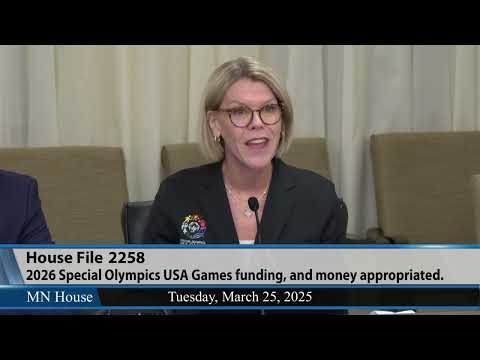
Sovereign, who introduced herself as CEO of the 2026 Special Olympics USA Games, said the event will host 16 sporting competitions and include three off-field priorities: athlete health and wellness, youth inclusion and athlete employment. The organizers plan two unified work forums for corporate partners, a forum for athletes and families focused on skills such as resume writing and interviewing, and a pop-up store at the Mall of America intended to provide unified work opportunities and public visibility for the effort. "Our hope is to enable and educate what is required to create meaningful work," Sovereign told the committee.
Eric Anderson, who introduced himself as "a proud athlete of Special Olympics Minnesota" and said he has worked for Special Olympics Minnesota for more than 12 years, told the committee he supports the unified work summit and said the Games can "shine a light on abilities of the people who have intellectual disabilities."
Committee members asked organizers what would happen if the state appropriation was not approved. Sovereign said organizers would prioritize athlete housing, dining and the athlete experience if total funds were not raised, but some ancillary or legacy activities — such as higher-profile opening-ceremony talent or off-time events in Athlete Village — could be scaled back. Organizers said roughly 10% of the Games' budget is the state request and about 90% is expected to be privately raised.
Sovereign also said the Games are expected to produce significant economic activity in Minnesota’s hospitality sector and provide a national platform for advancing inclusive-employment practices; organizers estimated the economic impact between $75 million and $100 million and said they expect more than 100,000 visitors during the final week of June 2026.
Representative Johnson recognized Representative Frazier for coauthoring the bill and asked that House File 2258 be "laid over for further consideration." The committee laid the bill over for further consideration; no final vote on an appropriation was taken.
Votes at a glance: House File 2258 — laid over for further consideration; no vote recorded.
Next steps: House File 2258 remains under consideration by the committee pending further action or a future scheduling of a vote.