Get Full Government Meeting Transcripts, Videos, & Alerts Forever!
Get email alerts on the Children Mental Health Terminology topic
No spam. Unsubscribe anytime.
House committee advances bill to replace 'emotional disturbance' with 'mental illness' in children's statutes
Summary
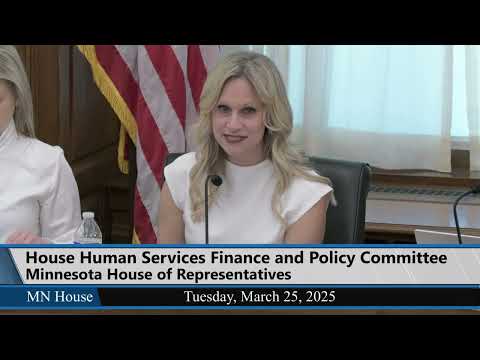
The House Human Services Finance and Policy Committee laid over House File 2,196 after adopting an author amendment that replaces the term “emotional disturbance” with “mental illness” across relevant statutes and substitutes child-welfare phrasing such as “out‑of‑home placement” with treatment‑specific terms.
The House Human Services Finance and Policy Committee on March 25 advanced legislation that replaces the phrase “emotional disturbance” with “mental illness” in multiple state statutes governing children’s behavioral health and clarifies terminology describing residential care.
Representative Tony Fisher moved House File 2,196 and successfully offered an A1 (author’s) amendment that removes statutory language deemed out of place and makes technical changes requested by the Department of Human Services. After members approved the amendment, the bill was laid over for possible inclusion in the committee’s omnibus package.
The bill does not change statutory criteria for services, sponsors and advocates said; instead it updates wording to reflect contemporary clinical language and to reduce confusion between special‑education categories and mental‑health eligibility. “Parents of children are no longer afraid of the term mental illness,” said Sue Abderholden, executive director of NAMI Minnesota, who testified in support of the change. She told the committee that the older phrase can be confused with the special‑education “emotional behavioral disorder” classification and that this confusion has prevented some families from obtaining appropriate treatment.
Testimony described a separate change in the bill that aims to remove child‑welfare phrasing such as “out‑of‑home placement” where children are placed in care to receive more intensive treatment. The bill instead uses clinical terms such as “residential treatment” and “therapeutic foster care” to distinguish children who leave home for mental‑health services from those placed because of abuse or neglect.
Supporters said the change is intended to make statutes clearer for families and for professionals working across systems. They noted historical barriers in which families seeking residential mental‑health services once had to file court paperwork or temporarily relinquish custodial authority; the bill updates statutory language to reflect more recent policy shifts that permit voluntary placements without entering the child‑protection system.
The A1 amendment modifies pages 47–50 (deleting identified sections) and also incorporates a technical change on line 1.3 that reflects DHS drafting assistance, according to Representative Fisher. The committee recorded no roll‑call vote; members answered “aye” to adopt the amendment. The full bill was then laid over for possible inclusion in the committee omnibus bill.
Committee members asked how the change would affect service delivery and interagency language consistency. Ms. Abderholden said staff and advocates reviewed instances of the old terminology across education and child‑protection statutes and updated references where “mental illness” is the intended concept. Representative Backer asked whether the change would improve service access; proponents said it clarifies language families and professionals use in everyday conversation and does not alter eligibility criteria.
The bill will return to committee as part of bill‑package negotiations. Supporters urged lawmakers to adopt the wording changes to reduce confusion across special education, child protection and children’s mental‑health systems.