Get Full Government Meeting Transcripts, Videos, & Alerts Forever!
Get email alerts on the Land Use Notice Reform topic
No spam. Unsubscribe anytime.
Tualatin staff propose expanded land‑use noticing options; council asks for more details
Summary
City planning staff reviewed state and local noticing rules and presented three enhanced options—double mailings to tenants, larger on‑site signs, and an improved projects website—while council members asked about costs, legal risk and social media. No code changes were approved at the work session.
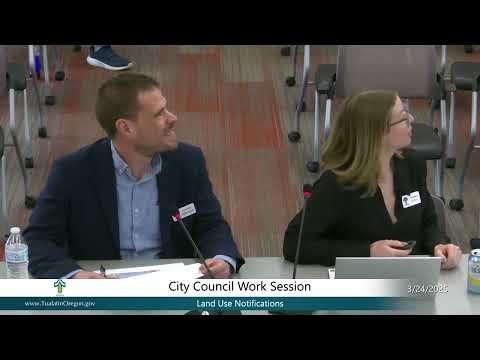
City of Tualatin planning staff reviewed the city’s land‑use noticing practices at a March 24 work session and presented three potential enhancements — expanded mailings to tenants, larger on‑site notice signs, and upgrades to the city’s land‑use projects website — while answering council questions about cost, legal risk and outreach reach.
The presentation was led by Steve Cooper, interim community development director, who said the state requires mailed notice to property owners within 100 feet but Tualatin’s development code (Chapter 32) currently mails to property owners within 1,000 feet and additionally notifies entire platted residential subdivisions. “The state rules required a mailed notice to property owners within 100 feet from the project site as determined through the most recent tax assessment roll,” Cooper said. Senior planner Erin Engman summarized how the city currently notifies by postcard mail, an on‑site sign, a projects webpage and (for hearings) a newspaper notice. “There are many reasons to provide land use notices,” Engman said, noting public involvement helps the city and applicants by surfacing local knowledge and perspectives.
Why it matters: Tualatin’s local radius is ten times the state minimum and can include entire subdivisions, producing widely different mailing footprints around a site and creating gaps where individual lots inside a subdivision are or are not included. Staff said the city’s broader practice reduces the risk of procedural challenge but also increases mailing volume and cost. Council members pressed staff on whether the city could make case‑by‑case adjustments to capture people who may be excluded by the subdivision rule; legal counsel warned that subjective standards could invite appeals to the Land Use Board of Appeals (LUBA).
Staff outlined three enhancements. Enhanced mailings (a so‑called “double mailing”) would send notices both to property owners on the tax rolls and to occupants at unit addresses (for single‑family, condominium and apartment units). Using a recent project as an example, staff said a standard mailing covered 391 property owner addresses, including 34 owners whose mailing address was outside Tualatin; a large multifamily project had more than 500 units inside the 1,000‑foot radius. Staff estimated an in‑house standard mailing cost roughly $300 in postage and took about 2.5 staff hours; outsourcing the standard mailing quoted about $570. An enhanced mailing for the example project would reach just under 1,500 notices, cost “a little over $1,100” and require additional staff time, staff said. Cooper and Engman warned that double mailings increase costs, add logistical complexity (especially for large apartment complexes) and can add several days to mailing timelines.
On signage, staff said the city’s current required sign is 18 by 24 inches (3 square feet). Enhanced signs similar to those used in Portland and other cities would be larger — examples presented included 4x6 or 4x8 feet, with Portland using about 4x5 — and are more visible but costlier for applicants and may be subject to vandalism or weathering. “At a minimum they at least alert people to the presence of something going on with the development,” Cooper said, while warning reliance on applicant‑installed signs creates a monitoring gap if signs fall over or are removed.
On web and email, staff described planned upgrades to the city projects page to allow interested parties to self‑subscribe and select the kinds of notices they want. Engman and Cooper said an enhanced website is low‑cost compared with mail and can reach people regardless of where they live, but it cannot be the only method because people must know to subscribe and emails may be filtered by firewalls. Council members asked whether social media could be used to drive people to the projects page; legal counsel advised that posting notices on social media is permissible but social media comments do not count as formal testimony on a pending land‑use application. “Those comments that are made in response to a social media post … would not technically count as testimony on a pending land use application,” counsel said. He also advised against creating subjective noticing standards because inconsistent application of such a standard could prejudice interested parties and increase appeal risk.
Council questions focused on frequency and annual cost (staff estimated roughly 20 to 24 notices a year that require mailed notice and suggested the department’s current annual postage budget is a few thousand dollars), whether notices are mailed more than once for an application (typically mailed once; staff said re‑noticing has been required rarely), and whether schools, neighboring jurisdictions and transportation agencies are notified (staff said school districts and agencies such as Washington County and ODOT are part of the coordination and that traffic impacts are scoped for study according to engineering practice). Several council members expressed support for larger signs and for exploring how to make the projects page easier to find and understand for average residents.
No code change or formal direction to adopt a specific enhanced noticing method was approved at the work session. Staff asked whether council was interested in pursuing any of the options and indicated they would return with more concrete cost and implementation details if directed.
Votes at a glance: At the end of the session the council approved two proclamations that were presented after the land‑use discussion — recognition of Vietnamese American Remembrance Day (April 30) and designation of April as Parkinson’s Awareness Month — and staff said both proclamations were approved. The land‑use noticing discussion generated direction to return with options rather than immediate policy changes.
Looking ahead: Staff said they will bring more detailed proposals, including draft sign standards, clearer cost estimates for a double‑mailing approach, and specifics on website subscription options and how notices would be presented and linked for easy sharing.