Get Full Government Meeting Transcripts, Videos, & Alerts Forever!
Get email alerts on the Energy Municipalization topic
No spam. Unsubscribe anytime.
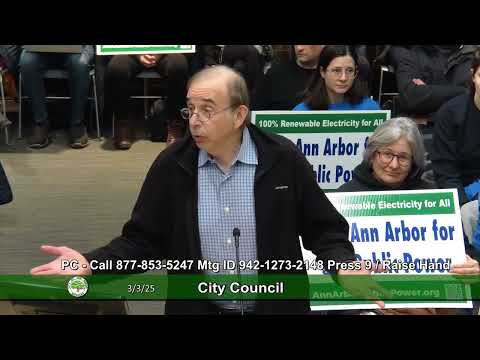
Ann Arbor council rejects funding for next-phase municipalization study; debate focuses on costs, equity and reliability
Summary
The Ann Arbor City Council voted down a request to fund a phase 2 study assessing purchase of DTE Electric assets, after extended public comment and council debate about cost, equity and timing amid federal funding uncertainty.
The Ann Arbor City Council on March 3 rejected a proposal to hire NewGen Strategies and Solutions LLC to complete a phase 2 electric-grid valuation and municipalization study, after weeks of public comment and more than two hours of council debate.
Proponents called for the study as a necessary independent analysis to determine whether municipal ownership could deliver greater reliability, faster transition to renewables and lower long-term costs. Opponents and some council members said the city cannot afford the study now and should prioritize immediate social services and existing climate programs.
Council member Maaz Malek, who supported the study, said it would provide essential information for any future voter decision on acquiring DTE’s local distribution assets. "Passing DC 1 and DC 2 tonight will help me make an informed decision on whether pursuing full municipalization is worth it," Malek said during debate. Supporters in the audience and callers told council that DTE’s outages, rate structure, and treatment of rooftop solar make municipal options worth studying.
Opponents pointed to uncertain legal, operational and financial risks. Council member Regina Disch, who voted no, said recent federal actions created a fiscal environment in which spending nearly $2 million on a study endangers funded programs that reduce emissions and help low-income residents. "The study before us is valued but can be postponed," Disch said.
The formal resolution before council (DC 1) would have authorized a $1,728,000 agreement to evaluate grid valuation and municipalization. The companion resolution (DC 2) would have authorized staff to perform preliminary work to prepare for a possible public vote and litigation. Both measures failed.
Public commenters supporting the study included residents who said outages and DTE's net-metering practices harm households and that municipalization or local control would prioritize resilience and equity. Speakers opposing or urging caution cited the high acquisition cost estimates from the city’s first-phase study, potential years of costly litigation, and the risk of diverting funds from homelessness services, energy-efficiency programs or other priorities.
Outcome and next steps: With DC 1 defeated on a 5–5 roll call (failing to reach the six-vote threshold needed), council did not authorize the phase 2 contract. Council members who opposed the measure said the topic will remain a live policy discussion but that the timing and funding approach require rethinking.
Votes at the meeting reflect continued council division on the issue and underscore community interest. Council members who voted yes on DC 1 were Maaz Malek, Yasmine Medina, Mayor Taylor, Gopal Iyer and Council member Watson. Council members voting no included Gazzi Edwin, Ackman, Cornell, Disch and Harrison. The motions to authorize staff preparatory work (DC 2) also failed.
The council did not adopt any new municipalization actions at this meeting; advocates said they will continue outreach and that citizen-led petitions or a future ballot initiative remain possible.