Get Full Government Meeting Transcripts, Videos, & Alerts Forever!
Get email alerts on the Cultural Plan topic
No spam. Unsubscribe anytime.
Dallas Office of Arts and Culture reports progress on 31-strategy cultural plan; committee urges clearer measurables
Summary
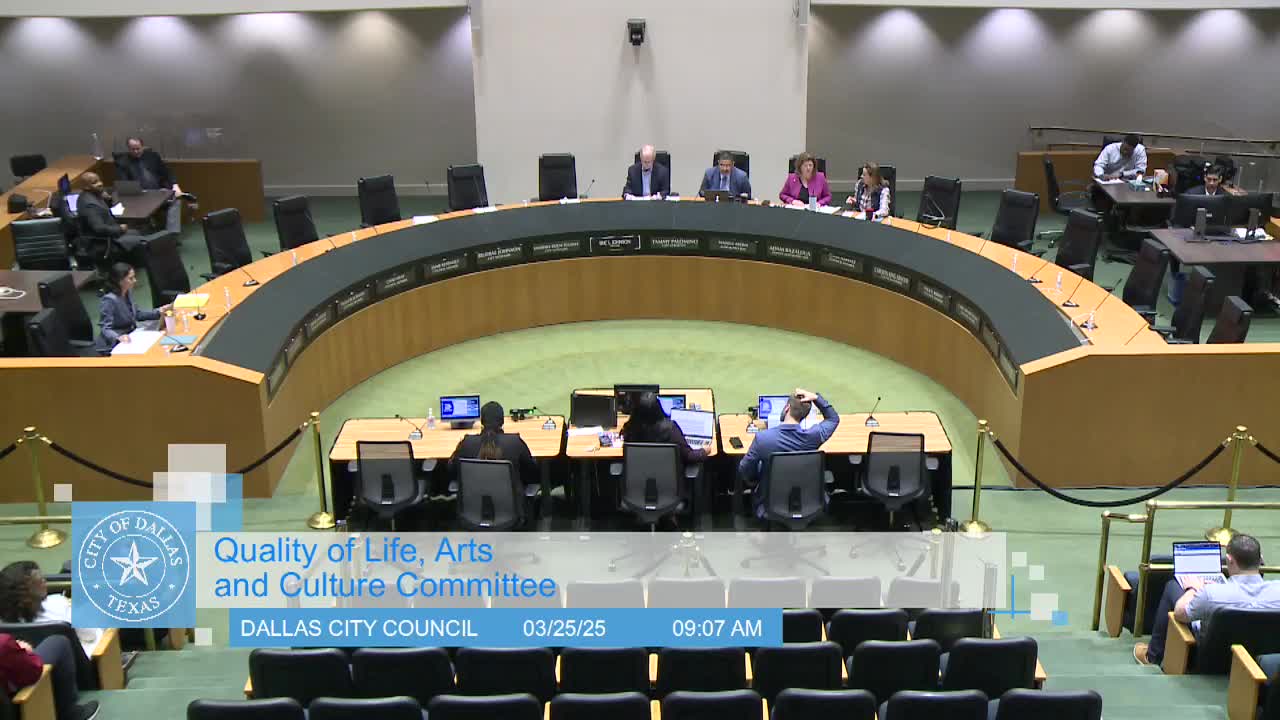
Office of Arts and Culture staff briefed the Quality of Life, Arts and Culture Committee on progress implementing the Dallas Cultural Plan, emphasizing equity targets, public art maintenance, and planning for a next-phase update; committee members asked for clearer metrics and suggested broader inclusion of hip hop and district-level strategies.
The City of Dallas Office of Arts and Culture (OAC) told the Quality of Life, Arts and Culture Committee on March 25 that it has implemented parts of the Dallas Cultural Plan adopted Nov. 8, 2018, and is preparing community engagement for a next-phase update.
Martine Philippe, director of the Office of Arts and Culture, said the 2018 Dallas Cultural Plan (DCP) was drafted through a yearlong process that engaged nearly 9,000 Dallas residents and is organized around six priorities and 31 strategies. “Our position is that we have accomplished what folks set out to accomplish when this plan became a policy in 2018,” Philippe said, and staff are preparing for a new iteration of the plan informed by community stakeholders.
OAC staff reviewed actions under the plan including the Arts Activate project-based funding program, a community artist program that supports free public programming, scoring criteria that encourage living wages and board diversity among grantees, expanded public-art engagement toolkits, and temporary public-art projects including an installation at Celebration of Life Park slated to open in April. The office said it is also revising fee structures at city cultural centers, pursuing public–private partnerships such as the Dallas Cultural Trail planning grant, and increasing its facilities maintenance budget following a 2024 bond proposition that allocated $75,200,000 for repairs to 15 city-owned cultural and performing arts facilities.
Staff highlighted policy and funding steps used to advance equity: the OAC said its Cultural Policy (2018) sets a goal that at least 40% of its cultural services funding go to organizations and artists serving communities identified as most in need; it also said administrative scoring now factors in living-wage and equity criteria when awarding grants.
Committee members asked for more measurable metrics tied to each strategy. “It would be great if we had them for each so that we can see,” said Council Member Schultz. Committee member Mister Resendiz suggested the plan do more to recognize hip hop. “Hip hop is such a significant, cultural force in the city,” he said, arguing the genre’s inclusion could broaden engagement.
Staff outlined three immediate next steps: work with an Arts and Culture Advisory Commission work group and community stakeholders to develop the plan’s next iteration (staff suggested a 3–5 year horizon), prioritize use of hotel occupancy tax funds for program impact (OAC said the city will move its hotel-occupancy allocation to 15% from the current 12.5% at the start of the next fiscal year), and collect committee guidance to shape implementation priorities for fiscal year 2026.
The committee received the briefing; no formal action was taken.