Get Full Government Meeting Transcripts, Videos, & Alerts Forever!
Get email alerts on the Child Passenger Safety topic
No spam. Unsubscribe anytime.
Committee advances bill to adopt 5‑step seat‑belt fit test and extend back‑seat guidance to age 13
Summary
Assemblymember Wilson presented AB 4 35 to implement the 5‑step seat‑belt fit test in California law and require most children to remain in the rear seat through age 12 unless they pass the test.
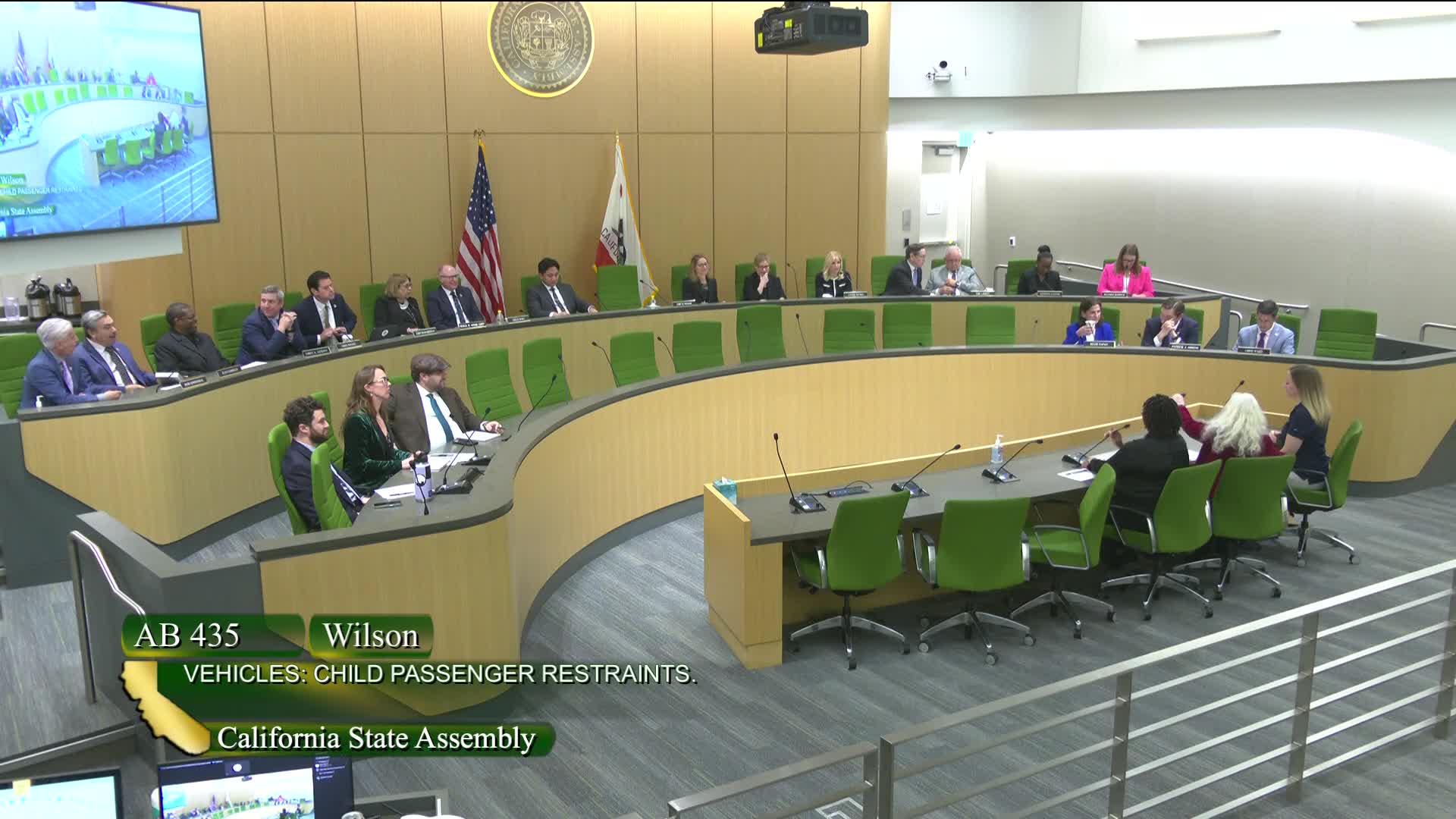
Assemblymember Wilson presented AB 4 35 to the Assembly Transportation Committee, saying the bill would implement the internationally recognized "5‑step test" into California child passenger safety law and align state statute with current safety guidance. "These practices recognized internationally and nationally…have proved to minimize injuries and fatalities," Wilson said, calling the change "part of a safety package."
The bill would: require children under age 10 to be properly secured in the back seat in an appropriate child passenger restraint; require that children ages 10 through 13 continue to sit in the rear seat in a child passenger restraint seat unless they meet the 5‑step test; and require children to meet the 5‑step test before being allowed to sit in the front seat. The author and witnesses said the change is intended to make law match current training and safety recommendations and to reduce injuries among children in crashes.
Support and technical detail Jennifer Rubin, representing Safe Kids Greater Sacramento, said many car‑seat educators already teach the 5‑step test and that current California law lags behind national recommendations. "A quick Internet search would be a very confusing mix of the California law and the national recommendations," Rubin said, urging the committee to make the law consistent with practitioners’ guidance.
Stephanie Tumbrello of SafetyBelt Safe USA described research cited by backers: a University of Michigan Transportation Research Institute study and a Washington state study indicating booster seats reduce crash injuries; SafetyBelt Safe USA data showing that many children who are 4 feet 9 inches or shorter fail the 5‑step test; and a finding that about half of children age 10 would still fail the 5‑step test. Tumbrello said the test is practical, empowers children to check belt fit themselves and is already used in California Department of Public Health materials.
Supporting organizations that registered or gave public testimony included the Automobile Club of Southern California, Rady Children’s Health, the California Hospital Association, Safe Kids Greater Sacramento, SafetyBelt Safe USA and juvenile product manufacturers.
Committee questions and implementation concerns Several members raised enforceability and equity concerns. Assemblymember Lackey, citing his law enforcement experience, asked how officers would determine age and belt fit during a stop and cautioned against officers reaching into passenger compartments. A child passenger safety technician noted the draft included an implementation date (committee testimony cited January 1, 2027) to allow education time and that some counties already provide diversion programs for families who receive citations to complete training.
Members also raised rural and cultural concerns. Assemblymember Hadwick and others asked about pickup trucks that have only a cab and no rear seating; the author said staff would work with members to craft exemptions or accommodations so the law does not prevent necessary transport in rural areas. Committee members asked whether the change would create a surge of citations; the author said she would consider delayed enforceability or citation diversion windows designed to emphasize education and behavior change.
Vote and next steps Assemblymember Jackson moved the bill, and Assemblymember Rogers seconded. The committee voted to pass AB 4 35 to the Appropriations Committee. The rollcall at the time of the vote recorded 12 ayes, several members recorded as "not voting," and the roll was held open for additional members to add their positions. The committee record shows the motion as "do pass to committee on appropriations." The author and supporters said they will continue working on language addressing pickup‑truck situations, enforcement timing and data requests for California‑specific crash/injury figures.
What the bill would change and outstanding questions As drafted, AB 4 35 would change statutory language so that belt‑fit (the 5‑step test) — not just age or a single height threshold — determines when a child may stop using a booster seat and when a child may sit in the front seat. Backers cite research showing booster seats reduce crash injuries and argue the 5‑step test accounts for variations in vehicle seat geometry and child proportions. Critics and some members asked for more California‑specific data, clarification on enforcement as a primary or secondary offense, and explicit language for pickup trucks and low‑speed neighborhood vehicles. The measure now heads to Appropriations for fiscal review and further amendment.