Get Full Government Meeting Transcripts, Videos, & Alerts Forever!
Get email alerts on the Emergency Response Road Design topic
No spam. Unsubscribe anytime.
Assembly committee advances bill requiring fire‑department consultation on major road projects
Summary
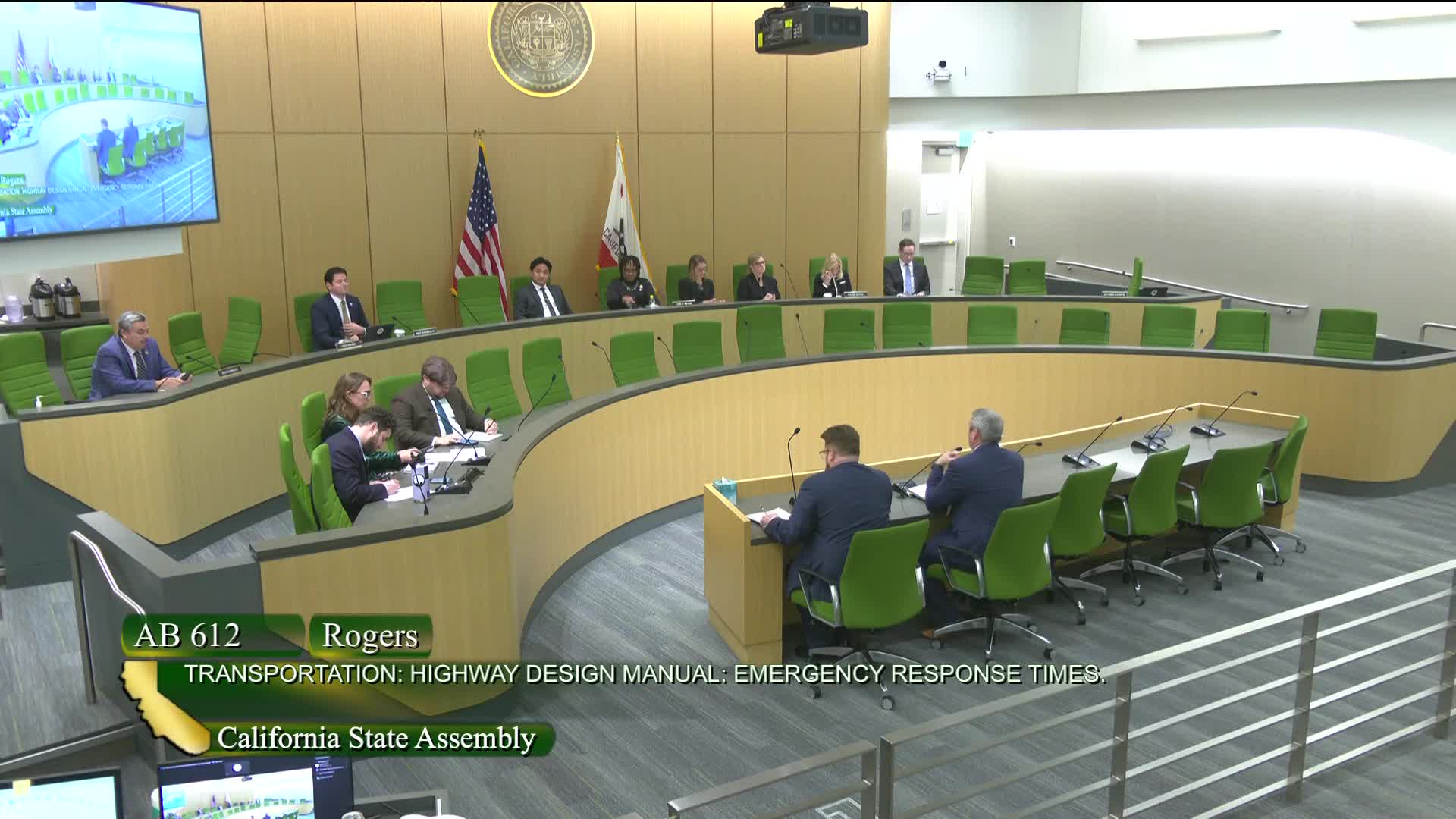
The Assembly Transportation Committee voted to send AB 6 12 to the Appropriations Committee after debate over whether the measure should mandate consultation or encourage it as best practice. The bill would direct Caltrans to update its highway design manual to require local jurisdictions to consult fire agencies on major road improvements.
Assemblymember James Rogers on behalf of the author presented AB 6 12 to the Assembly Transportation Committee, saying the bill would require the California Department of Transportation to update its Highway Design Manual to instruct local jurisdictions to consult with local fire departments on major road improvement projects.
The bill’s sponsor, Doug Soopers of the California Professional Firefighters, told the committee that recent local road design changes—such as uncoordinated roundabouts—have impeded emergency vehicles. "When a response is delayed, it can have negative impacts on the person who called for help," Soopers said, adding the bill “would just really enhance that collaboration…while having safer streets.”
Why it matters: supporters say the change aims to reduce delays in emergency response for fires, medical calls and other incidents by ensuring road planners incorporate input from fire and emergency agencies. Opponents and some local officials said the measure, as drafted, could be overly broad and costly if applied to all road projects.
Supporters and concerns California Professional Firefighters, the bill sponsor, said AB 6 12 is not meant to prioritize response time over other street‑safety measures but to add an explicit coordination step so emergency agencies can advise on design choices that affect vehicle access.
Yvonne Fernandez, representing the California Federation of Labor, registered support during public comment. Mark Newburger of the California State Association of Counties said CSAC was "support and concept" but warned that a mandatory requirement could be problematic in rural counties that lack a local fire district or where routine maintenance projects (for example, chip sealing) would not meaningfully change response times. "There are a variety of road maintenance projects where it wouldn't be appropriate for consultation with fire departments," Newburger said, urging language that narrows the requirement to major projects that could affect emergency response.
Opponents including George Spies of Traffic Violence Rapid Response and Mark Vokesovich of Streets for All said the bill could undermine prevention‑first street design and Complete Streets projects. Spies argued that emphasizing response time could push jurisdictions back toward wider, higher‑speed street designs that increase crash risk. Vokesovich said the bill as drafted could transfer policy decisions from elected bodies to de facto veto power by fire departments and could impose complex, costly transportation network modeling requirements.
Committee action and vote Assemblymember Lowenthal moved the bill, and Assemblymember Harabedian seconded. After public comment and discussion of possible clarifying amendments, the committee voted to pass AB 6 12 to the Committee on Appropriations. The motion passed with the committee roll showing 16 ayes, no recorded no votes or abstentions. The committee record lists the motion as "do pass to committee on appropriations." No amendments were adopted on the floor at the hearing; the author said he was open to working with stakeholders on language to address concerns about minor maintenance projects and rural implementation.
What the bill would do and next steps As presented, AB 6 12 directs Caltrans to revise its Highway Design Manual so local jurisdictions are instructed to consult their local fire agencies when undertaking major road improvement projects. The author and sponsor said the change is intended only to add a required consultation step and not to mandate particular design outcomes. The author and supporters told the committee they will work with bicycle advocates, county officials and other stakeholders to clarify which projects require consultation and to preserve Complete Streets goals where possible.
The bill now moves to the Assembly Appropriations Committee for further fiscal review. If it advances from Appropriations, it would return to the Assembly floor for additional action.