Get Full Government Meeting Transcripts, Videos, & Alerts Forever!
Get email alerts on the Psps Communications topic
No spam. Unsubscribe anytime.
Committee advances bill to require utilities to improve public information on power shutoffs, with amendments
Summary
SB 559 was advanced as amended; sponsors said the bill and amendments aim to require greater transparency and timely information during public safety power shutoffs (PSPS) while preserving utility discretion for safety and restoration operations. The committee vote was recorded as 13–0.
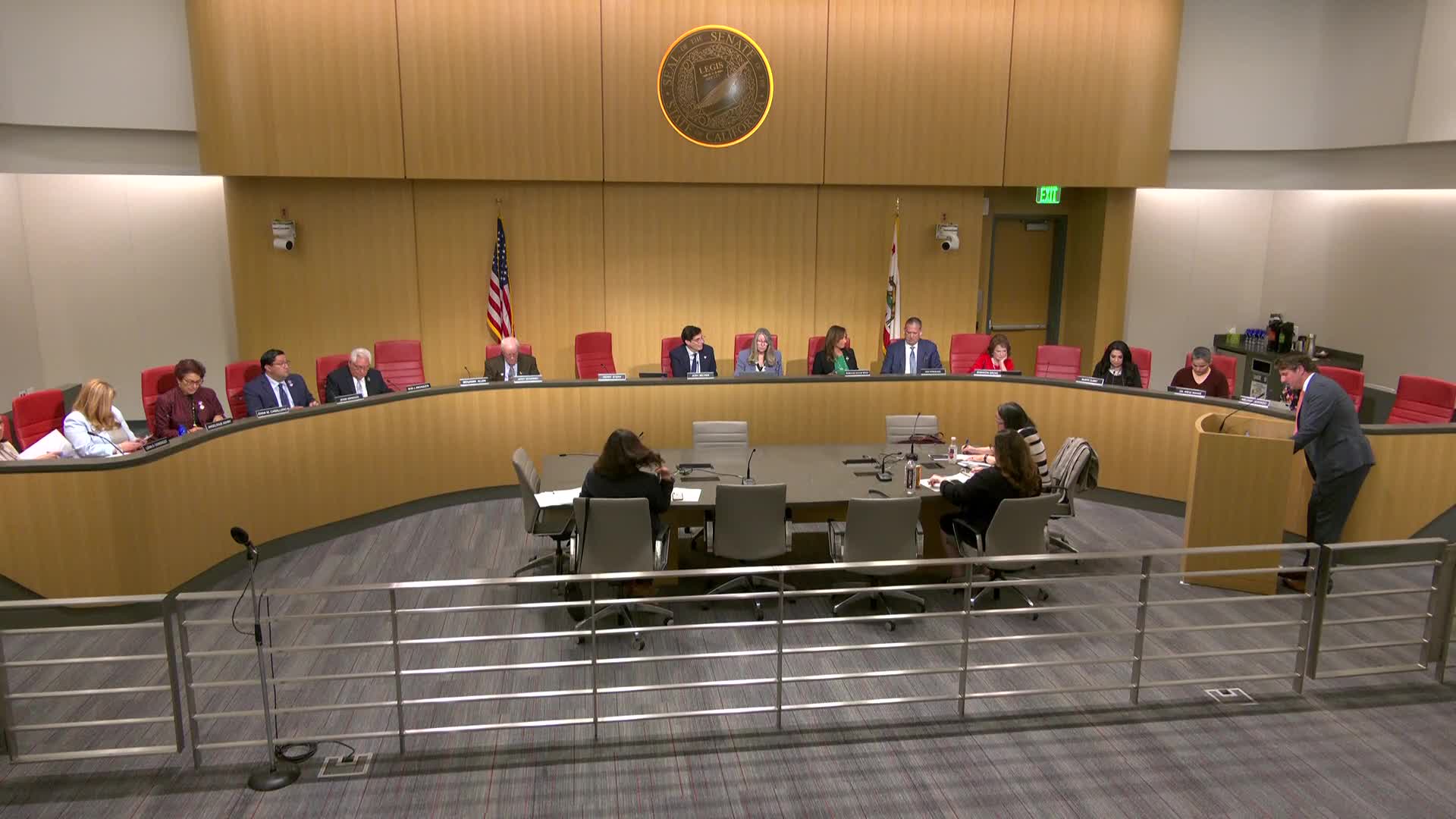
Senate Bill 559, a measure authored by Senator Stern to increase transparency and public information during public safety power shutoffs (PSPS), was advanced by the Senate Committee on Energy, Utilities and Communications as amended.
Senator Stern described PSPS as a balance between preventing utility-ignited wildfires and avoiding prolonged outages that endanger vulnerable residents who rely on electrically powered medical devices. "When your power's off and you have nowhere to turn ... and you're in the dark, not just for 12 hours but for 6 days ... people call my office. Thousands and thousands of people do and I feel powerless," Stern said. He said committee amendments grant utilities discretion on restoration decisions while requiring more public-facing information about circuit status and scheduled inspections.
Support testimony included Danny Anderson, disability access manager for Ventura County, who described the risks PSPS pose to people with access and functional needs (AFN): "When you're a member of the AFN community ... relying on an electrically powered medical device ... it was very scary when I didn't know when power would be restored." Jean Hurst, representing the Ventura County Board of Supervisors, detailed local impacts from January 2025 events: 61 circuits were de-energized, some for more than four days, and grocery stores and traffic signals were affected.
Opposition witnesses urged caution. Will Abrams, a wildfire survivor and intervenor at the CPUC, said the bill risks treating de-energization as one-size-fits-all, and urged maintaining flexibility and two‑way communications among utilities, emergency operations centers and other partners. Catherine Borg of Southern California Edison and representatives from San Diego Gas & Electric and Pacific Gas & Electric described operational concerns and asked for language adjustments; SCE said the committee amendments addressed several issues and said it would review the bill in print.
Committee members discussed whether the CPUC could or should adopt similar protocols by rule, the level of real-time data to require publicly, and the practical limits of customers accessing online information during outages. Witnesses from SDG&E said they publish circuit-level weather and condition updates every 10 minutes on a public website during events; PG&E and SCE representatives described different public interfaces and said they would work with the author and CPUC staff on details.
The committee accepted amendments that, among other things, align definitions with existing CPUC PSPS protocols, provide utilities more discretion about the precise real-time information required, and remove a strict requirement for hourly public weather condition updates. The committee motion to pass as amended carried with a recorded vote of 13–0 and the bill was referred to the Senate Appropriations Committee.
Notes: Sponsors and several committee members said they will continue to work with utilities and CPUC staff to refine implementation details and to consider whether additional CPUC rulemaking might be a better institutional pathway for certain operational elements.