Get Full Government Meeting Transcripts, Videos, & Alerts Forever!
Get email alerts on the Infrastructure Wastewater topic
No spam. Unsubscribe anytime.
Commissioners introduce ordinance clarifying wastewater-treatment definition, add accessory wastewater use category
Summary
The board introduced a zoning ordinance bill to require that a wastewater treatment facility perform treatment, storage and disposal (all three) to be classified as such, and to reclassify accessory wastewater treatment facilities as a permitted use subject to special-use exception; the measure was scheduled for public hearing in April.
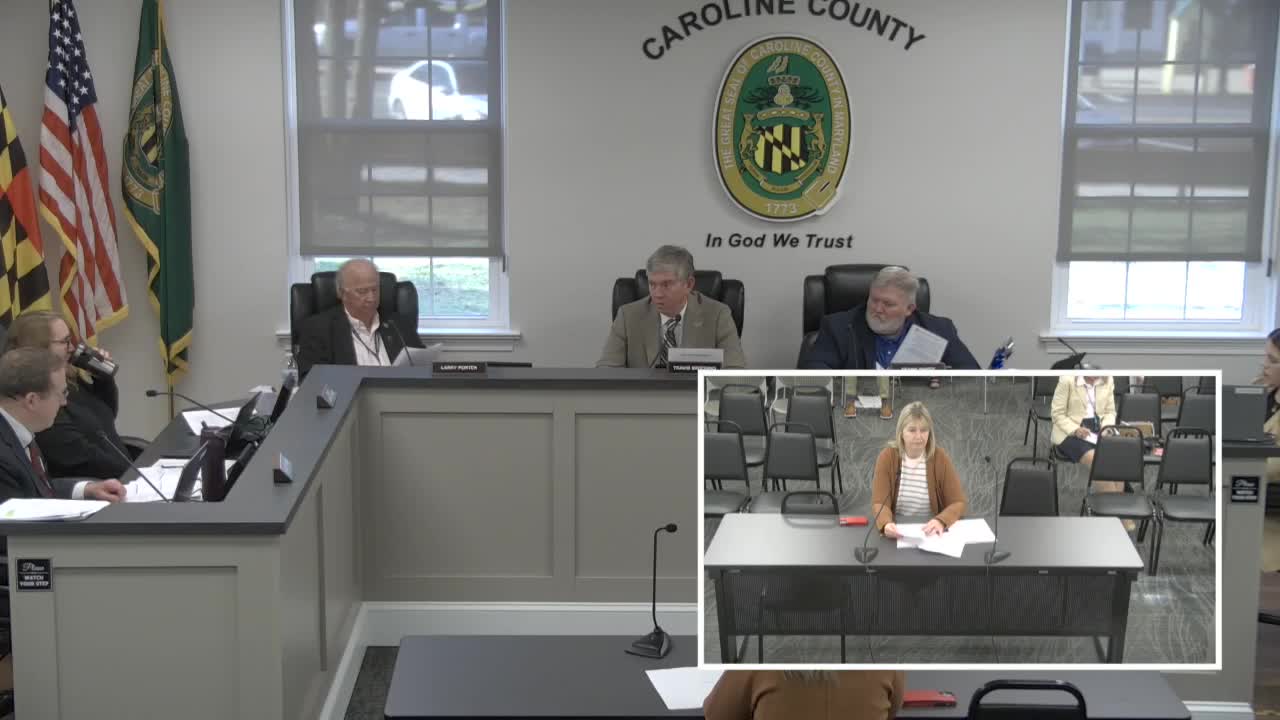
County staff introduced a proposed amendment to chapter 175 of the Caroline County Code on March 25 to clarify the definition and allowable classification of wastewater treatment facilities. The amendment would require a facility to include all three functions — treatment, storage and disposal — to meet the county definition of a ‘‘wastewater treatment facility.’’
The proposed change also reclassifies non-accessory wastewater treatment facilities so they are not a permitted use in certain rural residential districts and adds ‘‘accessory wastewater treatment facilities’’ as a permitted use subject to a special-use exception when the facility serves the property generating the waste.
During discussion commissioners asked whether storage-and-disposal-only operations would be affected. Staff said the proposed definition change switches language from an ‘‘or’’ to an ‘‘and’’ so that standalone storage or disposal operations without treatment would not be classified as wastewater treatment facilities under the county code. Commissioners and staff discussed hypothetical situations, such as municipal collection and spray-irrigation systems serving small village clusters, and staff said accessory wastewater treatment (serving on-site generation) would remain permitted subject to a special-use exception.
The ordinance was introduced on the board’s standard legislative schedule; a second reading and public hearing were set for April and a third reading with potential enactment for mid-April.