Get Full Government Meeting Transcripts, Videos, & Alerts Forever!
Austin Energy study: systemwide burial of distribution lines would cost about $50 billion; recommends targeted undergrounding
Summary
Austin Energy and consultant 1898 & Co. presented findings of an underground‑feasibility study showing a full systemwide conversion would cost roughly $50 billion, and recommended strategic, prioritized conversions combined with overhead hardening measures rather than citywide burial.
Austin Energy staff and a consultant on March 25 presented the results of an underground-feasibility study that concluded burying all remaining overhead distribution lines in Austin would be technically feasible in many places but extremely costly, and recommended targeted conversions rather than a systemwide program.
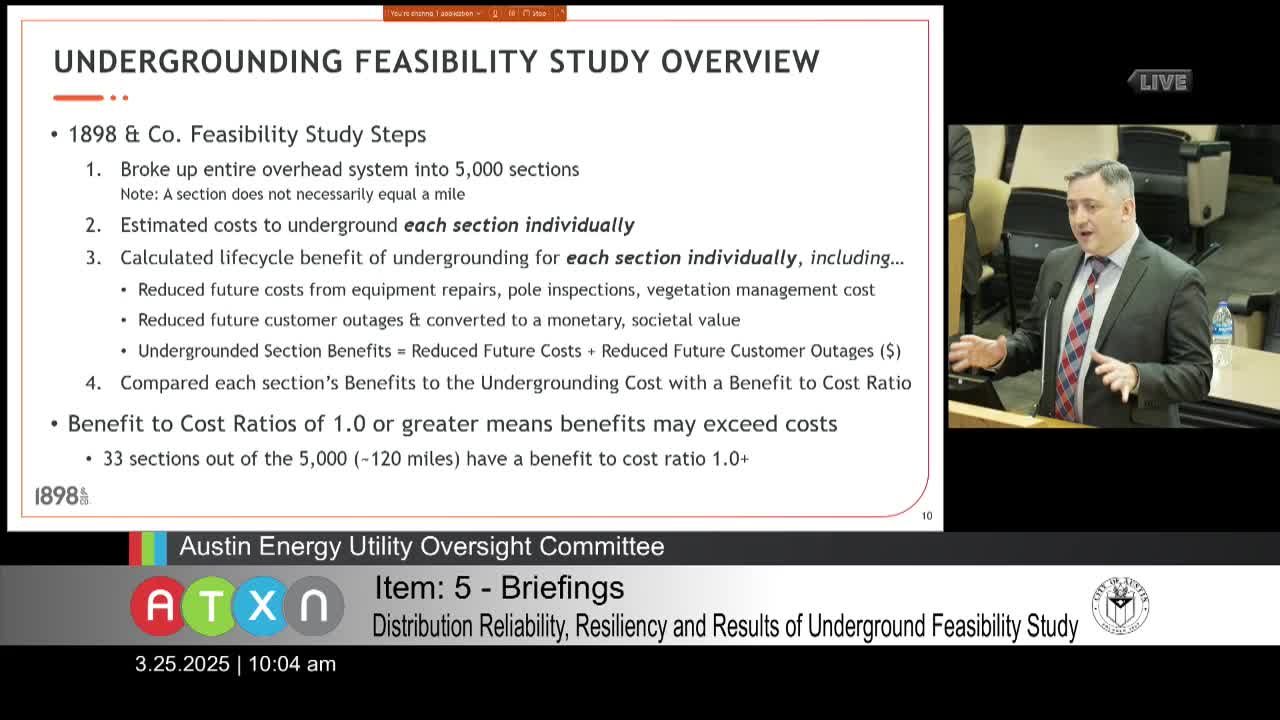
The study, conducted by 1898 & Co. (part of Burns & McDonnell) and reviewed by Austin Energy, estimated Austin’s distribution system at about 12,000 miles, of which roughly 7,000 miles are underground and 5,000 miles remain overhead. The consultant estimated a citywide undergrounding price tag in the ballpark of $50,000,000,000 and found about 33 discrete sections (roughly 120 miles) where a benefit‑cost ratio exceeded 1 on a lifecycle basis.
Why this matters: Undergrounding reduces outages caused by vegetation and weather and can improve resilience in wildfire and storm‑prone areas, but it also raises large upfront costs, environmental permitting issues, utility telecommunications coordination, and localized engineering challenges such as shallow bedrock and tight easements. Committee members pressed staff on where undergrounding could be coordinated with other public projects and on options short of full burial, such as overhead hardening and sectional investments.
The study’s scope and main findings
“We broke up the entire system into about 5,000 sections,” said Arlen Muir of 1898 & Co., describing the analytic approach used to estimate section‑level costs and…
Already have an account? Log in
Subscribe to keep reading
Unlock the rest of this article — and every article on Citizen Portal.
- Unlimited articles
- AI-powered breakdowns of topics, speakers, decisions, and budgets
- Instant alerts when your location has a new meeting
- Follow topics and more locations
- 1,000 AI Insights / month, plus AI Chat