Get Full Government Meeting Transcripts, Videos, & Alerts Forever!
Get email alerts on the Employment Development topic
No spam. Unsubscribe anytime.
Eugene report: employment permits steady but industrial land lags forecast
Summary
City staff told the Envision Eugene technical advisory committee that employment permits averaged 41 a year from 2013–2024 and that commercial development has outpaced industrial land supply; industrial acreage and overall industrial development remain well below the buildable lands inventory forecast.
EUGENE, Ore. — City staff told the Envision Eugene technical advisory committee on March 20 that employment development activity has been largely steady since 2013 but remains well below earlier industrial forecasts.
The city reported an average of 41 employment permits per year from 2013 through 2024 and about 4.2 million net new employment square feet during that monitoring period, Heather O'Donnell, senior planner on the long‑range team, said. "The numbers really don't look much different than as we reported in the annual report last year," she said.
The update matters because the buildable lands inventory (BLI) and urban growth strategies rely on accurate permit and demolition tracking to estimate future land need. "We capture demolition permits as TBD when the new use hasn't been permitted yet," O'Donnell said, explaining that some demolition permits remain listed as "to be determined" for years when no replacement permit arrives. The committee heard that staff are working to link demolished uses to replacements in the database so redevelopment patterns can be analyzed.
Key findings presented to the committee included:
- Employment permits averaged 41 per year (2013–2024) and about 4,200,000 net new employment square feet were recorded over the monitoring period, staff said.
- Commercial non‑retail permits (for example, offices and some medical uses) constitute the largest share of permits.
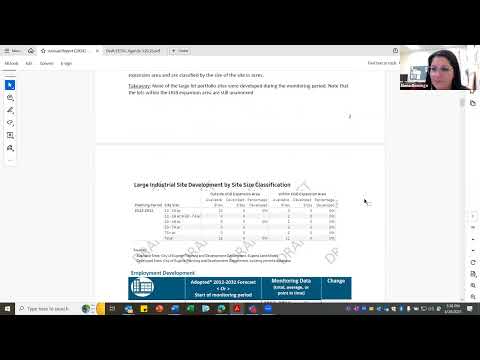
- Industrial development has underperformed: the annual forecast for industrial land was 57 acres, while the city has averaged 12.2 acres per year. Commercial land development is also below forecast (forecast 12.9 acres; current average 5.5 acres per year).
- Since 2013, staff counted about 380 acres developed with employment permits; developed commercial land was reported at roughly 115% of forecast while industrial land was at about 13% of forecast.
Committee members asked for clarification about the "TBD" demolition entries; O'Donnell explained that a demolition permit without a subsequent building permit remains flagged as TBD in the employment chart and that staff account for demolished square footage in net totals even if the new use is not yet recorded. "There's a demo. We assume there's probably gonna be some new development happening there, but we don't know what that is yet," she said.
Members also discussed how "special area zones" are treated in the BLI. Elena (last name not specified), associate planner on the long‑range team, said the BLI is compiled at the plan‑designation level and that special area zones often include subareas (for example, mixed‑use or high‑density residential) that staff map into the higher‑level categories used for the inventory.
The committee raised infrastructure and annexation as constraints on developing certain employment lands. One committee member asked whether lack of infrastructure was the reason Crow Road area parcels had not developed; staff replied that the needed infrastructure is now in the city CIP and that the parcels also need annexation before full development, because services must be close enough to authorize annexation.
Staff said they have begun outreach to developers and the permit counter to understand why efficiency measures for employment land (E1 and E2 designations) are not producing the expected development, and that preliminary conversations have already included local developers. Phil Farrington, Planning and Real Estate Development Director for CBC Management Corp. and chair of Cornerstone Community Housing's board, confirmed he had been consulted.
The report noted one additional acre had been developed using employment efficiency measures in the most recent year, and staff said they will continue to refine the inventory and the database linkages that show what was demolished and what replaced it.
Committee members asked staff to include a short explanatory line in the annual report clarifying what "TBD" means on the permit charts, since multiple members raised that same question during the meeting.
The committee also heard that Santa Clara Community Park construction added to parks and open space acreage during the monitoring year.
The committee did not take formal action on the report; staff said the data will inform upcoming urban growth strategy work and potential revisions to the city's employment efficiency measures.