Get Full Government Meeting Transcripts, Videos, & Alerts Forever!
Get email alerts on the Land Use Solar Storage topic
No spam. Unsubscribe anytime.
Conservation group and Caroline County commissioners urge opposition to state solar bills, cite battery safety concerns
Summary
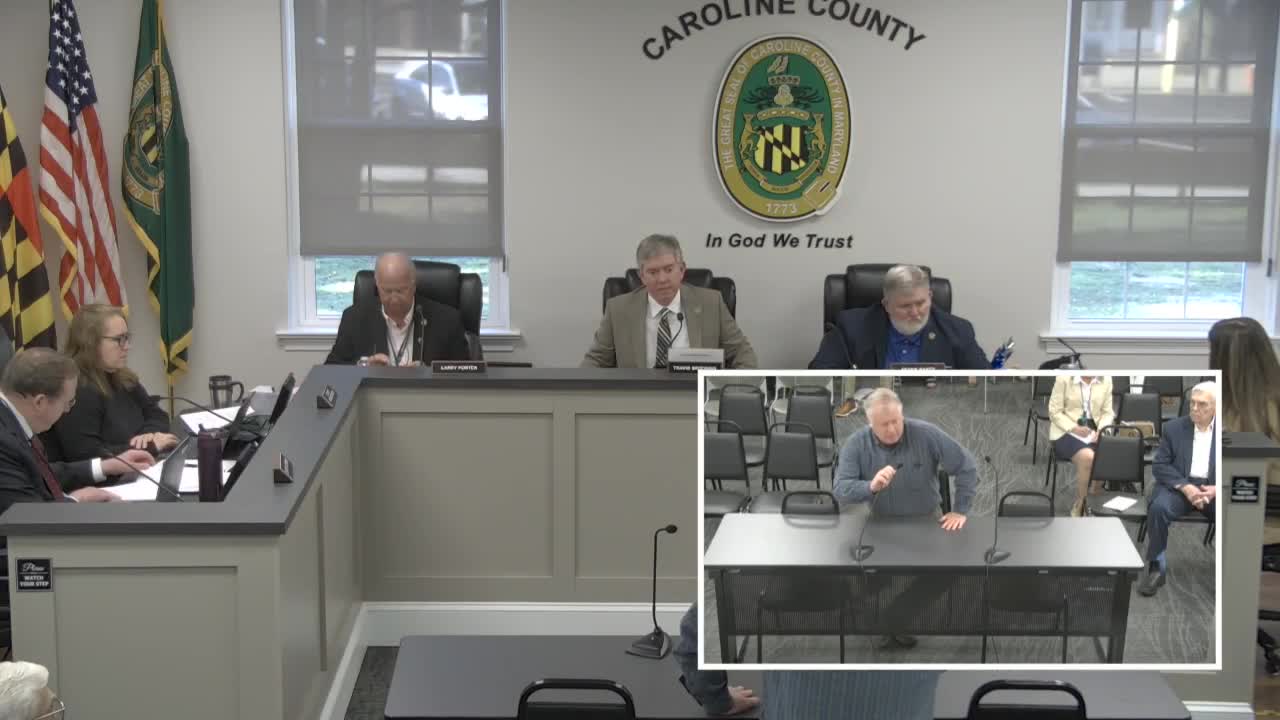
Jay Falstad, executive director of the Queen Anne's Conservation Association, thanked the Caroline County commissioners on March 25 for opposing state bills he said would strip local control over solar and battery-storage projects.
Jay Falstad, executive director of the Queen Anne's Conservation Association, thanked the Caroline County commissioners on March 25 for their public opposition to Maryland bills House Bill 1036 and Senate Bill 931, which he said would allow private entities to operate like utilities and remove local zoning and taxing control over solar and battery-storage projects.
Falstad told the board the bills ‘‘represent the single greatest threat to Maryland’s Eastern Shore’’ and urged commissioners to keep pressing the Eastern Shore delegation to record opposition on the floor. ‘‘For the very first time in my memory, it’s allowing private entities to act as a public utility and completely eliminating any local zoning control and taxing control as it relates to solar projects and battery storage units,’’ he said.
Commissioners and public commenters focused on two themes: limits on local control and the safety and regulation of battery energy storage systems (BESS). Falstad and county commissioners said Maryland has not yet finalized safety guidance for BESS and that the county has a moratorium on battery storage units in effect.
Commissioner (name recorded in the meeting as Commissioner) said the county will not allow battery storage ‘‘until I am clear about what the fire suppression requirements are going to be.’’ That commissioner also said the state fire marshal’s office had not finalized revisions to the applicable fire-code section (NFPA 855), and that an earlier bill intended to set safety requirements had been pulled back.
Falstad and commissioners discussed amendments that had been circulated by proponents; Falstad said some amendments restored limited local controls such as screening, buffering and setbacks but did not attach other enforcement mechanisms such as caps or taxes. Falstad said a proposed 5% cap discussed in negotiation would still allow ‘‘close to 10,000 acres in Caroline County’’ in priority preservation areas under his calculation.
Commissioners said they would prepare a county letter on their letterhead to the Eastern Shore delegation and consider circulating an opposition letter across shore counties; they discussed adding battery-storage and decommissioning language to that letter.
The public comment thread included several speakers who framed the issue as one of food and national security if farmland is removed from agricultural production. Falstad urged residents to contact delegates and senators.
The county did not take a formal legislative vote during the public-comment segment, but commissioners directed staff to prepare and submit a county letter of opposition and to coordinate with other Eastern Shore counties on a shared message to their legislative delegation.