Get Full Government Meeting Transcripts, Videos, & Alerts Forever!
Get email alerts on the Tax Policy topic
No spam. Unsubscribe anytime.
Minn. tax committee hears broad objections to governor’s SF 2374: sales-tax expansion, county aid cuts and conservation programs targeted
Summary
At a March 25, 2025, Minnesota Senate Taxes Committee hearing on Senate File 2,374, county officials, conservation groups, legal and tax practitioners and researchers urged lawmakers to reject cuts to county aids and urged caution on a proposal to expand the sales tax to professional services while lowering the rate.
The Minnesota Senate Taxes Committee continued testimony on Senate File 2,374 on March 25, 2025, hearing more than a dozen witnesses representing counties, conservation groups, legal and financial professions and tax practitioners about the bill’s combination of an expanded sales-tax base and reductions in several state aid programs.
Supporters of current county aid and conservation funding told the committee cuts would shift costs to property taxpayers and risk outcomes ranging from fewer local inspections for aquatic invasive species (AIS) to reduced stewardship of private forestland. At the same time, industry groups and tax professionals urged caution about the governor’s proposal to broaden the sales-tax base to include professional services such as legal, accounting and financial advice, calling the definitions in the bill vague and the compliance burden large.
“The abstract 34% cut across PILT payments to counties … will — and it’s important to know that PILT really is a partnership with the state and its communities,” Matt Hilgert, who said he works for the Association of Minnesota Counties, told the committee. Hilgert gave Koochiching County as an example: “Koochiching County…has 2,000,000 acres of total land. 1,400,000 acres of their land is PILT eligible…A 34% cut to their PILT means $1,500,000. Now that doesn't sound like a whole heck of a lot, but what it really means is a 19.73 levy increase right off the bat to replace those dollars.”
Conservation groups and AIS researchers described the state’s county-led AIS prevention program as effective and warned the proposed reduction — from $10 million per year to $5 million under the governor’s proposal — would increase infestations and long-term costs. “We estimate over the last 10 years without the benefits of the AIS prevention aid program, we would have expected 70 more lakes in Minnesota to become infested with zebra mussels,” Nick Phelps, director of the Minnesota Aquatic Invasive Species Research Center, said. Phelps added that research and modeling show prevention produces large long-term savings compared with later management.
Stephanie Pincala, government relations director for The Nature Conservancy in Minnesota, told the committee the bill’s changes to the Sustainable Forest Incentive Act (SFIA) would lower payments and allow enrollees to break long-term covenants early, a change she said would “raise alarm bells” for forest canopy and the state’s climate goals. “SFIA has been a critical tool for ensuring forest cover is retained in large tracts,” Pincala said.
On the sales-tax side, industry groups and tax professionals argued the bill’s language is ambiguous and would be difficult to administer. “Taxable accounting services are defined as including, but not limited to, audits, bookkeeping, financial statement preparation, payroll, and income tax preparation,” Todd Koch, a CPA and leader of the Minnesota Twin Cities Tax Professionals, said. Koch and other tax preparers warned that the proposal’s language is nebulous on where services are performed, taxing remote providers, county/transit/city variations in rate collection, and the timeline for compliance.
Brian Lake of the Minnesota State Bar Association argued taxing consumer legal services would be especially harmful to low- and middle-income Minnesotans in matters such as protection orders, evictions and debt collection. “Legal services are not a luxury,” Lake said. He told senators the tax would disproportionately harm under-resourced parties in “David versus Goliath” disputes.
Representatives of financial and insurance industry groups similarly opposed taxing financial advice and services. “Many of our members are headquarter companies and as a result we have a disproportionate number of Minnesota clients,” Brian Peach told the committee, urging lawmakers not to tax services used by people building retirement and emergency savings.
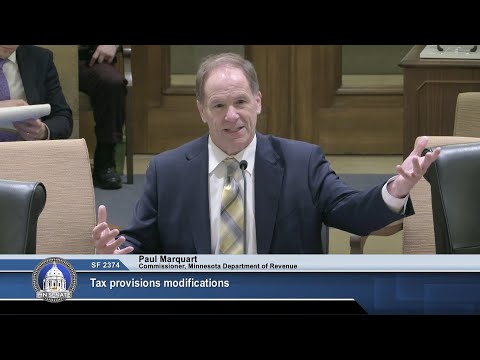
Several witnesses urged clearer nexus and collection rules tied to existing multistate frameworks. Senator questions referenced Minnesota’s membership in the Streamlined Sales and Use Tax Agreement and asked whether bill definitions align with streamlined definitions; Commissioner Paul Marquardt of the Minnesota Department of Revenue said he would get back to the committee on that point.
Commissioner Marquardt defended the broader objective of the governor’s tax package, saying it aims to “make the tax code more fair and more stable” by expanding the sales-tax base and lowering the rate. He also said the governor protected certain major property-tax reliefs and local government aid lines, and noted the supplemental budget proposal adds more cuts elsewhere in order to address a multibillion-dollar structural imbalance. Marquardt told senators the administration views the sales-tax base expansion as an incremental start and invited stakeholders to work on more specific definitions.
Committee members from Greater Minnesota pressed the administration on regional impacts, saying the combination of PILT cuts, AIS reductions and changes to forest incentives would disproportionately affect northern counties that host large amounts of tax-exempt public land and tourism economies. Senator remarks emphasized that the compounds of program reductions and prior obligations could translate into higher local levies in impacted counties.
No final committee vote on SF 2,374 occurred at the hearing. Testimony concluded with an agreement among senators and the commissioner to continue work on definitions, nexus questions tied to remote services and written analyses of the county-impact calculations the administration cited.
What happened next: committee leaders said the taxes committee will continue to take up tax-exemption and sales-tax issues in subsequent meetings this week; no formal amendments or votes on SF 2,374 were recorded at this hearing.