Get Full Government Meeting Transcripts, Videos, & Alerts Forever!
Get email alerts on the Early Learning topic
No spam. Unsubscribe anytime.
Senate panel hears testimony supporting $300,000 for Metro Deaf School birth-to-3 program
Summary
Parents, school staff and advocacy groups told the Senate Education Finance Committee that Senate File 2502 would extend $300,000 in biennial funding for Metro Deaf School's birth-to-3 early learning program to reduce language deprivation risks for infants who are deaf, deafblind or hard of hearing.
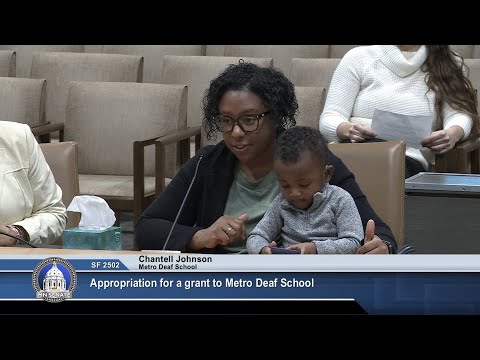
Senate File 2502, which would appropriate $300,000 toward Metro Deaf School's birth-to-3 early learning program, was presented and laid over for possible inclusion in a future omnibus bill after a morning of testimony before the Minnesota Senate Education Finance Committee on Dec. 25, 2025.
Supporters told the committee the funding would sustain a program that gives infants and toddlers who are deaf, deafblind or hard of hearing regular access to American Sign Language (ASL) and Deaf community peers and instructors. "Sign language remains the only way a family can guarantee that their deaf or hard of hearing child is immersed in a fully accessible language," Senator Kunish said while introducing the bill.
Dr. Susan Outlaw, executive director of Metro Deaf School, said the school does not receive Part C funds for birth-to-3 services and described the program offered: a 90-minute parent-infant class and twice-weekly half-day infant/toddler classes amounting to about five hours per week. "We simply do not get funds for part c... What we're trying to do is combat language deprivation," Outlaw said, adding that brief home visits do not provide the language immersion infants need.
Multiple parents and family members spoke in favor of the bill and described personal experiences. Sarah Klarstrom, a parent and Metro Deaf School board member, said her family had to move closer to the Twin Cities so their daughter could access ASL before kindergarten. "Those first 3 years were a challenge ... we had to wait until she was 3 to start the programming," Klarstrom said, describing language gaps the family saw before earlier access. Other parents described school districts'early intervention services that offered limited ASL exposure and recounted improvements after enrollment at Metro Deaf School.
Speakers drew a connection between early language access and later literacy and academic outcomes. Outlaw referenced research linking early language development to reading skills and said the appropriation is a small investment to reduce future special education costs.
Alicia Lane, government relations director for the Minnesota Commission of the Deaf, DeafBlind and Hard of Hearing, urged committee members to support the appropriation and thanked bill sponsors. The committee chair laid the bill over for possible inclusion in a future omnibus bill.
Two actions were recorded on the bill'a motion to move the bill before the committee and the committee decision to lay it over; no final vote on funding was held at the hearing.