Get Full Government Meeting Transcripts, Videos, & Alerts Forever!
Get email alerts on the State Development And Redevelopment Plan topic
No spam. Unsubscribe anytime.
Middlesex County holds public kickoff on New Jersey state development plan; farmland, transit and watershed concerns raised
Summary
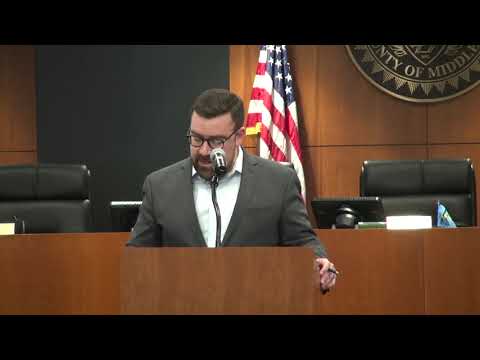
Middlesex County officials and state planning staff on Tuesday held a public meeting to kick off the county's cross-acceptance review of the draft New Jersey State Development and Redevelopment Plan, outlining how counties and municipalities can submit feedback and request map changes to align local plans with the state's policy framework.
Middlesex County officials and state planning staff on Tuesday held a public meeting to kick off the county's cross-acceptance review of the draft New Jersey State Development and Redevelopment Plan, outlining how counties and municipalities can submit feedback and request map changes to align local plans with the state's policy framework.
The presentation by Walter Lane, acting executive director of the New Jersey Office of Planning Advocacy, described the draft plan's 10 goals, the voluntary nature of the plan and a compressed schedule that calls for county cross-acceptance reports in the spring and a state adoption process by December. Middlesex County interim planning director Vijayan Sajanshi and county officials said the county will offer training and staff support to municipal committees preparing local responses.
Why it matters: The cross-acceptance process is the primary mechanism by which the state and local governments compare planning documents, propose map changes and seek a shared approach to directing growth and preservation. Alignment with the state plan can affect a municipality's eligibility for certain state resources and scoring in state programs, officials said.
Lane said the draft plan, which updates the last statewide plan from 2001, frames 10 policy goals ranging from economic development, housing and transportation to climate resilience, open space and equity. He emphasized that the state plan is a voluntary guide, not a regulatory mandate. "The state plan is not a regulatory document. This is a voluntary guide that counties and municipalities and other regional planning groups strive to be consistent with the state goals and policies objectives," Lane said.
Lane described the cross-acceptance phases: counties and municipalities compare their existing plans to the draft plan and submit a high-level cross-acceptance report (the county acts as the primary reporting entity to the state); the state and counties negotiate suggested changes to the draft plan; the state releases a revised draft for comment in late summer; and finally the State Planning Commission will hold public hearings and adopt a final plan, with adoption targeted for December. He said counties' initial cross-acceptance reports are due in May and that the state will hold six public hearings in mid-September.
The Office of Planning Advocacy has published a shortened draft plan (about 80'90 pages), a citizen's guide and an online comment form. Lane also introduced a beta Smart Growth Explorer mapping tool developed with Rutgers that scores sites for development or preservation factors and an ArcGIS-based policy-map editing tool for submitting suggested map changes.
Local officials said the county will provide a cross-acceptance response template, staff support and three training sessions in early April to help municipal committees complete the county-level submission.
Public comments focused on farmland preservation, transit-oriented development and watershed collaboration.
Farmers and agricultural advocates said they want stronger, faster tools to keep farmland in production and to prevent loss to large-scale development such as warehouses. One participant who identified himself as a member of the Middlesex County Board of Agriculture said counties and the state should consider giving ag-development committees an earlier opportunity to pursue purchase or stewardship options before land developers proceed. He described the value of local food networks during the COVID-19 pandemic and urged more aggressive preservation outreach.
Lane and county speakers said the draft plan recognizes farmland through mapped planning areas (4A and 4B) and that counties already operate farmland preservation programs tied to the State Agriculture Development Committee (SADC). A county official at the meeting noted existing local initiatives including farm incubator and training programs intended to encourage new farmers and to maintain agricultural activity as part of the county's Destination 2040 strategy.
On transit and land use, municipal representatives asked how New Jersey Transit and metropolitan planning organizations would be integrated into decisions about where to focus growth. Mike, a resident who asked about transportation-land use separation, noted that planning in many places treats the two independently. Lane said the state is coordinating its long-range transportation update and metropolitan planning organizations with the plan and that some state grant and scoring programs give additional points to projects located in more growth-oriented planning areas or designated centers. For proposals such as reactivating passenger rail service, Lane said the Office of Planning Advocacy can convene agencies and foster collaboration but cannot direct agency decisions.
Susan Bristol, municipal policy specialist at the Watershed Institute, urged communities to pursue watershed-scale planning to improve water quality and reduce flooding, noting that rivers and streams cross political boundaries and that municipal MS4 stormwater permits increasingly require regional approaches. Lane said the state plan aims to foster that kind of collaborative work.
Officials repeated that the cross-acceptance process is intended to be collaborative and that counties will package municipal inputs into the county submission to the state. Lane encouraged specific, actionable feedback on draft policies and mapping, noting the state is seeking proposed changes rather than exhaustive plan-by-plan reviews.
Next steps and how to comment: the state released the draft plan in early December; counties are compiling cross-acceptance reports now with initial county submissions due in May. The state will negotiate reported changes through the summer, release a revised draft in August and hold six public hearings in mid-September before a final adoption targeted for December. The Office of Planning Advocacy is accepting comments through an online form, email and paper forms provided at the meeting.
No formal votes or regulatory decisions were taken at the meeting. Participants were invited to submit written comments and to use county-provided templates and training sessions for the cross-acceptance response.