Get Full Government Meeting Transcripts, Videos, & Alerts Forever!
Get email alerts on the State Budget topic
No spam. Unsubscribe anytime.
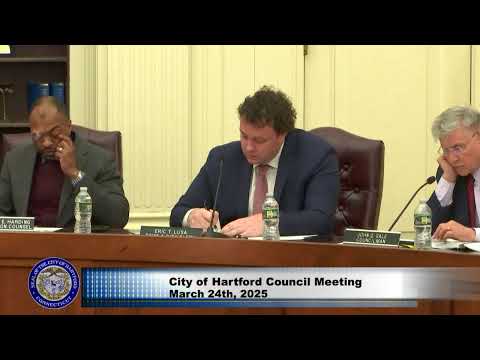
Hartford council debates nonbinding resolution urging change to Connecticut fiscal guardrails
Summary
The Hartford Common Council on March 24 debated a nonbinding resolution (item 6.5) urging the Connecticut legislature and governor to change the states fiscal "guardrails," which Councilman Mitchell said have accumulated about $4,000,000,000 of revenue outside the general fund.
The Hartford Common Council on March 24 debated a nonbinding resolution (item 6.5) urging the Connecticut legislature and governor to change the states fiscal "guardrails," a mechanism Mitchell said has accumulated roughly $4,000,000,000 of revenue outside the general fund.
The measure, introduced as a resolution supporting an adjustment of Connecticuts fiscal guardrails, was presented for action by the council. Councilman Mitchell described the guardrails as a system created during a past state fiscal crisis to set aside revenue outside general spending and said changing the rules would free funds for priorities such as increased special-education reimbursements and pilot payments to cities.
Mitchell said the proposal is backed by a wide set of labor organizations and unions with membership in Hartford, and he listed multiple unions during his remarks, saying the change "is not just some crazy, you know, socialist thing" and that the city should "tell the delegation what the city needs." He also said the committee had returned an unfavorable recommendation but asked colleagues to "rethink that."
Mitchell told colleagues: "What they are is a system that was set up some years ago when the state was in a very acute fiscal crisis to always set aside a certain amount of revenue and put it outside the reach of the general fund and general spending. And that accumulation of revenue has reached in the order of $4,000,000,000 now." He added the resolution is "saying change how you do money state, so that all of our other asks can get funded."
Mitchell identified organized labor groups supporting the change during his floor remarks, naming among others: AFT Connecticut; Connecticut AFL-CIO; SEIU State Council; AFSCME Council 4; Hartford Federation of Teachers; Food and Commercial Workers locals; and several state employee and higher-education unions.
He also recalled a question raised in committee about optics: "If we pass this, does this look like Hartford coming with its hand out again... ?" Mitchell said the city should press the delegation to prioritize needs of the poorest residents over bond ratings and other protections.
During the roll call on the action item, the transcript records Councilman Bility voting "No" and Councilman Clark saying he would recuse himself from the vote; the transcript does not include a complete roll-call tally or a clear item outcome. The resolution is described in the agenda as nonbinding.
Why it matters: The proposal addresses how the state sets aside and spends large reserves that affect municipal funding flows. Changes to the guardrails would be made at the state level; the councils resolution is a formal request to Hartfords legislative delegation and the governor.
Background: The resolution was presented to the full council after consideration in committee, where the committee issued an unfavorable recommendation. The measure was characterized on the council floor as aimed at expanding the state's flexibility to allocate revenue to programs and reimbursements that affect Hartford residents.
The transcript does not show any formal direction to staff or follow-up tasks tied to implementation, nor does it record a final approved/failed status for item 6.5.
Votes at a glance
- Item 6.5, "Resolution supporting an adjustment of Connecticut's fiscal guardrails": recorded roll-call statements in the transcript show Councilman Bility voting No and Councilman Clark recusing himself; the transcript does not include the final tally or declared outcome (not specified).