Get Full Government Meeting Transcripts, Videos, & Alerts Forever!
Get email alerts on the Public Safety topic
No spam. Unsubscribe anytime.
Hartford mayor credits community policing, city-funded violence-prevention for recent public-safety gains
Summary
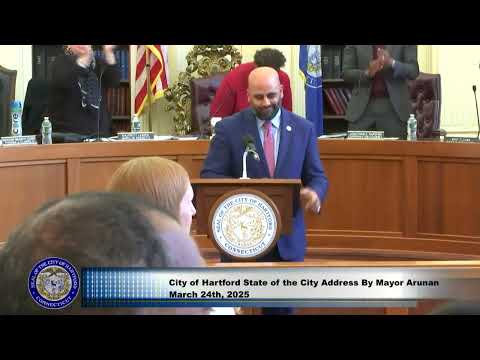
In a March 24 Committee of the Whole meeting, the mayor said Hartford reduced 911 response times, removed more than 320 illegal guns last year and has launched a city-funded hospital-based violence intervention program after federal funding was set to lapse.
Hartford Mayor (name not provided) told the Court of Common Council at a March 24 Committee of the Whole meeting that the city has made measurable public-safety gains by expanding community policing, investing in technology to curb illegal ATV use and launching a city-funded violence-prevention strategy that includes a hospital-based intervention program.
The mayor said the city "took over 320 illegal guns off the street last year alone," that 911 call times have been reduced and that Hartford recorded "the lowest number of shootings that we've had in at least two decades." He described a new public-safety strategy that coordinates the police department with recreation, the Department of Children and Families, nonprofits and hospitals.
"We created a hospital based violence intervention program that shows up at the scene," the mayor said, adding the program connects victims with immediate services to reduce the chance of future violence. He warned that the program is "set to lose all of its federal funding in the next year," and said the city budget submitted to the council fills that federal gap for another year.
The mayor credited community policing measures, including new neighborhood "walk beats," for strengthening trust between officers and residents. He described walking Albany Avenue with Officer Diana and Officer Russell as part of the launch and thanked officers by name for their work. He also said the police have added patrol officers and invested in new technology such as a remote-monitoring system to detect illegal ATV activity, with the goal of impounding offending vehicles.
City officials also created an Office of Violence Prevention, the mayor said, and described partnerships — including sports and recreation programs and nonprofit service providers — that the office uses to try to interrupt cycles of violence.
The mayor framed the city’s approach as a mix of law enforcement and prevention: "Our police are essential partners in public safety... but we cannot ask them to do everything for society." He cited the hospital intervention program as an example of that coordinated response.
No formal vote or ordinance was presented during the address. The mayor asked the council to support the budget that includes continued local funding for the violence-intervention work.
Looking ahead, the mayor said the city will continue to combine enforcement (for example, removing illegal guns and impounding ATVs detected by new technology) with prevention programs, and requested council support for budget items tied to those efforts.