Get Full Government Meeting Transcripts, Videos, & Alerts Forever!
Get email alerts on the School Finance topic
No spam. Unsubscribe anytime.
North Polk officials explain proposed levy ceiling as residents press on bonds, state funding
Summary
District staff reviewed a public notice showing an upper levy of $18.99 per $1,000 and explained assumptions in the published effective-rate tables while residents raised questions about a recent $17 million bond, rising insurance and special-education costs, and state funding levels. The board closed the public hearing without adopting a levy.
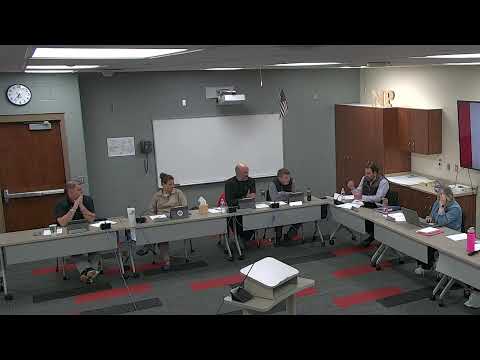
A district staff member told residents at a public hearing that the North Polk Community School District has not set a tax rate and that the $18.99 per $1,000 figure published in state notices represents an upper levy ceiling, not a final determination.
The explanation came as the staff member walked through two published notices — one printed in the Des Moines Register — that show (1) the district's current property-tax collections of $13,067,000 and a current levy of $18.77 per $1,000 of assessed value, and (2) a proposed ceiling of $18.99 per $1,000 that would increase projected collections to $14,125,000 under certain assumptions. “So the tax rate is not yet set. That is our upper range,” the district staff member said. “The effective tax rate ... Ask questions if you have them because it is messy at best.”
Why it matters: The state-published notice includes an “effective” column that assumes a 10 percent rise in assessed values and applies a recent change in the Iowa Department of Revenue rollback percentage — assumptions district staff said may not apply to this tax year because property assessments occur only in odd-numbered years under Iowa Code chapter 441. The staff member said the rollback rate increased from 46.34 percent to 47.43 percent; using a $100,000 house as an example, the rollback change alone equated to about a $20 increase in taxes, and combining that with the district’s upper-levy figure would raise that example bill by about $31, of which roughly $11 would be attributable to the district portion if the district were to adopt the higher levy.
Details and community concerns: Speakers at the hearing repeatedly raised the interaction among the bond referendum passed in November 2023, property assessments, and state funding. The bond referendum — discussed by speakers as a $17,000,000 measure passed by voters in 2023 — increases district debt service obligations; staff said the district’s new debt-service item in the published figures includes roughly $681,000 for the new bond debt service. A district staff member also cautioned that the notice’s middle column does not reflect new bond debt.
Residents questioned the notice’s wording and assumptions. Angela Vadrasco of 800 East Southside Drive said, “I’m not against giving money to my school district, but I am definitely against money sending for school choice,” and asked how much of any increase would leave the district for school choice. Audrey Hyatt of 1102 Oakwood Drive said she read the posted materials and found them misleading: “I didn’t see, tax bill not going up. I saw that the levy rate would not go up,” Hyatt said, calling the messaging “a little disingenuous.” Emily Taller of 13211 Northeast 14th Street criticized rising household costs and said, “Between my property taxes and my home insurance, I’m paying more than what I used to pay for a mortgage.”
District cost pressures cited by staff include steep insurance and personnel costs. The presenter said property-insurance increases had been about 30 percent in fiscal 2024, 24 percent in fiscal 2025, and staff were budgeting for an additional 10 percent increase in fiscal 2026; health-insurance costs for existing employees were cited as up about 11.3 percent. The district also reported enrollment growth; the presenter stated the district’s October count showed an increase of 46 students this year and that enrollment increases are not funded until the following year. The presenter added that the district currently carries a more-than-$1 million special-education deficit.
Tax mechanics and state role: Staff explained the calculation sequence used in the notice: assessed value × rollback percentage = taxable valuation; taxable valuation ÷ 1,000 × levy rate = gross property taxes, minus any credits (for example, military or homestead credits). The staff referenced Iowa Code chapter 441 when explaining that assessors generally revalue properties in odd-numbered years and said the Department of Revenue’s assumed 10 percent assessment increase in the state notice is not applicable in a nonassessment year.
Board action and next steps: The board closed the public hearing by voice vote and then adjourned the meeting; no tax levy was adopted at the hearing. Board members and district staff told residents the budget process is ongoing, that the published notice represents potential ceilings, and that final levy-setting will reflect state funding decisions and the full budget process. Staff encouraged residents to contact state legislators about school funding; the presenter noted a recent meeting with state Rep. Ryan Weldon.
Votes and formal actions recorded in the meeting minutes related only to procedural items: a motion to close the public hearing and a motion to adjourn were approved by voice vote.
What remains unresolved: The district has not adopted a final tax levy for fiscal 2026; the final levy will depend on (1) the district’s chosen levy within the published ceiling, (2) the Department of Revenue’s final rollback and assessed-value determinations, and (3) state funding decisions that the district said remain unsettled. Residents at the hearing urged clearer public messaging about how the voter-approved bond and assessment changes interact with household tax bills.