Get Full Government Meeting Transcripts, Videos, & Alerts Forever!
Get email alerts on the Neighborhood Conservation topic
No spam. Unsubscribe anytime.
Cambridge council delays decision on Half Crown Marsh neighborhood conservation district after heated public debate
Summary
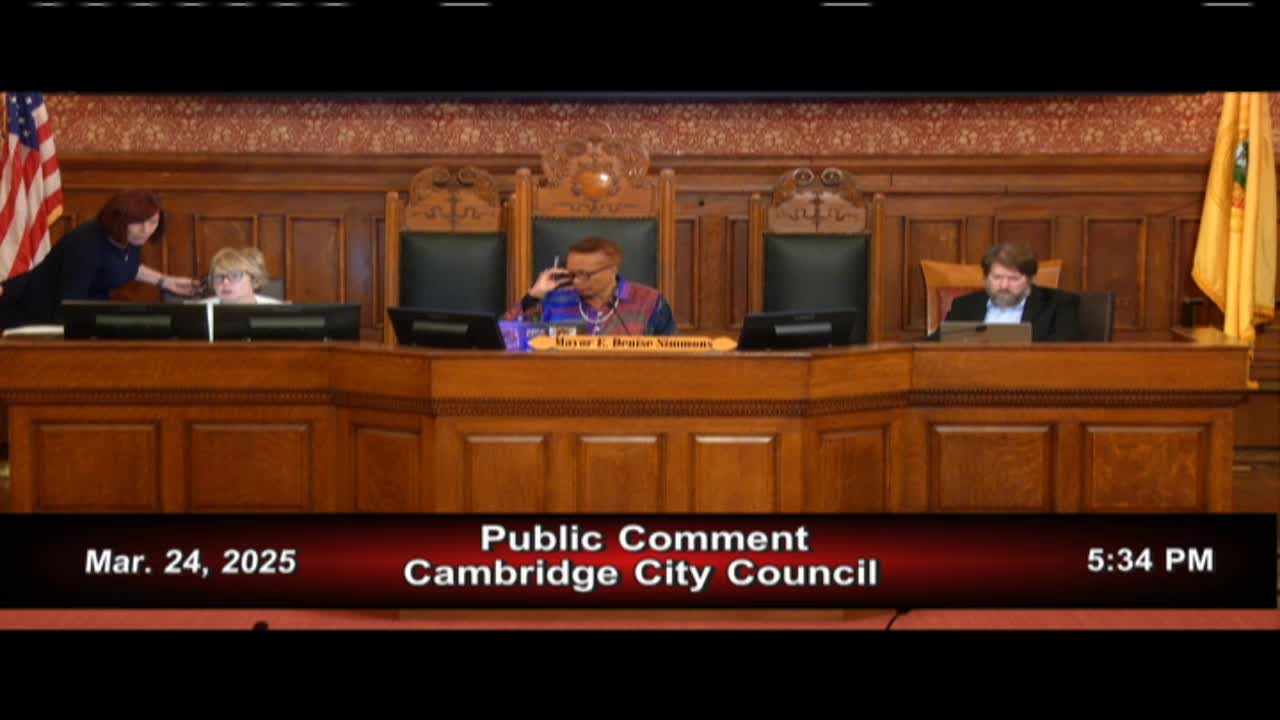
After more than an hour of public comment and council discussion, the Cambridge City Council postponed a final vote on renewing the Half Crown Marsh Neighborhood Conservation District, with a councilor invoking a charter right to delay action and ask for further study.
The Cambridge City Council on May 24 deferred a decision on whether to renew the Half Crown Marsh Neighborhood Conservation District (NCD) after extended public comment and debate, with Councilor Zusi exercising a charter right that prevented a final vote and sent the matter for further review.
The council heard contrasting testimony from neighborhood residents, preservation advocates and housing-rights speakers about whether the NCD helps preserve local character or acts as an obstacle to multifamily housing. The city solicitor told council members the ordinance gives three clear procedural options: reapprove the NCD (with or without changes), discontinue the NCD, or establish a study committee to consider boundary, guideline and procedure changes.
Supporters of the NCD said the district protects historic housing and provides a public, volunteer-driven review process. "With the district comes a commission comprised of volunteer members, resident and nonresident of the district... a democratic process," said Marie Pierre Dillenseager, who stated she is the chair of the Half Crown Marsh NCD commission but was speaking as a private citizen. Suzanne Blier, a Marsh Half Crown resident, described the NCD as having preserved modest, densely built housing and said it has not blocked multifamily development in practice.
Opponents argued the NCD functions as a tool for exclusion and can be used to slow or block housing. "It reads as another example of blocking housing over character concerns, which is often a code for keeping people out of the neighborhood," said Ethan Frank, a Cambridge resident. Justin Saif, who testified against renewal, told the council, "Please do not vote to renew the Half Crown Marsh Neighborhood Conservation District in its current form." James Zahl and other speakers urged the council to consider the NCD’s historic role in limiting multifamily construction.
City historical staff and commission representatives framed the NCDs’ origins as a response to demolition threats in the 1980s and said the districts were created to offer a local, less-restrictive alternative to full historic-district designation. "The Conservation District was established" after demolition threats in the 1980s, staff member Mr. Sullivan explained, describing episodes that led the council to adopt protections for modest, immigrant-built housing stock.
Council discussion noted that the NCD ordinance was amended in 2023 to remove certain review powers (notably jurisdiction over height, shape and setbacks for new construction) and that the city’s multifamily zoning changes adopted Feb. 10 create a new context for assessing NCDs’ impact on housing. The city solicitor told the council the 2023 amendments and the recent multifamily zoning changes are part of what commissioners and the council must consider going forward.
Rather than adopt, amend or discontinue the Half Crown Marsh NCD at the May 24 meeting, Councilor Zusi invoked a charter right to delay final action so the council can consider next steps, including the option of forming a study committee. Solicitor Bear (city solicitor) told the council that the ordinance requires the council to act no later than three months after the end of the calendar year in which the NCD was subject to review (the commission’s review took place in 2024), a timeline the solicitor described as “by the end of this month” in council remarks.
What happens next: The council has the ordinance-defined choices of reapproving the NCD (with or without changes), discontinuing it, or creating a study committee to examine district boundaries, guidelines and procedures. Council members and city staff indicated they will pursue follow-up briefings and options analysis before a final decision.
Why it matters: The NCD debate centers on competing city goals — preserving historically significant neighborhoods and speeding multifamily housing production —and has implications for who can develop and live in parts of Cambridge. The council’s decision will shape which local review tools remain available to residents and how those tools interact with the city’s recent zoning changes.
Community reaction during the meeting showed sharp differences: some residents urged renewal as a venue for neighborhood deliberation and protection of modest historic housing; others framed the district as an instrument that can be used to exclude denser, multifamily housing. The council’s deferral preserves time for additional legal and policy review before a binding vote.