Get Full Government Meeting Transcripts, Videos, & Alerts Forever!
Get email alerts on the Subdivision Site Plan topic
No spam. Unsubscribe anytime.
Planning commission recommends denial of two exceptions for Knights Landing subdivision after weeks of resident objections
Summary
Flower Mound planning staff and the Knights Landing applicant presented a nine‑lot subdivision site plan March 10 that included two exceptions — deferred lot benching and an exemption from burying about 2,170 linear feet of overhead utilities — but the Planning & Zoning Commission voted to recommend denial of both exceptions after sustained public concern about drainage, erosion and tree loss.
Flower Mound planning staff and the Knights Landing applicant presented a nine‑lot, roughly 24‑acre site plan on March 10 seeking two exceptions: (1) to defer lot benching and grading until individual building permits are filed, and (2) to avoid burying about 2,170 linear feet of existing overhead utilities along Sunset Trail and Rocky Point Road.
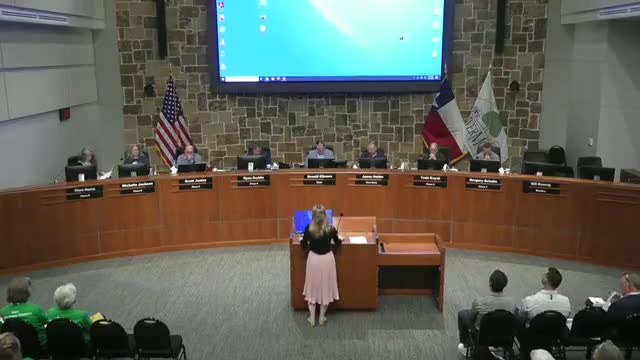
The Planning and Zoning Commission recommended denial of both exceptions after extensive public comment raising concerns about stormwater drainage, bank erosion in an existing creek, loss of specimen trees and traffic and emergency access. Commissioners voted to deny the exceptions and approved the remainder of the site plan application for recommendation to town council.
Why it matters: The requested exceptions would have allowed the developer greater flexibility in grading pads for future custom homes and would have left a long span of overhead electric lines in place rather than having the developer pay to underground them. Residents and several commissioners said those changes would affect runoff and community character and that the town ordinance establishing current benching and undergrounding standards exists to protect adjacent properties and preserve streetscape consistency.
Staff presentation and applicant response Cody Freeman, a planner with the town, described the Knights Landing site and the two exception requests. He outlined conditions staff would require if benching were deferred and if undergrounding were not required — including a licensed engineer preparing plans, stormwater pollution controls and a tree survey for lots where grading is deferred.
Applicant representative Jacob Sumter said the subdivision would contain nine residential lots of at least two acres each and described the developer’s reasons for the exceptions: deferred benching would allow custom home buyers to site houses around existing trees and natural topography, and burying the nearby overhead lines would cost roughly $260,000 based on an Encore estimate done several months earlier. Sumter said burying the lines also would require easements and would conflict with several large live oak trees the purposed route would impact.
Public testimony and concerns At least a dozen nearby residents and property owners spoke during the public hearing. Common concerns included: - Flooding and erosion: Multiple speakers said existing culverts and drainage features on adjacent streets were undersized, damaged or blocked and that additional runoff from new lots would worsen flooding on Miracle Lane, Surveyors Lane and nearby properties. Several residents urged an independent drainage study. - Tree removal and habitat loss: Neighbors and a landscape designer urged preserving large post‑oak and live‑oak trees and criticized an earlier clearing of underbrush in the creek channel. The applicant acknowledged a request to remove a 26‑inch post‑oak (identified as a specimen tree) on Lot 8 to allow a future home site but said they are preserving other large trees, including a 50‑inch post oak. - Utility relocation costs and fairness: Several residents noted homeowners in the area had to bury lines at their own expense when renovating, and asked why the developer should be allowed an exception if the town’s code requires underground utilities.
Commission questions, staff clarifications and conditions Commissioners focused on how deferred benching would affect drainage, what grading the developer must already perform for subdivision improvements (roads and swales), and whether leaving utilities overhead would create long‑term issues. Town engineering staff said the subdivision’s public improvements (roads, drainage swales) are designed to convey water in the same general directions regardless of whether individual lots are benched now or later; benching primarily shapes how each lot drains to the right of way and defines individual house pads. Engineering staff and planning noted that even if benching is deferred, each lot will require an engineered grading plan and must meet lot‑to‑lot drainage rules at the time of building permit.
Deliberation and vote After planning commissioners debated the tradeoffs — some said deferred benching helps preserve vegetation until a buyer chooses a house site, while others said granting exceptions would reduce certainty for neighbors — the commission voted to recommend denying both exceptions and to recommend approval of the rest of the site plan. The recommendation to deny the exceptions was adopted in roll call and will go to the Town Council for final action.
What remains: The remaining site plan (without the two exceptions) will proceed to town council for final action. The developer may choose to bury the utilities and bench lots as required by town code, or could return with revised requests, but the commission’s recommendation signals local regulatory resistance to the two specific deviations sought for this subdivision.
Votes and formal action The Planning and Zoning Commission recorded a formal recommendation to deny the two requested exceptions for Knights Landing (benching deferral; undergrounding exemption) and to approve the remainder of the subdivision site plan for referral to Town Council. The commission’s recommendation will be part of the public record sent to council for final consideration.
Community next steps Town council will receive the commission’s recommendation at an upcoming meeting. The applicant may revise the plans or request the town council to consider exceptions despite the commission’s recommendation. Residents who spoke requested additional follow‑up on drainage fixes and are likely to continue monitoring engineering reviews and any future construction activity.