Get Full Government Meeting Transcripts, Videos, & Alerts Forever!
Get email alerts on the Homelessness topic
No spam. Unsubscribe anytime.
Homeless Strategy Office outlines shelter capacity, prevention focus and HEAL encampment approach
Summary
Homeless Strategy Officer David Gray told the task force about system capacity, shelter operations and a renewed emphasis on prevention and matching interventions to needs; staff reported roughly 6,000 people sleeping unsheltered on any night and highlighted diversion funds and shelter throughput in HEAL encampment closures.
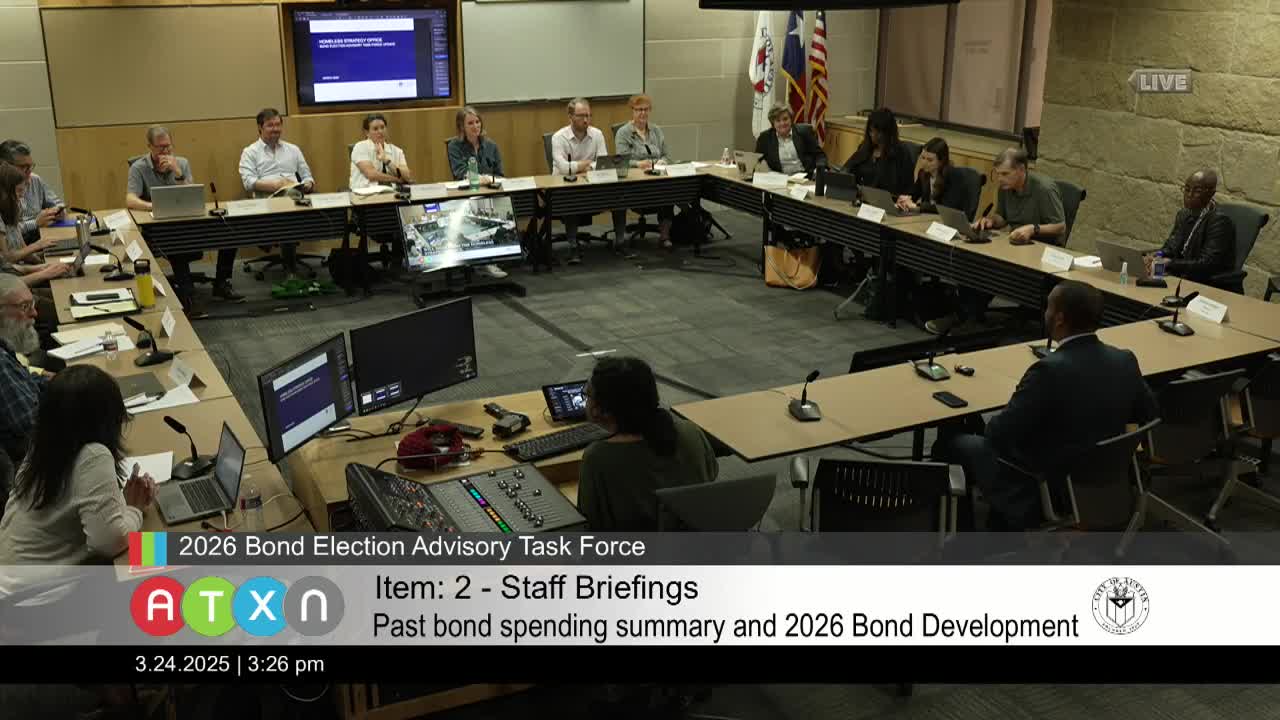
David Gray, the City of Austin’s Homeless Strategy Officer, briefed the Bond Election Advisory Task Force on March 24 about the structure and current needs of Austin’s homeless response system, shelter capacity and the office’s priorities for prevention, encampment response and ensuring appropriate interventions.
On-scale and system figures
Gray said approximately 6,000 people sleep unsheltered on any given night in Austin; in the prior year the system recorded about 3,000 successful exits from homelessness—an increase Gray described as roughly 50% over 2022. He said about 24,000 distinct people interacted with the homeless response system over the year and about 8,400 people entered homelessness for the first time in that period (a 72% increase from 2022). Gray said roughly 30% of the total homeless population is considered chronically homeless (long-term unsheltered plus a disabling condition).
Shelters and operations
Gray and staff described six city-owned shelter sites: the Arch (men’s shelter), H Street (women and gender diverse), Northbridge and Southbridge (hotel-conversion shelters used for encampment interventions), the Marshalling Yard temporary shelter (warehouse space with roughly 300 adults on a typical night), and the Austin Center for Women and Children (operated by Salvation Army). Across city-run shelters staff said they provide close to 1,000 beds nightly; additional nonprofit-operated beds exist outside city shelters.
Programmatic emphasis
Gray described three priorities that will shape the office’s bond considerations and operations: homeless prevention (helping people at risk stay housed or rehouse them within 30 days), the HEAL initiative (coordinated encampment response that moves people from encampments into shelter and then into housing), and interventions tailored to client need (matching people to the most appropriate program to improve long-term stability).
The office also oversees outreach, encampment closure enforcement and shelter expansion planning; staff emphasized diversion funds in shelters to help rapidly exit people from shelter into housing and noted the system’s performance: when people move from shelter into housing the system keeps approximately 95% of those people stably housed over time, a figure Gray said exceeds some national averages.
Why it matters: Gray told the task force the city should prioritize investments that increase system capacity where modeling shows gaps, that demonstrably reduce prevalence of homelessness, and that offer high leverage—prevention and rapid rehousing interventions often cost less per person and have high success rates.
Sources: Presentation and Q&A with David Gray, Homeless Strategy Office.