Get Full Government Meeting Transcripts, Videos, & Alerts Forever!
Get email alerts on the Housing topic
No spam. Unsubscribe anytime.
Austin Housing Department: demand outstrips bond funds; new underwriting tool due in June
Summary
Housing staff told the bond advisory task force on March 24 that previous general obligation housing bond dollars are largely committed, demand for affordable housing far exceeds current bond resources, and the department will roll out a new underwriting and scoring tool in June.
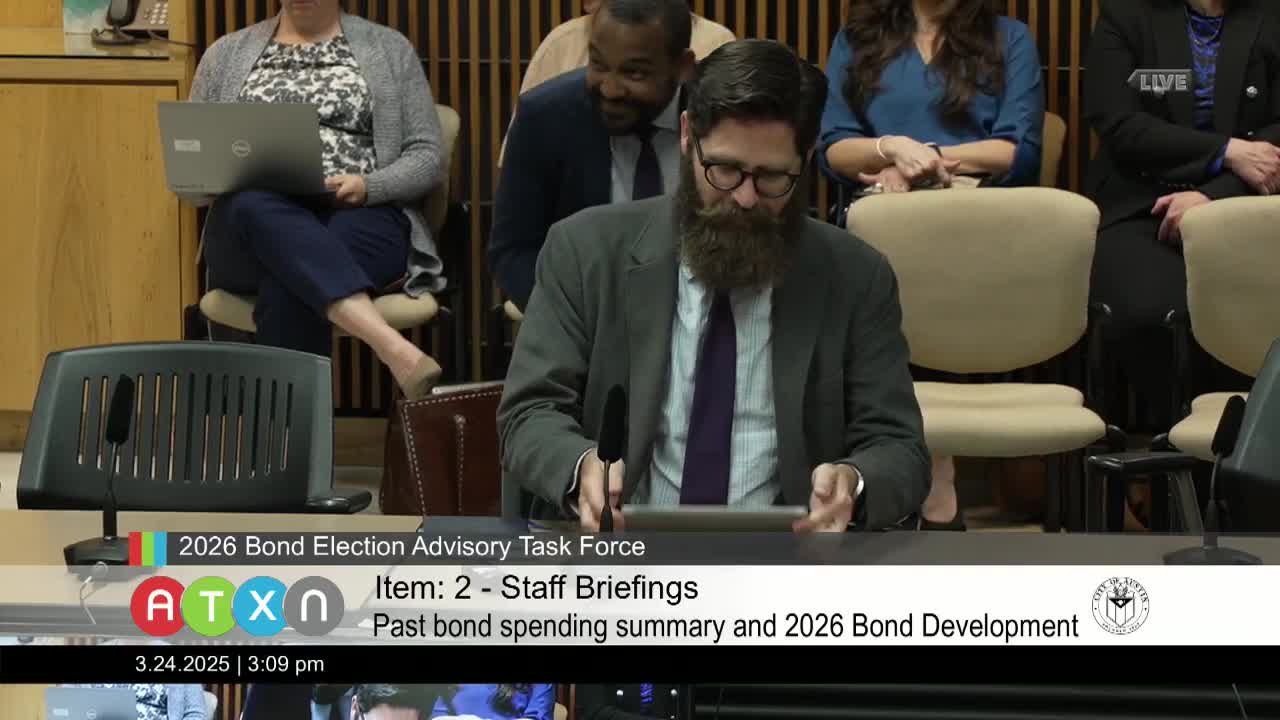
James May, Austin’s Housing and Community Development Officer, briefed the Bond Election Advisory Task Force March 24 on the department’s mission, past bond spending, program structure and how bond funds are allocated to produce affordable housing.
May said the 2018 housing bond approved by voters totaled $250 million; the department has issued about $225 million of that package and encumbered an additional $18.8 million. For the 2022 general obligation housing bond, voters approved $350 million; the department has spent about $61 million and encumbered approximately $90 million with roughly $157 million shown as available in the program budget, but May said some of those dollars are budgeted across multiple fiscal years.
The department told the task force it routinely leverages bond funds with other sources—Low Income Housing Tax Credits, Parkland Dedication funds, private fundraising and other public programs—and that bonds typically fill financing gaps that other resources do not. May described one recent action: the department committed $5 million to acquire the El Gallo site on South Congress to assemble a transit-oriented housing development adjacent to Project Connect lines.
Program delivery and scoring
May explained the department’s major bond programs: home repair, ownership housing, rental housing development assistance (RHDA), and Austin Housing Finance Corporation acquisitions. Rental production and preservation represent the largest share of bond allocations.
May said RHDA scoring historically used a 50-point threshold for underwriting applications and that threshold has been a low entry point; the department is working with consultants (Guidehouse) and community stakeholders to deploy a revised application and scoring tool that will be released in June to evaluate gap‑financing requests more consistently.
Why it matters: May emphasized that bond dollars are a relatively small but critical part of Austin’s larger affordable‑housing financing ecosystem. Demand outstrips supply; projects funded by bond loans often rely on multiple sources and reimbursement timing means the city’s cash outlays lag project construction.
Numbers and recent activity
- 2018 GO bond: $250,000,000 approved; ~$225,000,000 issued; $18,800,000 encumbered (department reported a recent $5,000,000 commitment for El Gallo acquisition). - 2022 GO bond: $350,000,000 approved; ~$61,000,000 disbursed (cash out the door); ~$90,000,000 encumbered; the department reported it has commitments and loans totaling tens of millions to developments and continues to be oversubscribed.
May said the department will continue to bring bond program recommendations and underwriting results to the task force and Council while working to improve scoring, increase private leverage and deploy funds where the city can secure the most community benefit per dollar.
Sources: Presentation and Q&A with James May, Housing & Community Development.