Get Full Government Meeting Transcripts, Videos, & Alerts Forever!
Get email alerts on the Field Contracts Audit topic
No spam. Unsubscribe anytime.
City auditor finds 28 active baseball/softball/soccer agreements; public access provisions vary and lack enforcement language
Summary
The City Auditor reported that the Parks and Recreation Department has 28 active contracts covering baseball, softball and soccer fields with 25 partner organizations; contracts vary widely in length and renewal practice, and the auditor found little contract language specifying enforcement steps tied to community access.
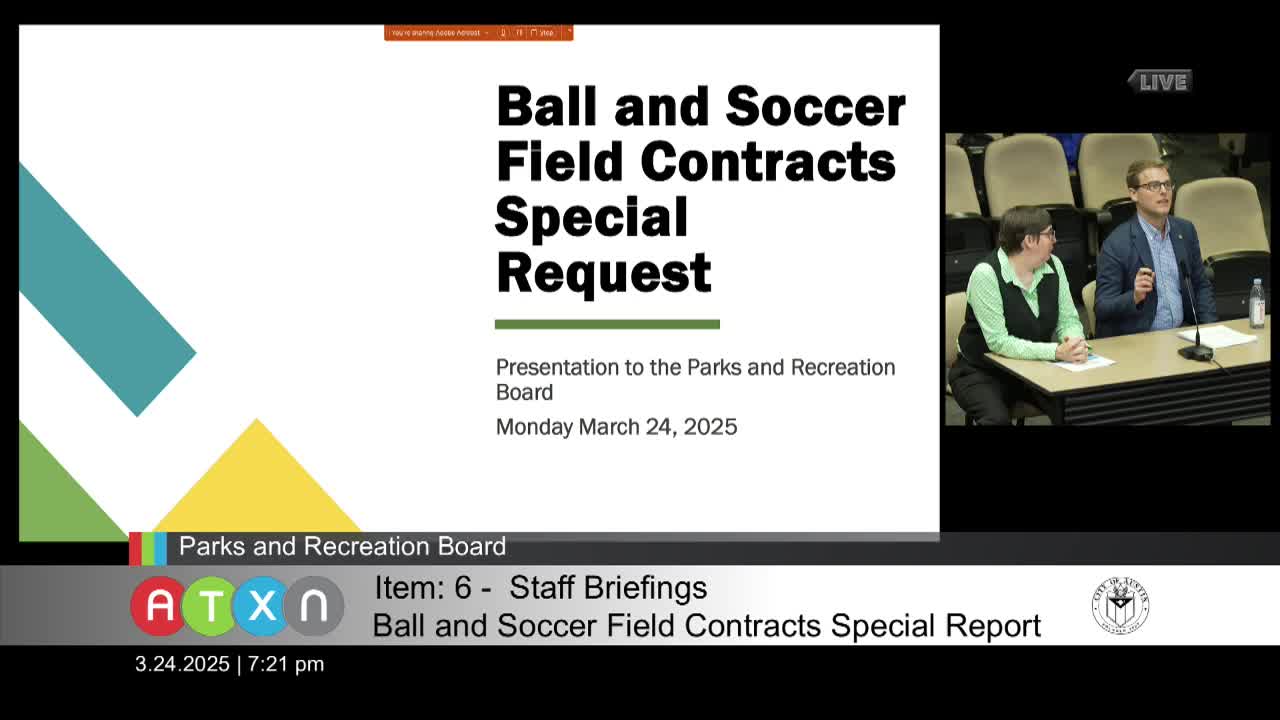
The City Auditor’s Office presented a special‑request report March 20 finding that the City of Austin has 28 active contracts that pertain to baseball, softball or soccer fields, executed with 25 outside organizations. The auditor told the Parks Board the contracts vary in length — from multiyear leases to annual renewals — and in how fields are reserved or made available to the public.
Why it matters: Residents have complained in recent months about difficulties locating available fields and understanding when city‑owned facilities are open for general public use. The auditor’s work was a targeted review requested by council offices to map contract terms, renewal dates and any contractual requirements for community access.
Key findings - Contract counts and partners: 28 active contracts, 25 partner organizations; three organizations (West Austin Youth Association, RBI Austin and AISD) appear with more than one relevant contract. - Contract duration and renewals: Most youth athletic facility use agreements renew annually. Parkland improvement/land‑use agreements and some long‑term athletic‑use agreements show a broad range (5 to 25 years) in contract terms. - Public access and scheduling: For city‑owned athletic facilities managed under contract, the general public remains permitted to use the facilities, but availability depends on schedules managed by the Parks athletics office or the contracted organization. For facilities hosted on third‑party property, the contracted organization often manages scheduling directly. - Enforcement and community access language: The auditor’s review found that while contracts typically include breach and termination clauses, they generally lack specific, enforceable language tying breaches to community‑access requirements or specifying remedies if contracted organizations limit public access.
Department process and next steps: Auditor Tyler Myers said the report provides an appendix listing each contract’s dates, renewal options and the contact(s) a member of the public should approach for access. Board members discussed using the report as a starting point to centralize public information (for example, a single calendar or web tool showing field availability) and to consider standard contract language to clarify public access expectations.
What the board asked for: Several board members requested follow‑up from staff on discrepancies that appeared in mapping online field maps to contracts (for example, fields showing as reserved on a public map while no contract was listed in the auditor’s appendix). The auditor and department staff agreed to follow up with additional detail by email to the board.