Get Full Government Meeting Transcripts, Videos, & Alerts Forever!
Get email alerts on the Transportation topic
No spam. Unsubscribe anytime.
Austin transportation staff proposes scoring framework to rank projects for 2026 bond
Summary
Transportation and Public Works presented a six-anchor, metrics-driven approach to identify and prioritize transportation projects for Austin’s potential 2026 bond, stressing equity, project readiness and leveraging outside funds; staff asked the task force for feedback on weighting and community priorities.
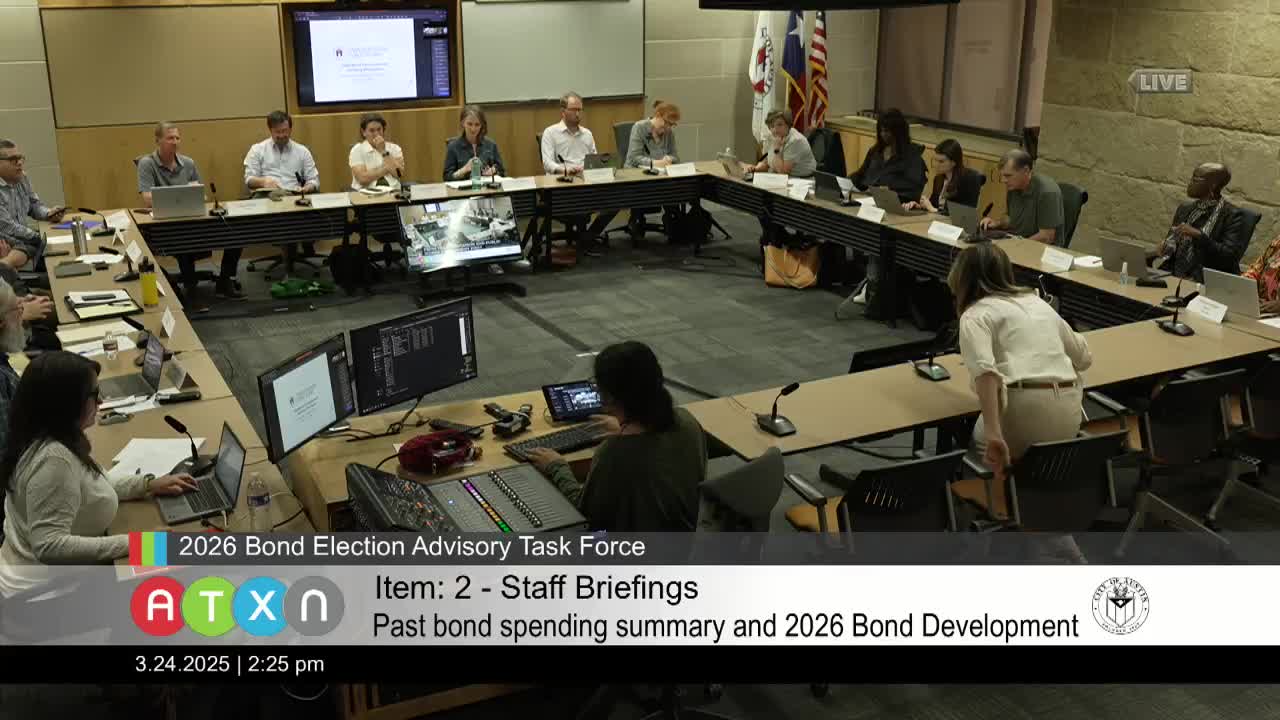
Transportation and Public Works staff outlined a six-anchor, metrics-driven framework March 24 to help score and prioritize transportation projects for Austin’s potential 2026 bond.
The department told the Bond Election Advisory Task Force it will use the City Strategic Plan anchors—equity, affordability, innovation, sustainability and resiliency, proactive prevention, and community trust—to evaluate projects and programs and translate them into measurable criteria such as equity analysis zones, transit route importance, sidewalk and bike facility gaps, high-crash network rankings and project readiness.
Transportation officer Michelle Marks told the task force the approach ties directly to the Austin Strategic Mobility Plan (ASMP) and the citywide strategic plan. “We have a vision that Austin is the model for safe, reliable and sustainable transportation,” Marks said. She said staff plan to quantify needs across the city, score projects against the anchors and return to the task force later with a scored and prioritized list of projects for further sensitivity testing.
Why it matters: the department said it faces a large universe of unmet capital needs and limited bond funding; the scoring matrix is intended to produce a defensible, comparable ranking so the task force and Council can choose projects that best meet citywide goals and are constructible within the bond timeline.
Key elements of the framework
- Equity: staff plan to prioritize projects inside the city’s Equity Analysis Zones (EAZs) and along Title VI-identified transit routes that serve low-income riders. - Affordability: projects that expand low-cost travel options (sidewalks, bikeways, transit speed/reliability) and that connect to Imagine Austin growth centers score higher. - Innovation: technical features (transit signal priority, smart signals) and project-readiness/leverage opportunities are measured. Staff said they will not propose bond projects that are not project-ready for the bond cycle. - Sustainability/resiliency: projects that reduce vehicle miles traveled (VMT), include green infrastructure or provide travel choices rank higher; staff will consider streets that are important during emergencies. - Proactive prevention: safety metrics (high-crash network, safe routes to school) are central to reducing deaths and serious injuries before they occur. - Community trust: staff will consider the intensity of prior community engagement and population/employment density in the project area.
Project readiness and timeline
Marks said projects proposed for the bond must be deliverable within the bond cycle; under current guidance a project must be substantially complete by the end of the bond cycle (2032) to be included. That requirement will act as a gatekeeper for large or complex projects that require multi-year design and permitting.
Programs as well as individual projects
Staff confirmed they will return not only with named construction projects but with programmatic proposals—local mobility and safety programs such as sidewalks, Vision Zero, urban trails and bikeways—showing how rolled-up programs achieve the same anchors.
Task force questions and staff responses
Task force members asked how staff will account for leveraging federal, regional or partner funds (for example, Capital Metro or county work). Marks said “leverage” is one of the innovation criteria and could be weighted higher; partnering dollars would improve a project score.
Task force members also asked for a carbon-emissions or lifecycle greenhouse-gas estimate for proposed projects. Marks and Director Anna Martin said the idea is important but will require further staff-level work to determine methodology; Martin said, “give us a moment to take that back and think that through.”
On construction materials and low-carbon concrete, staff said they have applied for federal pilot funding to test low‑carbon concrete locally and are evaluating materials that reduce pavement temperature and embodied carbon. Staff noted electrification infrastructure (for example, to support electric buses) will require coordination with Austin Energy and Capital Metro.
What’s next
Transportation staff will apply the proposed criteria to the department’s universe of needs, return to the task force with scored projects later in the year, and solicit the task force’s view on weighting the six anchors. Staff asked the task force for feedback on the proposed anchors and measures before the scoring work proceeds.
Sources: Presentation and Q&A with Michelle Marks and Anna Martin, Transportation & Public Works.